
Turkey is trying to gain more influence in the Balkans. Erdoan Shipoli, an expert on Turkey and the Balkans in the United States, explains to Deutsche Welle what this means for the European Union. DW: What are Turkey’s goals in the Balkans: what is it trying to achieve there? Dr. Erdoan Shipoli: Historically, Turkey’s institutions, such as […]
Erdogan Wants “Influence” in the Balkans and Europe

Turkey is trying to gain more influence in the Balkans. Erdoan Shipoli, an expert on Turkey and the Balkans in the United States, explains to Deutsche Welle what this means for the European Union.
DW: What are Turkey’s goals in the Balkans: what is it trying to achieve there?
Dr. Erdoan Shipoli: Historically, Turkey’s institutions, such as the military or the country’s bureaucracy, have always been connected to the Balkans, because they have viewed the Balkans as a gateway to Europe. Turkey has always seen the Balkans as a route it could use to reach Europe. However, in the last years of the Erdogan era, it has also begun to see the Balkans as something it can use for influence. Thus, Erdogan’s government wants to increase its influence in societies there by investing and supporting some civil society associations…It does this so that tomorrow it can tell Europe: “We have all this influence in the Balkans, at your back door, and we can use this influence to blackmail you.”
So Erdogan’s government thinks it will be able to use its presence in the Balkans to influence European politics and push Europe in a certain direction?
Yes. That is at least what Erdogan thinks, but I do not believe he is actually able to do that. When it comes to political influence in Kosovo, Albania and Bosnia, Turkey is undoubtedly an important regional player, but only insofar as its policies coincide with those of the European Union. For the Balkan states, the main goal is EU membership. For many years, this was also Turkey’s goal. Now Turkey is moving away from this goal, and Turkish influence in the Balkans is declining as well.
How strong is Ankara’s political influence in the region, really?
As for the former Yugoslav states, its strongest influence is in Bosnia, followed by Macedonia, Kosovo, and Albania (not a former Yugoslav state) comes last. It undoubtedly has better trade relations with Bulgaria and better communication with the Turkish community in Bulgaria than in Kosovo, for example. In reality, Turkey does not have the political influence in the Balkans that it claims to have, and it does not have the influence it wants. The only way Turkey can increase its influence in the Balkans is if the European Union fails to keep its promise to work with the Balkan states. Otherwise, if they have a choice, the Balkan states would side with Europe and never look back to Turkey.
Even so, people in Bosnia and other Muslim communities throughout the Balkans see Erdogan as a kind of big brother. Erdogan himself used the Srebrenica massacre as proof of Europe’s hatred of Muslims and likes to present himself as a defender of Muslims. To what extent is this feeling genuine, and to what extent is it a political stance?
He does this only for domestic consumption in Turkey. Of course, Bosnian Muslims feel sympathy toward Turkey, because Turkey and some other Muslim states helped them during the war before the EU and the US did. This did not happen in Kosovo, and Kosovo’s Albanian Muslims do not see Turkey as their big brother. Nevertheless, at a time when Erdogan and Turkey have no power to influence anything in the Balkans, Erdogan is a master at exploiting discourse and narrative to his advantage. He uses the Srebrenica massacre to prove to Turks that he cares about Muslims, and this will bring him a lot of votes, because we have to remember that there are many Turks with Bosnian, Bulgarian or Albanian roots who have historically not voted for Erdogan. In this way, he is trying to win their votes in a referendum by showing them that he will fight for the Balkans—in this case, against the Dutch in Srebrenica.
What is Turkey doing to increase its influence? After the attempted coup, many Turkish institutions in the Balkans were viewed with suspicion by Ankara…
Since the coup, Erdogan’s government has tried to increase pressure on Balkan governments, particularly in relation to the Gulen movement, but this has not been very successful.
We can see this in Macedonia and Bulgaria, where it is trying to create its own political parties and to use established parties in other countries, parties directly controlled by Erdogan’s close allies. He is trying to use people who are loyal to Erdogan, who have studied in Turkey and are known to have links to Erdogan’s circles. What I fear is that he is gaining support in some civil society organizations. For example, TIKA (the Turkish Cooperation and Coordination Agency) is investing, organizing trips to Turkey, and doing things of that nature. It is said that some more controversial actions have also taken place, which are being investigated.
Here we must also distinguish between Turkey and Erdogan’s government, because the latter’s objective at the moment is not to increase Turkey’s influence—it is to increase Erdogan’s influence and popularity. We know that he has organized these rallies and takes some people to Prizren, Skopje or Novi Pazar and gives them pictures of Erdogan, to show that he has supporters everywhere.
How far is Ankara willing to go in this direction? Is Turkey interested in destabilizing the Balkans, triggering a new wave of nationalism and encouraging militaristic attitudes?
I do not think so. Turkey is not interested in destabilizing the security situation in the Balkans. But if there is something Erdogan can use, he will not hesitate to do so. I do not believe Turkey wants a destabilized Balkans, because then it would be completely surrounded by unstable regions. But some of the burden also falls on EU states to support the Balkans and not let it fall prey to Erdogan’s agenda.(dw)
Erdoan Shipoli, who was born in Kosovo, is a visiting scholar at the Center for Muslim-Christian Understanding at Georgetown University and Associate Dean of the School of Public and International Affairs at Virginia International University.
Related
Interview
Sabedini: The Hague trial has lost credibility; I expect an acquittal for the accused
Interview
Ukrainian journalist staying in Kosovo: Serbia is helping Russia with fighters and propaganda
Interview
The Ancient Egyptian Alphabet: What Are Hieroglyphs?
Interview
Kuçi after the cameraman’s arrest: They arrest the cameraman more harshly than the woman’s murderer
Interview
Vjosa as an Instrument
Interview
The mysterious murder of Festim Lato: the “Prime Minister of the Republic of Chameria” speaks
Interview
Sejdiu: The President has no mandate to discuss border correction
Interview
Çollaku: Dialogue should bring everyone together
Interview
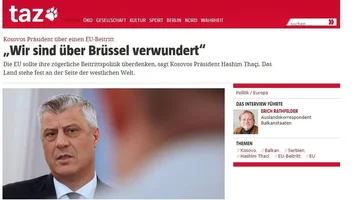
Thaçi to Tageszeitung: Anti-Western ideologies have no chance in Kosovo
Interview
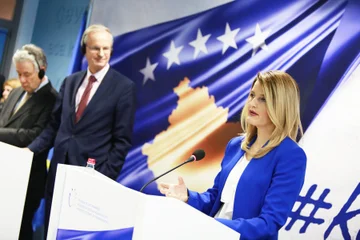
Hoxha: In 2018, we must shift into sixth gear
Interview
“Kosovo cannot progress with this political elite”
Interview
Haradinaj in Tagesspiegel: Kosovo Is Not Yet a Finished Product





