
The University of Mitrovica North operates under Serbia’s directives and not according to the curriculum of the Ministry of Education, Science and Technology (MEST). This parallel university was established by a decision of UNMIK, without the wishes or consent of Kosovo’s institutions. This is what the Minister of Education, Science and Technology, Arsim Bajrami, said in an interview with the Ekonomia Online News Agency, […]
Bajrami: University in the north is parallel, will not be part of the Association

The University of Mitrovica North operates under Serbia’s directives and not according to the curriculum of the Ministry of Education, Science and Technology (MEST). This parallel university was established by a decision of UNMIK, without the wishes or consent of Kosovo’s institutions.
This is what the Minister of Education, Science and Technology, Arsim Bajrami, said in an interview with the Ekonomia Online News Agency, adding that if this institution meets the requirements, it will not be denied the right to be established as a separate university.
“That university is not being persecuted; it is a parallel institution that was also established by a decision of UNMIK. Our wish is to put an end to this process of non-recognition of the Republic of Kosovo and to have it recognized by law. Naturally, this university can then decide whether it wants to be a university. We will not obstruct it, but it must be a university of Kosovo and must respect Kosovo’s legislation,” Bajrami said.
Regarding the Serbian List’s request for this university to be part of the Association, Bajrami said that the state of higher education and the university cannot be left to the wishes of a list that did not vote for legislative changes in education.
“This list has these now familiar positions because it links everything to the establishment of the Association. Higher education everywhere is a central policy, not a local policy, and it cannot be left within the Association’s remit, given that the Serbian List has not shown a willingness to vote for this law. We have allowed an additional period for consultations, also at the suggestion of the international community and our strategic partners in education, the EU and the US, who support higher education, to give the integration of this university into Kosovo’s national framework a little more time,” Minister Bajrami said.
Regarding the teachers, professors and the way this educational institution operates, Minister Bajrami said that the university, which was put into operation by a UNMIK decision, is managed by neighboring Serbia.
“The university operates on the basis of a license issued by UNMIK, which licensed it. It is true that the university works under Serbian laws, and as regards accreditation, as well as teachers’ salaries, those teachers are not paid and those programs are not accredited. Naturally, because of the policies pursued by our state, we have not acted to close it, but have given academic dialogue and the integration of that university a chance. I think we have acted correctly, because this is a responsible approach that allows the university to see that it must operate in Kosovo,” Bajrami said.
Regarding the PISA 2015 test and its results, as well as the work the ministry is doing for the next test, Minister Bajrami offered a message, saying they did not agree that students were to blame for the PISA results.
Asked about the Media Education subject, which has been requested as part of the school curriculum, he expressed hope, saying that the subject is very necessary for pre-university education and that students may soon learn about the media and what surrounds them every day.
“We have not agreed, and we will not agree, and we will not blame the students. Students are what their teachers are, what the curriculum is and what the teachers’ methodology is,” Bajrami said.
“We are ready to work on such a subject, naturally in the form of a module. It is very important to have the curriculum for this subject, to know what its purpose is, and to see who the teachers will be. First, the teachers must be trained; then we must prepare the curriculum and textbooks,” Bajrami said.
Regarding the Albanian community living in the Preševo Valley and the exchange of books that Kosovo was supposed to send to Eastern Kosovo, Bajrami said that the Serbian government had not allowed this, despite the agreement, as, according to him, Serbia considers books in the Albanian language to be weapons.
“The Serbian government continues to hold to the idea that school materials in Albanian are hostile texts. They still have the oppressive communist mindset that texts should be banned in this century. We still have Serbian leaders in government who consider textbooks a hostile tool and think that supplying books from Kosovo indoctrinates children. This is a very primitive approach. On the other hand, the Serbian government has done nothing to provide quality textbooks, since they still see Kosovo as a hostile state, a state they do not recognize,” Bajrami said.
He said that the law for teachers from the 1990s would be one of the measures to be implemented during his term as Minister of Education.
“Now, after 15 years of waiting, it seems that we, as a ministry, will manage to finalize this law. I have also asked parliament to make this a responsible legislature that completes this work, because this is the fifth legislature that has failed to do so, and the fifth government that has not dealt with it. We have taken it seriously. The Ministry of Education has completed its work, the union has been part of the process, as has the Prime Minister’s Office and the Ministry of Finance. We have reduced the cost to a minimum, and I am very optimistic that we will now find the budget, this law will be adopted, and teachers will receive the contributions they deserve,” he said.
Bajrami also spoke about the functioning of the PDK-LDK coalition, saying that it is doing good work.
However, he added that if they see that the state is not functioning, party leaders must make a decision that could perhaps include early elections.
“When we see that the state and its functioning are being harmed, then we must discuss a fresh start. Going to elections requires a consensual decision, one that will produce good elections. I am not a supporter of snap and surprise elections, because I do not know whether we will be ready to hold elections with high credibility and high standards, and to ensure sufficient conditions for a campaign based on positive values rather than reciprocal attacks, one that is not unequal or burdened with a dose of patriotism or other elements,” Bajrami concluded.
Related
Interview
Sabedini: The Hague trial has lost credibility; I expect an acquittal for the accused
Interview
Ukrainian journalist staying in Kosovo: Serbia is helping Russia with fighters and propaganda
Interview
The Ancient Egyptian Alphabet: What Are Hieroglyphs?
Interview
Kuçi after the cameraman’s arrest: They arrest the cameraman more harshly than the woman’s murderer
Interview
Vjosa as an Instrument
Interview
The mysterious murder of Festim Lato: the “Prime Minister of the Republic of Chameria” speaks
Interview
Sejdiu: The President has no mandate to discuss border correction
Interview
Çollaku: Dialogue should bring everyone together
Interview
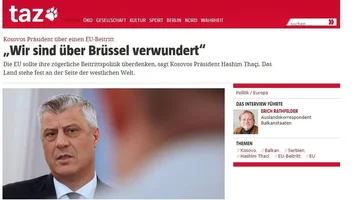
Thaçi to Tageszeitung: Anti-Western ideologies have no chance in Kosovo
Interview
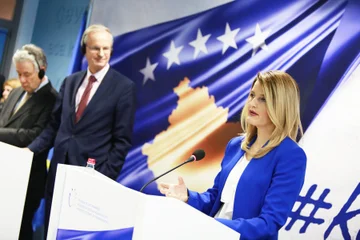
Hoxha: In 2018, we must shift into sixth gear
Interview
“Kosovo cannot progress with this political elite”
Interview
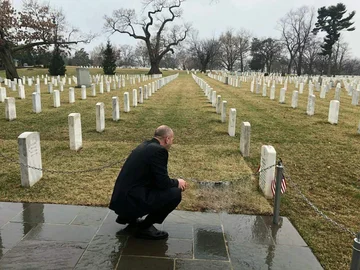
Haradinaj in Tagesspiegel: Kosovo Is Not Yet a Finished Product





