
Analyst Naim Rashiti speaks in an interview with DW about the influence Erdoğan could have in Kosovo following the result of the referendum on constitutional changes in Turkey. DW: Mr. Rashiti, following the results of the referendum on constitutional changes in Turkey and Erdoğan’s victory, official Pristina has still not commented on the result of this referendum. How […]
Rashiti: Turkey and Erdoğan have influence in Kosovo and the region

Analyst Naim Rashiti speaks in an interview with DW about the influence Erdoğan could have in Kosovo following the result of the referendum on constitutional changes in Turkey.
DW: Mr. Rashiti, following the results of the referendum on constitutional changes in Turkey and Erdoğan’s victory, official Pristina has still not commented on the result of this referendum. How do you explain this?
Rashiti: Holding the referendum and Erdoğan’s victory have to do with a complete change in governance, something that also changes the form of politics that has functioned since 1913. So this is something that brings many unknowns and much uncertainty about the actions of the Turkish state, not only domestically but also outside Turkey.
The policy changes Turkey has made in recent years, from a potential conflict with Russia to a consolidated friendship, point to Turkey’s political instability in international affairs. And the Erdoğan model shows how maximum political power and political control can be achieved through long-term governance.
In this respect, Kosovar society knows that this model of governance conflicts with the European values Turkey aspires to, and will place Turkey in a long-term relationship with the West. The West also bears some blame in its relations with Turkey, but, whatever the case, Erdoğan’s victory is not good news for either the Turks or regional developments.
Models and ambitions like Erdoğan’s in Turkey have already appeared in Macedonia and Serbia for years, so the Balkan region is becoming less democratic.
DW: How do you explain the fact that after the failed “coup” in Turkey last year, Kosovar politicians were the first to line up in support of Erdoğan, while now, after his referendum victory, they still have not said a word?
Rashiti: I don’t believe the situation was properly analyzed then, or that it is being properly analyzed now. At the time of the coup, concerns in the Balkans and the West were about Turkey’s stability, given that both Western countries and the United States condemned the coup.
And Kosovar politics often aligns itself with the West, so these were actions of the moment, short-term responses that did not anticipate the situation in which Erdoğan, to everyone’s surprise, changed the course of policy in relation to Russia.
From now on, I believe people will be more cautious, particularly politicians in the Balkans, regarding the ambitions of the new Turkish leader. Some say this referendum has not strengthened Erdoğan’s power, but in reality it has given him the right to remain in power for another 12 or 13 years.
DW: Given the ties established between Turkey and Kosovo over the many years since the end of the war, what should Kosovo’s position toward Turkey be following the referendum there?
Rashiti: I don’t believe there will be any immediate effect on economic cooperation; Turkish companies will continue to be interested in investing, both in Kosovo and in the region.
But it will not be long before Pristina’s positions need to be clarified in relation to the West’s stance toward Turkey. For example, the issue of a law reinstating the death penalty will come up soon, and Kosovo will have to declare its position on it, as well as on cooperation with the Turkish government organization TIKA; then there are other issues that may arise, such as asylum seekers and visa liberalization, where, unfortunately, Kosovo risks being included in a package with Turkey.
So in the coming years, not entirely through Turkey’s fault, the distance between the West and Turkey will grow, and in this relationship Pristina will have to reposition itself.
DW: Mr. Rashiti, you mentioned this earlier, but please explain it to me in a little more detail: Turkey has influence in Kosovo, whether through economic ties, the Turkish minority, or Erdoğan’s visits to Kosovo at least twice, during which he was accompanied throughout by the then-prime minister, Hashim Thaçi. What effects will the result of the Turkish referendum have in Kosovo in specific areas?
Rashiti: Turkey’s relations with Kosovo have been consolidated since the 1990s, and Turkey has been a major supporter of Kosovo. After the war, too, Turkey extended its influence not only in Kosovo but throughout the region, mainly through economic development and economic or development assistance.
And, naturally, Erdoğan’s policy has focused on the Balkans and the Caucasus in terms of developments outside Turkey, and in the Balkans there are three countries in order of importance: first Bosnia, then Macedonia, and third Kosovo.
As we know, Turkish investments have been made on the basis of political agreements, meaning they have not resulted from fair competition.
Kosovo will soon face these issues, when we have to apply European competition and procurement rules and economic policies more strictly. The second issue is the closeness of Kosovars to Turkey because of their shared past, visa-free travel to Turkey and other things; these have all contributed to Kosovo’s positions drawing closer to Turkey’s.
This is also a result of the lack of visa liberalization, which meant Kosovars could find no other places to go on holiday except Turkey, as well as their business ties with Turkey. So Turkey has filled a significant vacuum in recent years. Thus, it is an established reality that Turkey has an impact on social developments in Kosovo.
DW: Mr. Rashiti, it is said that Kosovo’s Turks voted overwhelmingly in favor of the constitutional changes in Turkey. How do you explain this?
Rashiti: Erdoğan has done something for Turkey, and that is why he won the referendum. It was precisely Erdoğan’s government that established lasting lines of cooperation between Turkey and Kosovo’s Turks, and the fact that Erdoğan’s government has been the most cooperative and the greatest contributor to the development of the Turkish community in Kosovo led Kosovo’s Turks to support Erdoğan. But I do not see this as dangerous, because Kosovo’s Turks have no real impact in Turkey or the region since they are very few in number.
Naim Rashiti is an analyst and executive director of the Balkan Policy Research Group (BPRG).
Related
Interview
Sabedini: The Hague trial has lost credibility; I expect an acquittal for the accused
Interview
Ukrainian journalist staying in Kosovo: Serbia is helping Russia with fighters and propaganda
Interview
The Ancient Egyptian Alphabet: What Are Hieroglyphs?
Interview
Kuçi after the cameraman’s arrest: They arrest the cameraman more harshly than the woman’s murderer
Interview
Vjosa as an Instrument
Interview
The mysterious murder of Festim Lato: the “Prime Minister of the Republic of Chameria” speaks
Interview
Sejdiu: The President has no mandate to discuss border correction
Interview
Çollaku: Dialogue should bring everyone together
Interview
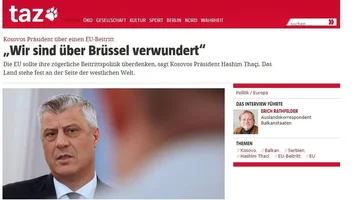
Thaçi to Tageszeitung: Anti-Western ideologies have no chance in Kosovo
Interview
Hoxha: In 2018, we must shift into sixth gear
Interview
“Kosovo cannot progress with this political elite”
Interview
Haradinaj in Tagesspiegel: Kosovo Is Not Yet a Finished Product





