
Ayaan Hirsi Ali has been called the most prominent feminist intellectual to emerge from Africa. In the West, however, the Somali activist has often been attacked for her fierce denunciations of radical Islam and Sharia law. Her biography is shocking. She survived genital mutilation, fled Africa and became a member of Parliament […]
“Changing People’s Minds”

Ayaan Hirsi Ali has been called the most prominent feminist intellectual to emerge from Africa. In the West, however, the Somali activist has often been attacked for her fierce denunciations of radical Islam and Sharia law.
Her biography is shocking. She survived genital mutilation, fled Africa and became a member of the Dutch Parliament. She collaborated with Theo van Gogh on his film “Submission,” which sharply criticized the treatment of women in Islam and led to the director’s murder. In 2014, following a campaign in which she was fiercely denounced, Brandeis University withdrew its honorary medal and invitation for her to speak at events.
Undeterred, she wrote the bestsellers “Nomad,” “Infidel,” “Heretic” and “The Caged Virgin,” as well as this year’s monograph “The Challenge of Dawa: Political Islam as Ideology and Movement and How to Counter It” (Hoover Institution Press). A Dutch and American citizen, she founded the Ayaan Hirsi Ali Foundation in New York to advance her work, writes bota.al.
In 2004, Dutch director Theo van Gogh was murdered. A death threat addressed to you had been pinned to his chest with a knife. What is life like under a fatwa?
I am surrounded by people carrying guns who tell me where I can and cannot go, and what I can and cannot do. So I am not completely free. That is all I can say, for security reasons.
You have changed. Whereas you previously thought that Islamic violence was inseparable from Islam itself, now you are calling for religious reform and have joined forces with like-minded Muslims?
First of all, I have grown up. But let’s make some distinctions. Islam is treated like any other religion in the United States. In reality, Islam is partly religious and partly political. And the argument I am making is this: Let’s protect the religious aspects of Islam. And let’s fight the political aspects of Islam that are subversive, using economic, diplomatic and political means.
Tell us about your new book, “The Challenge of Dawa”?
Dawa is the infrastructure used to indoctrinate and radicalize people. These Dawa groups have taken root in America and have influence in ethnic communities. Dearborn, Michigan, was once home to an assimilated American Muslim community. Today, you see things that are familiar to a European. A woman walking behind her husband. Rows of houses where the women simply do not go out. Parents trying to isolate their children from American life, either by homeschooling them or sending them to Muslim schools and centers. We are seeing what is happening in Europe.
Are we, in any sense, winning the “war on terror”?
No, because we are not fighting. We do not even acknowledge that we are fighting an ideological war. Part of it is arrogance. We think of radical Islam more as a nuisance. “Oh, it’s Al-Qaeda. OK, we’ll send in a few guys, then some drones. That’s all.”
A chapter in “Heretic” suggests countering jihadist terrorism with an information campaign, as the West did during the Cold War. Prominent intellectuals, including Bertrand Russell, Karl Jaspers and Jacques Maritain, supported distributing more than 10 million books and magazines in Eastern Europe.
And we never said that our system was a moral equivalent of the Soviet system. Nor did we claim that capitalism was some kind of salvation, a counter-utopia. It wasn’t. By the way, Bertrand Russell was attracted to the idea of communism until he saw it in practice.
You say that we once celebrated Aleksandr Solzhenitsyn, Andrei Sakharov and Václav Havel—and that we should do the same with Islamic reformers. Can you name one or two? Who are the Voltaires of Islam?
There is one here in the United States. His name is Faisal Al Mutar, and he is from Iraq. I have heard him speak on American campuses. He is compelling, logically consistent, persuasive and very entertaining.
His organization, “Ideas Beyond Borders,” succeeds in changing people’s minds. I don’t know what the future holds for him, but if we are looking for compelling people who can reach thousands, perhaps millions of minds and hearts, he is determined to do that. I use him as an example because he speaks Arabic and works from the United States.
There is another name that should not be forgotten: Raif Badawi, a young Saudi citizen. He sounded the alarm about injustices in Saudi Arabia: the abuse of power, the concentration of power in the hands of the clergy. He argues for greater secularism. He was sentenced to a thousand lashes. Fifty have been administered. He is being tortured and is diabetic and in poor health. Publicity is keeping him alive. If there is one thing I could ask Donald Trump to do, it would be to free that young man.
People on the far right have used your name to justify Islamophobia and stir up an anti-Islam movement in America. What would you say to them?
I would say that there is no Islamophobia. It is a strategically designed term, intended to provoke the same response in Westerners as when they condemn homophobia or racism. Islam is a religion. It is a set of ideas. So if you are critical of this set of ideas, you are not phobic: You have an opinion.
Many people consider the things you say offensive?
I think what was once called “provocative” is now called “offensive.” We are at the intersection of identity politics and political correctness. Radical elements benefit from this and exploit it. People do not see that Sharia has spread from its center all the way to the West. Female genital mutilation is happening in the United States. Child marriage, forced marriage and honor killings are happening in the United States and Europe. They are not reported because the term “Islamophobia” is thrown in everyone’s face. Television news outlets feel too intimidated to cover this subject.
So, to return to your earlier question: Yes, I have changed. It was difficult for me to talk with Muslim reformers because I got stuck on a logical inconsistency. On the one hand, you want to reform Islam, but you do not want to question Muhammad’s legacy or the morality of the Qur’an. So how can you reform it? I have realized that, first of all, these things take time. Sincere people are working on this—Asra Nomani, Zuhdi Jasser and others. I am also working with former Muslims who want to raise critical questions. I want to create a broader platform for people within Muslim communities in the United States, especially on campuses, where the minds of future leaders are shaped.
How realistic is your hope for reform? Are you naïve?
We forget the Islamic Republic of Iran. An entire population in Iran has lived under Sharia from 1979 until now, and they are very much against it. Can I say that, of the people I have met, those most hostile to religion in general and Islam in particular are Iranians?
How did the Arab Spring affect the thirst for reform?
After the Arab Spring and the rise of ISIS, Muslims who had avoided confronting Islam as a political system could no longer do so. They were put in a position where they had to decide. Now they have joined a more visible group of people that I call “modifiers.” They recognize that something about Islam—tradition, religion, scripture—must be viewed historically rather than carried into the 21st century. I give examples in my book “Heretic.” For instance, a cleric who asks the rhetorical question: “Why should we hate Jews, when we benefit from all the discoveries Jews have made?” Such questions may seem reasonable here, but they are revolutionary in parts of the Middle East, where the population at large has been indoctrinated for years and years to hate every Jew, good or bad.
And what changes have you seen for women?
Women are organizing in Saudi Arabia, the United Arab Emirates and Iran. In Saudi Arabia, they say they do not want a male guardian. They are being accused of seeking a change that goes against Sharia, but they keep demanding it anyway. They continue to demand the right to drive. They continue to demand the right to work. All these things are anti-Sharia.
And yet the electoral process has not necessarily borne out your hopes, has it?
The Arab Spring opened people’s eyes, and I was very optimistic about what was happening in Tunisia and Egypt. In both countries, the Muslim Brotherhood entered the scene. They were very well organized and had candidates for election. They won in Egypt, and in Tunisia, they won twice. To me, this was predictable. What was encouraging was the opposition, the people who did not want Sharia law and said so as clearly as possible: “We oppose the Muslim Brotherhood because they want to establish Sharia, and we do not want Sharia.” You ask what changed my mind. It is this mass of empirical evidence, right before our eyes. Not only did I change my mind, but I began to see this opportunity that our governments are not taking advantage of.
So Islamic doctrine has not changed, but perhaps, potentially, there is a large constituency that can change it, can modify it. Many are trying, and paying with their lives.
Related
Interview
Sabedini: The Hague trial has lost credibility; I expect an acquittal for the accused
Interview
Ukrainian journalist staying in Kosovo: Serbia is helping Russia with fighters and propaganda
Interview
The Ancient Egyptian Alphabet: What Are Hieroglyphs?
Interview
Kuçi after the cameraman’s arrest: They arrest the cameraman more harshly than the woman’s murderer
Interview
Vjosa as an Instrument
Interview
The mysterious murder of Festim Lato: the “Prime Minister of the Republic of Chameria” speaks
Interview
Sejdiu: The President has no mandate to discuss border correction
Interview
Çollaku: Dialogue should bring everyone together
Interview
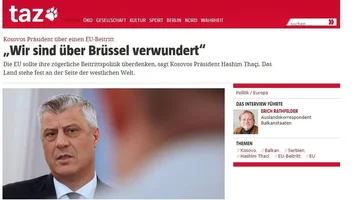
Thaçi to Tageszeitung: Anti-Western ideologies have no chance in Kosovo
Interview
Hoxha: In 2018, we must shift into sixth gear
Interview
“Kosovo cannot progress with this political elite”
Interview
Haradinaj in Tagesspiegel: Kosovo Is Not Yet a Finished Product





