
The head of the Kosovo Judicial Council, Nehat Idrizi, tells Radio Free Europe in an interview that the unification of the justice system in the north is expected to begin on October 17. He says that judges from the criminal division from all the communities who have been selected will be assigned to the northern part of Kosovo. Idrizi admits […]
Idrizi: Unification of the justice system in the north is expected to begin on October 17

The head of the Kosovo Judicial Council, Nehat Idrizi, tells Radio Free Europe in an interview that the unification of the justice system in the north is expected to begin on October 17. He says that judges from the criminal division from all the communities who have been selected will be assigned to the northern part of Kosovo. Idrizi admits that the justice system continues to face a large number of unresolved cases. In the interview, he also discusses possible political influence on the justice system.
RFE: Mr. Idrizi, the justice system in Kosovo has continually been criticized by both local and international actors, whether for its lack of independence or for political influence. In your view, what is this system suffering from?
Idrizi: The justice system, specifically the judicial system, after the war, starting with the rules and procedures for appointing judges, has contributed to our having a truly large number of accumulated cases and, in a way, to the infringement of citizens’ right to a trial within a reasonable time.
In 2013, some reforms were made to our judicial system. A new organization of the judiciary was introduced, replacing the one in place until 2012. The organization had been based on the laws of the former federation (Yugoslavia), whereas now we have a new structure. In the past, judges were appointed for a fixed term and did not have permanent mandates. In a way, they lacked legal security. There are many other factors, but this was one of the main factors that may have contributed to their lacking the motivation or willingness to engage and work harder.
However, since Kosovo emerged from a state of war, the large number of disputes and offenses committed increased the number of cases. As a result, judges found it impossible to resolve cases efficiently and on time. This has caused citizens to lose confidence in the judiciary. We hope that, gradually, this will change. Since taking up the position of head of the Council, I have made resolving the accumulated cases a priority, so that they can be dealt with within a reasonable time. In other words, so that citizens do not have to wait for years to realize a right of theirs. As for interventions and influence, at least in my view, there has never been a call from any politician or official regarding a particular case.
However, the possibility cannot be ruled out that, perhaps on an individual basis, a judge may allow interference or influence from outside and thereby also violate the judicial code of ethics.
RFE: Is there sufficient courage in Kosovo’s judiciary to handle cases of crime and corruption, especially high-level cases?
Idrizi: Judges are now hearing cases. What levels these cases will involve—that is, whether those accused are high-, mid- or low-level—does not depend on the judiciary; it depends on the Prosecutor’s Office, as the competent body responsible for conducting investigations and bringing indictments.
As the Judicial Council, we have drawn up an action plan and prioritized corruption cases. On a monthly and quarterly basis, we receive reports from the commission responsible for collecting information from court presidents on the stage each corruption case has reached and how it is being processed.
That is to say, judges have the courage and determination to hear and rule on high-level corruption cases without hesitation. [Under review] are cases involving ministers, deputy ministers, directors, agency officials, police officers and judges themselves, though perhaps not at the level the public expects.
This does not depend on the judiciary, but on what indictments the Prosecutor’s Office submits to the court.
RFE: During the selection of the presidents of the Supreme Court and the Court of Appeals, foreign embassies and European representatives raised concerns about the selection process. How closely were their recommendations followed?
Idrizi: Recommendations from embassy representatives are not binding on us. We welcome any assistance and any contribution, but these are their views and opinions. (The concerns) mainly related to the voting process. Their request was that the vote be open.
Under the standards and practice to date, the president of the Supreme Court, his deputy, the State Chief Prosecutor, the president of the Court of Appeals and prosecutors in the (basic) courts have been elected by secret ballot. The presidents elected previously were also chosen by secret ballot.
We acted in accordance with the recommendations in the Constitutional Court’s judgment. There were two main recommendations for the Judicial Council. The first was that the vote on candidates be held using a single combined list, rather than individually, and that the meaning of an abstaining vote be clarified. We complied with the recommendations in the Constitutional Court’s judgment. We amended the regulation; all candidates were included on a single ballot, and Council members voted for a candidate of their choice. The meaning of an abstaining vote was also clarified. I believe this issue has been resolved.
I said that we have a cooperative relationship and that we are grateful to our international partners for their advice and suggestions. But that does not mean we will always be able to agree, because these are standards, and the Constitutional Court’s decision also recommends that a secret ballot is the standard and is provided for by the Constitution of the Republic of Kosovo.
RFE: How much of a challenge does the parallel system in northern Kosovo pose to a unified justice system?
Idrizi: In 2013, the two prime ministers of Kosovo and Serbia signed the Agreement on Justice. Unfortunately, this agreement has not been implemented from 2013 to the present, even though we made all the preparations for its implementation to begin in January of this year. But that did not happen.
We now hope that, following the meeting between the two presidents in Brussels, where they pledged that implementation would take place, we are now in the preparation phase for implementing this agreement. We hope that everything will be ready by October 17 and that, finally, despite some previous failures, this agreement will be implemented.
The main goal here is to have a unified judicial system in the north, meaning that judges will also work under Kosovo’s legislation. Serbian, Albanian, Turkish and other judges will work together, both in the north and in the south.
Judges from the criminal division from all the communities who have been selected will be assigned to the northern part. Meanwhile, in the southern part, the judges from the civil division as well as the juvenile criminal department will be assigned to the former Jugobanka building.
Related
Interview
Sabedini: The Hague trial has lost credibility; I expect an acquittal for the accused

Interview
Ukrainian journalist staying in Kosovo: Serbia is helping Russia with fighters and propaganda

Interview
The Ancient Egyptian Alphabet: What Are Hieroglyphs?
Interview
Kuçi after the cameraman’s arrest: They arrest the cameraman more harshly than the woman’s murderer

Interview
Vjosa as an Instrument

Interview
The mysterious murder of Festim Lato: the “Prime Minister of the Republic of Chameria” speaks
Interview
Sejdiu: The President has no mandate to discuss border correction

Interview
Çollaku: Dialogue should bring everyone together
Interview
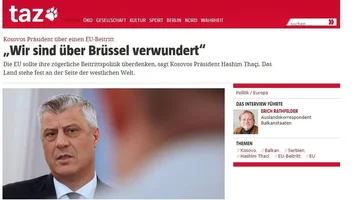
Thaçi to Tageszeitung: Anti-Western ideologies have no chance in Kosovo
Interview
Hoxha: In 2018, we must shift into sixth gear
Interview
“Kosovo cannot progress with this political elite”

Interview
Haradinaj in Tagesspiegel: Kosovo Is Not Yet a Finished Product





