
“I felt that after three terms it was time to give way to new people who may have a different vision for the city’s development; the people want change and decide on it. I’m sorry to say it, but when I took over, Vushtrri was a medieval city. We have made efforts to bring back […]
Mulaku: Three terms are too many, let alone four

“I felt that after three terms it was time to give way to new people who may have a different vision for the city’s development; the people want change and decide on it. I’m sorry to say it, but when I took over, Vushtrri was a medieval city. We have made efforts to bring back the remains of Shotë Galica as well; in this attempt, too, we have encountered obstacles from the government,” Bajram Mulaku, mayor of Vushtrri for three terms, tells Klan Kosova.
It was then the secretary-general of the Democratic Party of Kosovo, Jakup Krasniqi, who persuaded the professor and former activist of its political rival, the Democratic League of Kosovo, Bajram Mulaku, to become the candidate of the ‘war wing’ party for mayor of Vushtrri—ten years ago.
He was a political prisoner during the Yugoslav regime, together with my brother, Mulaku tells Klan Kosova. ‘After lengthy negotiations, Jakup Krasniqi persuaded me to accept the proposal’.
Since 2007, Bajram Mulaku has governed Vushtrri without making much of a splash in the media, in either sense of the word. After his second term in office, it was said that he would not run again. For various reasons, often unclear, but mainly linked to strained relations with the PDK. He denied this by running again and being re-elected.
But in his third term as mayor, he would face declining support for the PDK. Thus, after the finalization of the central election results, Mulaku announced that he would not run again. He categorically denies any connection between these events. This is Bajram Mulaku’s first interview with a media outlet since that decision.
After three candidacies and three victories, why did you decide to step down? Have you thought this through?
Of course. Otherwise, I would not have made this decision. There are several reasons that led me to step down after three terms. Experience has shown me that one term is too short to carry out plans. Two terms are a lot. Three terms are too many, let alone four. Other reasons include my age—I am somewhat advanced in years. So, taking into account the heavy workload of a mayor, I made this decision. I also felt that after three terms, it was time to give way to new people who may have a different vision for the city’s development.
Were you afraid of a possible loss? Could you have done this out of concern that the general election results would be reflected in the local elections as well?
I don’t believe the local elections will be like the central ones. I don’t want to draw parallels between them. But the fact that changes have been made at the top of the Democratic Party of Kosovo may have been the reason that affected its election result. I think good, solid work has been done in our municipality, work the PDK candidate can draw on, along with his own intellectual credentials, of course.
Or is this (your departure) Kadri Veseli’s move?
The party chairman, as well as the branch chairman, have asked me several times to continue for another term. But I was determined not to do so, and seeing this, they stepped back. I had hesitated to run for the term I am now completing as well.
Do you think the central election result is directly the fault of the PDK government?
The fact that the PDK has led the central government for three terms is a handicap, because citizens are looking for something new. Not to mention the accusations of corruption and poor governance. I don’t find it surprising that people are seeking change this time. Not at all.
What has hit the PDK hardest? Its long period in government, or the reforms?
A bit of both. Reforms themselves are a factor that generates these kinds of situations. Kadri Veseli has not had the chance to prove himself through his work, although I emphasize that he took over the party’s leadership at a difficult time. But I know he has extraordinary determination to continue working, with a positive approach and positive commitment, and I believe he will succeed.
Has Hashim Thaçi’s own profile been a handicap for Veseli?
He is somewhat hampered because Hashim Thaçi governed the country for two terms, while the PDK has governed for three. The PDK’s long period in government has been a handicap for Kadri Veseli. Because, as I said earlier, the people want change; they want to see whether someone else can achieve better results.
How do you assess this year’s candidates?
It is not for me to assess this year’s candidates. But as for the PDK candidate, I believe that, with the work I and the PDK have done during my time in office, we have left him a substantial legacy of major achievements, and he can ask for votes with his head held high.
Now that we’ve talked about your departure, let’s go back in time and talk about your arrival at the head of the municipality. How did it happen? Who proposed you? Who persuaded you?
In 2007, the local leadership did not propose that I be the candidate. But the PDK leadership called me in for a meeting to make me this proposal. In addition to Hashim Thaçi, as party chairman, I also spoke with Jakup Krasniqi, then its secretary-general and, like my brother, a former political prisoner. After lengthy negotiations, he persuaded me to accept the proposal.
You took the helm of the municipality before the PDK took over the executive branch. Do you feel you had a hand in the PDK’s victory at the central level in 2008?
First, I want to talk about the trust I received from citizens. I was not an unknown figure to the people of Vushtrri. I worked at the town’s gymnasium, then at a higher school and at a faculty in Mitrovica. Many people from Vushtrri studied there. I was then politically active in the LDK for around 10 years, working to keep Albanian-language education alive and organizing various efforts to collect aid for citizens in need. We also worked hard on blood feuds reconciliation. Perhaps this past work helped me earn the trust of citizens from my first term.
Did your work in the LDK not prevent you from earning the trust of the PDK’s highest-ranking officials for your candidacy?
Not at all. I had, and continue to have, their full support, even now.
You still haven’t told us: do you feel that your victory helped the party in the general election?
I can’t say that. But if that is the case, I would be glad.
What was the municipality like when you took over?
Like all of Kosovo. A place emerging from Yugoslav communism, which had completely neglected it. A place with many deficiencies. Kosovo was underdeveloped because it was under the Serbian yoke. Add to that the destruction caused by the war. I found all of this when I took over the municipality. Given the war damage, everyone tried to rebuild as best they could afterward. This resulted in urban planning anarchy. There was not an adequate network of roads, water supply, schools, or public spaces. The first thing I did was draw up an urban plan, so that everything would be built according to it.
Do you believe you have managed to legalize and structure the urban area in Vushtrri?
So far, we have built more than 400 kilometers of roads. I saw the road network as a fundamental prerequisite for the municipality’s economic development. Only two villages remain where we have not managed to pave the roads. Work has also been done on the water supply infrastructure. We now have a water treatment plant in the village of Balinc.
Apart from building the water plant, what are two or three other achievements from your term that you value most?
The first important project for the people of Vushtrri was the construction of the Tërstenka River channel. It looks dry in summer, but it used to flood nearly half the city. Also, the construction of the road at the entrance to Vushtrri, the ‘Dëshmorët e Kombit’ boulevard, as well as the construction of schools and healthcare facilities, which have a direct impact on people’s lives.
I would add that we have completed more than 1,630 projects, worth over 110 million euros.
And the failures?
I don’t call them failures, but projects that have not yet been completed. Among them is the construction of the cultural center. I don’t consider it a failure, since the project is ongoing. We have an agreement with the Ministry of Culture, under which we were supposed to draw up the project. But since this process has taken a little longer, we have had problems with funding. So it is still unclear whether it will be put out to tender this year.
It has been my dream to build a facility for the families of martyrs and those in need. We have set aside land for this. We have drawn up a conceptual design, but due to a lack of funds, we have not yet been able to begin.
We have decided to build ‘Hasan Prishtina’ Square on the site currently occupied by the municipal building, and we have allocated funds for his statue. Tenders have been announced for both. We are waiting to move into the new municipal building so that construction of the square can begin. As part of this, I have repeatedly requested—of the government and the Municipality of Kukës—that the remains of Hasan Prishtina be returned to our city, also at the request of his family. But so far, I have received no response.
Who is to blame?
I don’t want to talk about that, but what matters is that it is not happening.
But I would add that we have also made efforts to bring back the remains of Shotë Galica. We have encountered obstacles in this attempt, too. The Albanian government is hesitating in both cases.
So you’re saying it’s to blame?
I can’t say that. Perhaps.
At the end of your third term, what is Bajram Mulaku’s record?
I think we have done good work. I’m sorry to say it, but when I took over, Vushtrri was a medieval city. Undeveloped, with uncontrolled urban growth. But it has changed for the better. The fact that more than 110 million euros have been invested in capital projects alone over these ten years speaks for itself. I think the city has never changed more in its history. But I’ll say it again: things could have been better. They can always be better, with a great deal of commitment from everyone.
What next? What will Bajram Mulaku do after October 22?
After this term, I was interested in staying out of politics altogether. I had decided that at the final session I would declare that from that moment on I would be nonpartisan. But I received requests, pleas—not to say pressure—from friends and party officials to continue within its structures.
Pressure of what kind?
In a positive sense, of course. After hearing all of this, I accepted the party’s proposal to be a candidate for the Municipal Assembly and to head the list.
So Bajram Mulaku is staying with the PDK?
With the PDK, of course. Because I have accomplished a lot with the PDK for the benefit of my fellow citizens. I have no reason to leave this party.
How do you see the future of the PDK, in Vushtrri and in Kosovo?
Work is needed, at the local level and at the central level. With this approach, it can survive and move forward, both locally and centrally. Otherwise, it cannot.
Related
Interview
Sabedini: The Hague trial has lost credibility; I expect an acquittal for the accused
Interview
Ukrainian journalist staying in Kosovo: Serbia is helping Russia with fighters and propaganda
Interview
The Ancient Egyptian Alphabet: What Are Hieroglyphs?
Interview
Kuçi after the cameraman’s arrest: They arrest the cameraman more harshly than the woman’s murderer
Interview
Vjosa as an Instrument
Interview
The mysterious murder of Festim Lato: the “Prime Minister of the Republic of Chameria” speaks
Interview
Sejdiu: The President has no mandate to discuss border correction
Interview
Çollaku: Dialogue should bring everyone together
Interview
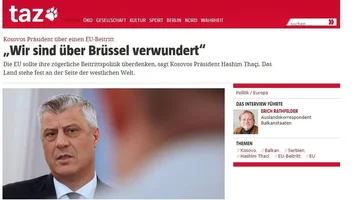
Thaçi to Tageszeitung: Anti-Western ideologies have no chance in Kosovo
Interview
Hoxha: In 2018, we must shift into sixth gear
Interview
“Kosovo cannot progress with this political elite”
Interview
Haradinaj in Tagesspiegel: Kosovo Is Not Yet a Finished Product





