
While Christmas has traditionally been seen as a time to gather as a family, exchange gifts and go to Church, the holiday has also coincided with some of history’s most significant events. “The most wonderful time of the year” has been interrupted by legendary battles, royal coronations and scientific inventions, and […]
7 Historic Events That Happened During Christmas
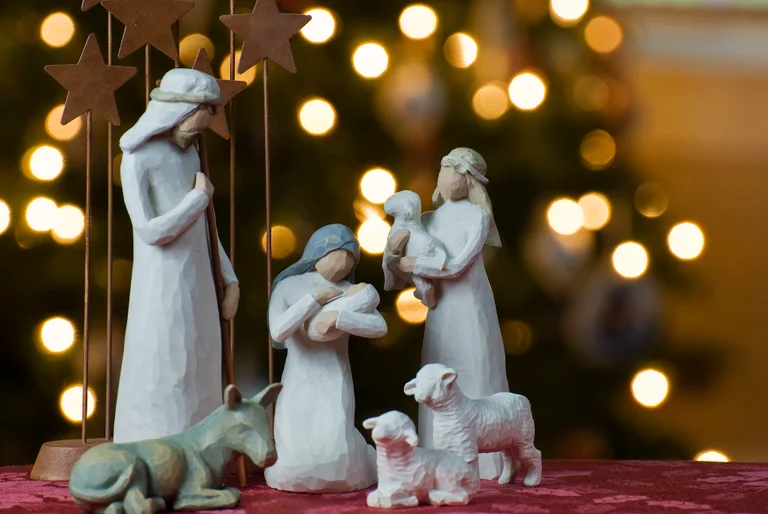
While Christmas has traditionally been seen as a time to gather as a family, exchange gifts and go to Church, the holiday has also coincided with some of history’s most significant events. “The most wonderful time of the year” has been interrupted by legendary battles, royal coronations and scientific inventions, and has even inspired one of the most famous wartime truces. Here are seven of the best-known historical events that took place on Christmas Eve and Christmas Day.
Charlemagne Is Crowned Holy Roman Emperor
Often called the “Father of Europe,” Charlemagne was a Frankish warrior-king who united much of the continent under the banner of the Carolingian Empire. Beginning in the late 700s, Charlemagne established a vast kingdom through military campaigns against the Saxons, Lombards and Avars. A devout Catholic, he aggressively converted his subjects to Christianity and implemented strict religious reforms.
On Christmas Day in 800, Pope Leo III crowned Charlemagne (Charles the Great) “Emperor of the Romans” in a ceremony at St. Peter’s Basilica. The coronation restored the Western Roman Empire in name and established Charlemagne as the divinely appointed leader of much of Europe. More importantly, it placed him on an equal footing with the Byzantine empress Irene, who ruled the Eastern Empire in Constantinople. Charlemagne would be emperor for 13 years, and his legal and educational reforms sparked a cultural revival and united much of Europe for the first time since the fall of the Roman Empire.
William the Conqueror Is Crowned King of England
An event that would forever change the course of European history took place during the 1066 holiday season. On Christmas Day, William, Duke of Normandy—better known as William the Conqueror—was crowned King of England at Westminster Abbey in London. The coronation followed William’s legendary conquest of the British Isles, which had concluded in October 1066 with victory over King Harold II at the Battle of Hastings.
During William the Conqueror’s 21-year reign, Norman customs and laws would take root in British life. After consolidating his power by building famous structures such as the Tower of London and Windsor Castle, William generously granted lands to his French allies. This not only forever changed the development of the English language—almost a third of modern English comes from French words—but also contributed to the rise of the feudal system of government that characterized much of the Middle Ages.
1776: George Washington and the Continental Army Cross the Delaware River
By the end of 1776, the Revolutionary War seemed to be slipping away from the colonial forces. A series of British victories had caused morale to fall, and many soldiers had deserted the Continental Army. In search of a decisive victory, General Washington led 2,400 troops on a daring mission to cross the frozen Delaware River at night. After secretly entering New Jersey on December 26, the Continental Army launched a surprise attack on Trenton, a town then held by a force of German soldiers known as Hessians.
Washington’s gamble paid off. Many of the Hessians were still disoriented from the previous night’s festivities, and the colonial forces defeated them with minimal bloodshed. Although Washington had achieved a stunning victory, his army was not well equipped to hold the town, and he was forced to cross the Delaware again that same day—this time with 1,000 Hessian prisoners. Washington would go on to win successive victories at the Battles of Assunpink Creek and Princeton, and the daring crossing of the Delaware served as a rallying cry for the dispirited Continental Army.
1814: The Treaty of Ghent Ends the War of 1812
On December 24, 1814, while many in the Western world were celebrating Christmas, the United States and Great Britain sat down to sign a famous peace agreement ending the War of 1812. Negotiations had begun in Ghent, Belgium, in early August—the same month British forces had burned the White House and the Capitol in Washington. After more than four months of debate, the American and British delegations agreed to a treaty that ended the war in a draw. All occupied territories were relinquished, and captured soldiers and property were returned to their respective countries.
Although the Treaty of Ghent ended the 32-month conflict, it did not take effect in the United States until it was ratified in February 1815. In fact, one of America’s greatest victories of the war—the Battle of New Orleans in January 1815—came more than a week after the Treaty of Ghent was signed.
1868: President Andrew Johnson Signs Amnesty for Confederate Soldiers
At the end of his term as president, Andrew Johnson gave a famous Christmas gift to a group of Confederate rebels. Through Proclamation 179, on December 25, 1868, Johnson granted amnesty to “all persons” who had fought against the United States during the Civil War.
Johnson’s pardon was actually the fourth in a series of postwar amnesty orders he signed. Earlier agreements had restored Confederate soldiers’ legal and political rights in exchange for written oaths of allegiance to the United States. The Christmas pardon was a final, unconditional act for Southerners, including many Confederate generals.
1914: The Christmas Truce of 1914 Takes Place
The Christmas spirit manifested itself in 1914 in the most unlikely of places: a World War I battlefield. Beginning on the evening of December 24, many German, British and French soldiers in Belgium laid down their arms and began a spontaneous Christmas truce. The truce was reportedly prompted by the Germans, who decorated their trenches with Christmas trees and candles and began singing songs such as “Silent Night.” British troops responded with their own version of “The First Noel,” and the combatants approached one another in “no man’s land”—the area between the trenches—to greet each other and shake hands.
According to accounts from those present, the soldiers exchanged cigarettes and whiskey, and some even exchanged Christmas gifts with the people they had been shooting at just hours earlier. Taking advantage of the temporary suspension of hostilities, some Scottish, English and German troops even organized a soccer match on the frozen field. The truce was not sanctioned by officers on either side, and the soldiers were called back to the trenches to resume fighting. Later attempts to meet during the holidays were largely suppressed, but as the war continued, the Christmas Truce stood as a striking example of humanity and brotherhood on the battlefield.
1968: Apollo 8 in Orbit Around the Moon
As part of the Apollo 8 mission, astronauts Frank Borman, Jim Lovell and William Anders spent Christmas Eve in orbit around the Moon. The operation had initially been intended to test the Lunar Module—which was later used for the Apollo 11 landing—in Earth orbit. But when it became clear that work on the module would not meet deadlines, NASA ambitiously changed the mission plan. Apollo 8 went on to bring a series of major milestones in human spaceflight: The three astronauts became the first people to escape Earth’s gravitational pull, the first to see all of Earth from space and the first to see the far side of the Moon.
Apollo 8 is perhaps best remembered today for the broadcast at the moment the astronauts entered lunar orbit on Christmas Eve. While viewers were shown images of the Moon and Earth’s orbit from lunar orbit, Borman, Lovell and Anders read the opening verses of the Book of Genesis from the Bible. The broadcast—which ended with “Merry Christmas, and God bless all of you, all of you on the good Earth”—became one of the most-watched events in television history.
Related

Curiosities
Jordan Blocks Telegram App After Deadly Church Attack to Prevent Extremism

Curiosities
Don’t Rely Only on Mileage: When Should You Change Your Engine Oil?
Curiosities
1979 Porsche 924 returns to the United Arab Emirates Police fleet

Curiosities
Restaurant in Canada bans children under 15, decision sparks debate
Curiosities
12 curiosities from around the world you shouldn’t miss

Curiosities
Why do mosquitoes prefer some people over others? The reason has been revealed

Curiosities
Father and son break Guinness record playing ‘Hungry Hungry Hippos’ blindfolded
Curiosities
Why Are Highway Direction Signs Green in Some Countries and Blue in Others?
Curiosities
What happens when there is a bomb threat on an aircraft?

Curiosities
NASA Searches for a Secret Underground Cave on the Moon

Curiosities
Wearing boxing gloves and a special costume, this dog became Halloween’s star
Curiosities
After 28 years and 50,000 kilometers, British adventurer Karl Bushby returns home





