
In 1468, shortly after Skanderbeg’s death, Ferdinand of Aragon sent a letter to the Hero’s widow. On this occasion, the letter reads “Scandalibech”. Serembe believes we are dealing with an extraordinary cryptogram… “Scandalibech” is a conventional sentence, whose substance must burst forth in each letter […]
Skanderbeg and the Red-and-Black Flag Under the Mystique of the Number “33” – the Symbol of the Freemasons
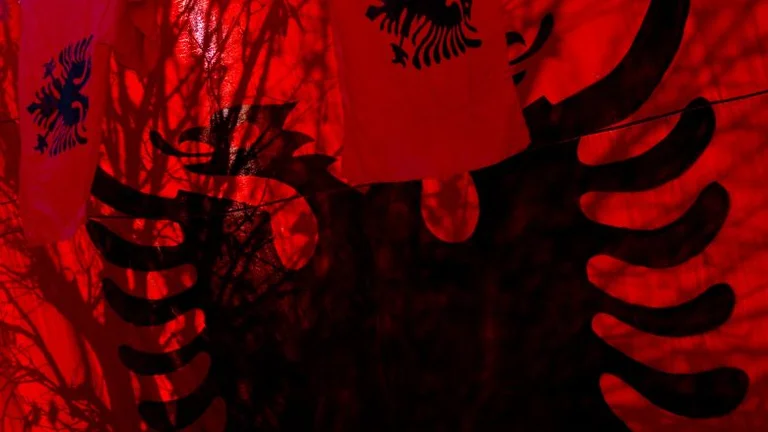
In 1468, shortly after Skanderbeg’s death, Ferdinand of Aragon sent a letter to the Hero’s widow. On this occasion, the letter reads “Scandalibech”. Serembe believes we are dealing with an extraordinary cryptogram…
“Scandalibech” is a conventional sentence, whose substance must burst forth in each letter in itself, an initial, meaningful, message-bearing letter. The whole mystery is connected to the ease of reading from right to left, that is, in reverse, according to Arabic rather than Latin reading.
We are dealing with these large initial letters: H. C. E. B. I. L. A. D. N. A. C. S.
By completing the initial letters with Latin words, we ultimately, finally, concretely, powerfully, easily, wonderfully and madly form this sentence: HUMILITER CORNU EPISTOLAE BARBARIS IN LOCO ANGUSTO DOMINI NOSTRAE ALBANIAE CELAT SEPULERUM. A free translation of this Hieronymian Latin informs us that the Lord of Albania (that is, Gjergj Kastriot Skanderbeg) has his remains (corpse) placed in a narrow space beside the altar, to the side, where Epistula is written, reports Telegrafi.
Which Epistula (Letter)? A biblical Epistula like those of Saint Paul, or a Testamentary Epistula, by Skanderbeg himself?
Serembe does not elucidate the enigma of the Epistula. Here the darkness begins. The impenetrable. Perhaps Serembe was inspired by Kabbalah, where the combination of letters produces phantasmagorical creations. An enthusiastic writer would believe it, would weave a stirring plot in which, beyond the Unbelievable, the Believable thrives.
But such a writer has not yet been born. Fortunately, mediocre writers are indifferent; for them, the whims of knowledge are a disturbing, annoying futility. Serembe invented an idea, built the pedestal for an incomplete monument, put forward a proposition, but did not prove it. He persisted, but could find nothing. He set off a firework, but the darkness did not recede. He had an inkling, made a start, but did not get there. The skeptics dared neither to pity him nor to indulge him. The living Skanderbeg was without a grave. But even after death, he does not need a grave. A grave? A garment in the funerary wardrobe? The hero has no need of this symbolic garment” (Moikom Zeqo, The Death of Gjergj Kastrioti, Tirana: Zenit, 2018, pp. 40–41).
This highly compelling excerpt, taken from the publication by scholar Moikom Zeqo, interweaves the mystical and the earthly. Moikom seems like an ancient “oracle” of his own land. He interprets time in a forgotten way: he deciphers symbolism and, on the other hand, assigns guiding symbols to events, people and history. Through his distinctive style, he manages to reveal a wholly unseen geometry of reality, with mystical trajectories that intersect and give us figures discernible only through his kaleidoscope. He reveals this invisible graphic pattern in Serembe as well. Moikom believes in the sketch that portrays the invisible side of history, the side beyond the curtain of the earthly, which is connected to our National Hero. So does Serembe. But can there exist a science of secrets that speaks through the language of historical enigmas? It seems that Moikom sees this language of enigmas as a possible inspiration for Serembe from “Kabbalah”. This perspective merits attention.
Perhaps a more thorough investigation into the mystical dimension of Gjergj Kastrioti would be needed. But while Kabbalah is rightly mentioned as linguistic mysticism, to compare this linguistic enigma, we might also look for this level of mysticism surrounding Skanderbeg in “Gematria”. That is, we should try to cross-reference the linguistic enigma with numerical mysticism. To be clear: this is in no way an attempt to find “connections” between Skanderbeg and Kabbalah or Gematria in themselves. Gematria is one of the Jewish methods for uncovering the hidden meanings of canonical texts, etc., by transforming letters into numbers. Each letter corresponds to a particular number. The method of numerical calculation of letters used by the Jews had even more ancient practitioners: the ancient Greeks and Babylonians. This is numerology, which links the divine and earthly in a single system; the inner universe of the human being with the universe of constellations. If in the beginning was the Word/voice/sound, at the heart of this inexhaustible universal vibration stood, stands, and will stand the number.
Number, vibration and universal or sacred geometry – these are the leaven of a timeless trinity, which Pythagoras described as follows: “Number rules the universe”. This universal rule makes us equal: people and stars, under a single universal principle, under one law, under an unbroken universal geometric design. At its core, this has been studied in its entirety by schools of esoteric thought, through their well-known systems of occult knowledge.
I was prompted by Moikom’s interpretation of Serembe, which touches on this “Kabbalistic” methodology of excavating hidden meanings, to draw attention to some coincidental numerical correspondences (?!) linked to the figure of Gjergj Kastrioti.
Numerology recognizes the use of different systems. The Chaldean system is the oldest system of numerology. The Chaldeans, or Babylonians of old, made great advances in the arts of magic and in the study of the magical aspects of nature. They delved deeply into the study of astronomy in order to discover the future through the stars, something we call astrology. “Bab-ilu”, the Gate of God, or the famous Babel of the tower that confused human language, belongs to this people, who used this system of numerology. According to this numerological system, letters are converted into eight numbers, from one to eight – numbers that correspond to the Babylonian solar system, which recognized eight planets, including the Moon. The number 3 in this system belongs to Jupiter.
If we calculate according to this method, the abbreviation GCS (Georgius Castriotus Scanderbeg) gives the number 333 and a total of 9; while, according to the same method of calculation, the name Scanderbeg gives the number 33. The name “Skenderbe” gives the number 33. The name “Iskanderbeg” also gives the number 33, while “Georgius” gives the number 30, which is again a consequence of the number three, but the consonants “G” and “S” that open and close the name create the number 33. If we were to look for a number symbolic of Skanderbeg, according to this method of calculation, it would be the number 33.
On 28.11.1443, Skanderbeg raised the flag with the double-headed eagle and sowed the idea of Albanian independence, which would be sealed on that same date in 1912 by the most famous of the Vlora clan, Ismail Qemal Bey Vlora. If we look at the date the flag was first raised, its numbers, added together until a single number is obtained, are 2+8 / 1+1 / 1+4+4+3, which in themselves give 1.2.3, or the sum 6. But if we calculate the name “Ismail Vloraj”, it gives the number 33. The use of surnames in Vlora is always accompanied by a “j” at the end, and he was a Vloraj. But if we calculate the version “Ismail Bey Vlora”, which gives the number 40, we can find it accompanied by the calculation of the name “Gjergj Kastrioti”, which likewise gives the number 40. The correspondences do not seem to end there. The calculation of the names “Ismail Qemali” and “Ismail Kemal” gives the number 28. Meanwhile, the sum of the year Skanderbeg raised the flag, “1+4+4+3”, gives the number “12”, which, ironically, is the 12th of Independence.
And as if to complete the picture, the national flag with the double-headed eagle is also part of these correspondences. If we calculate the name “shqipe” (eagle), it gives the number 23, but the word “dykrenore” (double-headed) again gives the number 33, and together they give us three threes: 333. The number 3, according to Chaldean numerology tables, belongs to Jupiter, who is associated with Zeus in mythology. Skanderbeg’s secret seal had the erotic theme of Zeus and Leda: that Pelasgian Dodonian Zeus who, according to Homer, reigned in wintry Dodona. If we calculate the version “Dodonea” of the name, it again gives the number 33.
And as if to place the “seal” with the number 33, the date the flag was raised is the meeting point of the historical trajectory. Skanderbeg raised the flag on November 28, when 33 days remained before the end of the year 1443. But the raising of the national flag by Ismail Qemali and the proclamation of Albania’s Independence – in the sequence of coincidences above – coincided with a leap year. Albania was declared independent in the leap year 1912, which means that year had one more day than other years, something that, as is known, recurs every four years. On November 28, 1912, Albania was declared independent. This happened on the 333rd day of the year, when 33 more days remained until its end. What might the exact appearance have been of the flag raised that day?
Several years ago, Vlora-based scholar Pirro Stefa acquired an old postcard (or post card, in the terminology of the time), published by Spiridon Ilo (a signatory of the Act of National Independence) in 1920, as the latter was leaving again for emigration in Boston (USA). According to scholar Stefa, the postcard reproduces the original flag exactly. Spiridon, who was originally from Korça, had lived in Bucharest for years and was related to the Korçë-born Marigo Posio (née Poçi). Some historians believe that the flag raised in Vlora was the same one that adorned the façade of the “Hotel Continental” in Bucharest. There are two versions of the embroidery: Mrs. Marigo embroidered only the fringe, or Mrs. Marigo embroidered the eagle’s body as well. In any case, Spiridon Ilo had the means to reproduce the correct version of the flag accurately on his postcard. What would it matter to know whether this flag of Spiridon Ilo was an accurate reproduction of the original? Spiridon Ilo’s version itself contains an almost unbelievable numerical correspondence, if we take all the coincidences so far into account. In a 2012 article, Agim Morina offers an interesting observation about this version of the Independence Flag, the one on Ilo’s postcard:
“From the time I was little, while reading the history of the Albanian people, I was amazed by the appearance of the 1912 eagle in a poor photographic reproduction in the history book. That eagle seemed more powerful, more elegant and prouder to me, especially when I compared it with the eagle flying on the official flags. Driven by this desire to see it in stronger and clearer colors, I made several copies of this eagle. As I worked, I absolutely had to look very carefully at every detail and count every feather of the eagle. And this, of course, brought me to an unexpected conclusion: the feathers on the eagle’s wings turned out to be 14+14, which together make 28! Naturally, my mind went to the 28th of November, the day our flag was raised in Vlora. I thought it might be a coincidence, but when I also counted the feathers in the eagle’s tail and got 11, I began to think that there was something more deliberate here, because the result was the 28th day and the 11th month. Then it seemed pointless to look for the year 1912 as well, because that was impossible. But apparently it had not been entirely impossible for the designer! When I counted the ridges on the necks of the eagle’s two heads, I got 6+6, which make 12. That is, the designer of the eagle had shortened the year 1912 to 12. I was very happy that our flag had been embroidered and designed with so much love and care. This conclusion also helps historically in determining more precisely the question of the date on which it was decided to raise the flag. The design points to the idea that either November 28 was predetermined and known some time earlier, or the flag was embroidered in a single night while Ismail Qemali was travelling to Vlora. In any case, this matter can be left for historians to examine” (Agim Morina, “The Symbolism of the Eagle in 1912”, Dervina.com, 2012).
If we add the numbers positioned according to the order of the eagle’s wings/feathers on the national flag raised in Vlora in 1912, we get another correspondence: (2+8).11.12. The sum of the three groups would be: 10+11+12. The number 33 appears once again.
But what does the number 33 or 333 represent? There is abundant material on the mystique of these numbers. Sometimes the information and interpretations are laughable and unconvincing, while at other times the interpretations can give you pause for thought. I will not include them all in this article, since that is impossible and would fill many pages. We can treat all that we have said as Einstein put it: “There are only two ways to live your life: Everything is a miracle or nothing is a miracle”.
I will content myself with presenting two symbolic approaches. The Freemasons (Freemasonry) have the number 33 as their symbol, even accompanied by an equilateral triangle and the double-headed eagle. Among the many connections and interpretations they make of this number in relation to secret societies, one that seems worth mentioning here is its comparison with the vertebrae of the human spinal column. Humans have 33 vertebrae. These are a symbol of the degrees of Freemasonry, of ascent toward the higher level, the one numbered 33. Degree 33 is the highest in the Masonic lodge. Many scholars link Masonic rituals to the Templars, who had, in turn, adopted some practices from Sufism. The Janissaries were also practitioners of Sufism, since they were Bektashis. Spiritual power, surpassing the physical powers of an ordinary human being, performing miraculous deeds, or knowing those elements later used by alchemy can be traced to these rituals, which came who knows from where and from what ancient depths. Returning once more to the symbolism of the vertebrae, the number 33, we can see that Ismail Qemali’s declaration of Independence is the construction of the national spinal column. It was imbued with a mystical spirit and, despite Albania’s tragic history, resembles a structure that will keep us standing for a long time. We are a people who have survived, and that is an act of strength. Survival shows that we have a backbone.
If the first symbol was endurance, the second is light. The Sun’s mass, according to NASA, is 333,000 times greater than Earth’s. Skanderbeg’s number 333 is the number 333 of our national gravitational star, around which our identity and national formation will revolve forever. It is the light of freedom and, like the Sun, that light and this national symbol are inalienable, irreplaceable and indestructible. They are a source of inspiration, hope and life – because they are a symbol of universal positivity, a symbol of triumph over destructive forces. It remains for a third 33 to be repeated, and Albanians will rise into the light once again!
Related

Curiosities
Jordan Blocks Telegram App After Deadly Church Attack to Prevent Extremism

Curiosities
Don’t Rely Only on Mileage: When Should You Change Your Engine Oil?
Curiosities
1979 Porsche 924 returns to the United Arab Emirates Police fleet

Curiosities
Restaurant in Canada bans children under 15, decision sparks debate
Curiosities
12 curiosities from around the world you shouldn’t miss

Curiosities
Why do mosquitoes prefer some people over others? The reason has been revealed

Curiosities
Father and son break Guinness record playing ‘Hungry Hungry Hippos’ blindfolded
Curiosities
Why Are Highway Direction Signs Green in Some Countries and Blue in Others?
Curiosities
What happens when there is a bomb threat on an aircraft?
Curiosities
NASA Searches for a Secret Underground Cave on the Moon

Curiosities
Wearing boxing gloves and a special costume, this dog became Halloween’s star
Curiosities
After 28 years and 50,000 kilometers, British adventurer Karl Bushby returns home





