
History books are full of stories that are sometimes hard to believe, but we should not rely only on the words people have written or said to describe past events, at least when it comes to the last 150 years. Fortunately, history has also been documented in many […]
14 Historic Moments in Photographs
History books are full of stories that are sometimes hard to believe, but we should not rely only on the words people have written or said to describe past events, at least when it comes to the last 150 years.
Fortunately, history has also been documented in many photographs depicting different moments.
These moments not only tell complete stories, but also prove the existence of various events that, if they had not been photographed, could have been erased from the pages of history.
Here are 14 historical events and moments captured on camera:

1. The passenger ship “St. Louis” with around 900 Jewish refugees from Germany (1939) – The ship tried to dock at the port of Havana in Cuba, but its entry into the country was denied. Entry into the United States and Canada was also denied. The ship then returned to Europe, and most of the refugees on board eventually disembarked in the Netherlands, France, Belgium and England, but around a quarter of them died in death camps.

2. An American engineer in the car he invented (1907) – John Walter Christie is known for inventing a car suspension system, later used in some of the tanks and armored vehicles that took part in World War II.

3. Women fighters during a training session organized in the jungle, Hao-Hao (1948) – The photo was taken for “Life” magazine during the First Indochina War, when these women formed a unit to fight in the jungle. They practiced with spears and swords, as well as rifles.

4. Khevsur warriors from Georgia (1914) – When World War I broke out, it took months for the news to reach remote areas, and when it reached northeastern Georgia, warriors from the Khevsur provinces rode their horses to the city of Tbilisi to volunteer and defend their homeland.

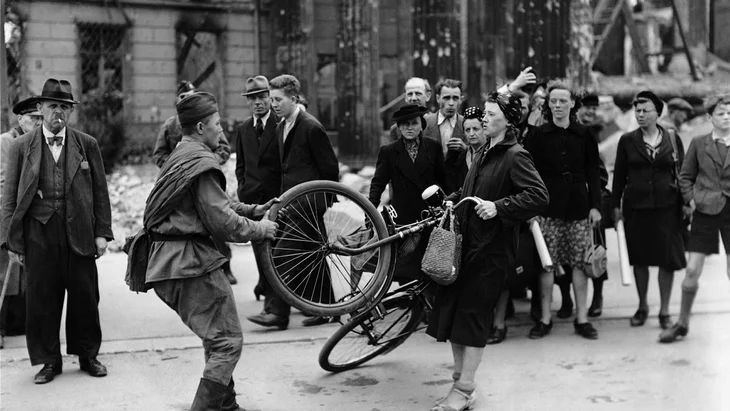
5. A Russian soldier taking advantage of his power in Germany (1945) – After the end of World War II, many Russian soldiers abused their power and “harassed” German citizens. The photo shows a Russian soldier trying to steal a bicycle from a German woman, but this is a small example of the horrors Russian soldiers would inflict on the country over the next three years. The soldiers are estimated to have raped 2 million German women.

6. Members of an African tribe at an international archery competition in St. Louis, USA (1904) – The World’s Fair held in the United States during those years coincided with the Olympic Games, and scientists saw it as an opportunity to prove the superiority of white people over other races. Unfortunately for them, the competitors they brought from other continents, such as Asia and Africa, sometimes refused to participate, and at other times simply did not understand the rules of the games.

7. Four models showing different styles of pajamas (1930) – This was precisely the time when clothing designers in the US began to dare to let women reveal more of their bodies, and traditional pajamas gave way to other, more liberal versions.

8. People climb a pyramid at Giza (1890) – In the past, tourists could climb the pyramids at Giza with guides who encouraged them to take a piece of stone as a souvenir. In the 1980s, Egypt opposed this practice and banned it out of concern for the integrity of the deteriorating structures, but if you pay the right people, it is still possible to do so.

9. Zulu warriors from Zululand, South Africa, with their weapons (1879) – When Britain began taking control of territory in South Africa, the Zulu came out to fight them in several battles, using primitive weapons and weak shields against soldiers armed with rifles. They outnumbered the British by a ratio of 30:1, but they had to fight to get close enough to strike them, and even when they managed to capture British weapons, the Zulu warriors were unable to use them properly. During the five months of war, they lost around 7,000 people, while the British lost around 2,000.

10. Japanese girls caring for their younger siblings (1901) – Even today, in traditional areas of Japan, it is common for girls to care for their younger siblings before they are ready to have children of their own. This is a tradition practiced around the world among poor families, in which parents have to work all day to support and feed the family.

11. Snow-removal wagons in New York (late 19th century) – A hundred years ago, the only way to clear snow-blocked streets was with the help of thousands of people working on snow-removal wagons.

12. Horse-drawn “bus” (1882) – Before the invention of buses and trams, and before cars began to appear everywhere, many cities in Europe and the US used horses to pull vehicles resembling a double-decker bus, which was very effective for several decades until the engine replaced the animals.

13. Members of the Yakuza criminal organization and their wives (1960) – To be accepted into the Yakuza, a centuries-old criminal organization from Japan, members had to decorate their bodies with tattoos, as did their wives. Today, there are estimated to be around 100,000 active Yakuza members worldwide.

14. “Disco Granny” (1978)
Related

Curiosities
Jordan Blocks Telegram App After Deadly Church Attack to Prevent Extremism

Curiosities
Don’t Rely Only on Mileage: When Should You Change Your Engine Oil?

Curiosities
1979 Porsche 924 returns to the United Arab Emirates Police fleet

Curiosities
Restaurant in Canada bans children under 15, decision sparks debate
Curiosities
12 curiosities from around the world you shouldn’t miss

Curiosities
Why do mosquitoes prefer some people over others? The reason has been revealed

Curiosities
Father and son break Guinness record playing ‘Hungry Hungry Hippos’ blindfolded

Curiosities
Why Are Highway Direction Signs Green in Some Countries and Blue in Others?

Curiosities
What happens when there is a bomb threat on an aircraft?

Curiosities
NASA Searches for a Secret Underground Cave on the Moon

Curiosities
Wearing boxing gloves and a special costume, this dog became Halloween’s star
Curiosities
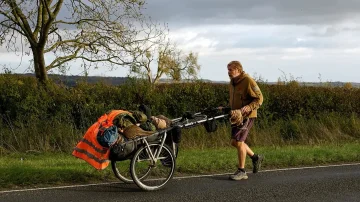
After 28 years and 50,000 kilometers, British adventurer Karl Bushby returns home





