
A deep partial lunar eclipse is expected to create one of the most spectacular sights in the sky this week, covering most of the Moon with Earth’s shadow and giving it a dark, reddish hue. The phenomenon will occur during the night of August 27 and 28, 2026 […]
“Blood Moon” to cover the sky on August 27, phenomenon sparks apocalyptic theories on social media
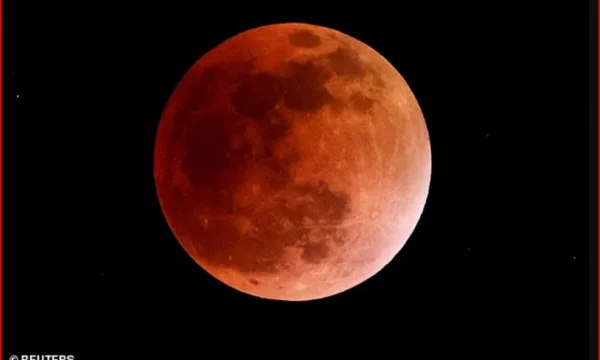
A deep partial lunar eclipse is expected to create one of the most spectacular sights in the sky this week, covering most of the Moon with Earth’s shadow and giving it a dark, reddish hue.
The phenomenon will occur during the night of August 27 and 28, 2026, and will be visible from most of North and South America, as well as parts of Europe and Africa. NASA classifies the event as a partial lunar eclipse.
Although the phenomenon has an entirely astronomical explanation, the sight of the so-called “Blood Moon” has also prompted speculation on social media, where some users have linked it to biblical prophecies and apocalyptic scenarios.
Around 96 percent of the Moon’s surface will be covered by the shadow
An eclipse occurs when the Sun, Earth and Moon align so that the Moon passes partially through Earth’s shadow.
This time, the phenomenon will come extraordinarily close to a total eclipse: around 96.2 percent of the lunar disk’s surface will be covered by the umbra, the darkest part of Earth’s shadow. NASA describes it as a very deep partial eclipse, with around 93 percent of the Moon’s diameter entering Earth’s umbra.
This is precisely what is expected to give the darkened portion a rusty or copper color.
The reddish color forms because some of the Sun’s light passes through Earth’s atmosphere, where blue wavelengths are scattered more, while red light reaches the Moon’s surface.
When will the spectacle take place?
According to astronomical calculations, the penumbral phase will begin on August 27 at 9:23 p.m. Eastern Time.

The visible partial eclipse phase begins around 10:34 p.m., while its peak is expected around 12:13 a.m. on August 28.
The partial phase ends around 1:52 a.m., while the entire event, including the passage through Earth’s fainter penumbra, will last approximately five hours and 38 minutes.
Unlike solar eclipses, a lunar eclipse can be viewed safely with the naked eye.
“Blood Moon” sparks theories about the end of the world
The dramatic sight has also revived religious interpretations on social media.
Some users have cited a passage from the biblical book of Joel, which describes the Sun going dark and the Moon turning “to blood” before “the day of the Lord.”
Similar references are also found in the Acts of the Apostles and the Book of Revelation, which is why “Blood Moons” have long been linked by some believers to ideas of divine judgment, upheaval or major spiritual events.
However, these are religious interpretations and speculation, not scientific predictions. Astronomers explain the reddish color as the normal result of the way sunlight is filtered through Earth’s atmosphere during a lunar eclipse.
A rare spectacle that will last for hours
At first, the Moon will enter Earth’s penumbra, where the dimming is slight and may be difficult to discern.
But once the partial phase begins, the umbra will appear to “bite” further and further into the full lunar disk.
Near its peak, only a very small portion of the Moon will remain outside the dark shadow, while the rest may take on its characteristic copper color.
The event is part of a series of eclipses; an earlier phenomenon associated with this cycle occurred on August 16, 2008, while the next is expected on September 7, 2044.
Whether viewed as an astronomical spectacle or imbued with symbolic meanings, the “Blood Moon” of August 27–28 is expected to be one of the most captivating night-sky events of the year.
Related

Curiosities
Jordan Blocks Telegram App After Deadly Church Attack to Prevent Extremism

Curiosities
Don’t Rely Only on Mileage: When Should You Change Your Engine Oil?

Curiosities
1979 Porsche 924 returns to the United Arab Emirates Police fleet

Curiosities
Restaurant in Canada bans children under 15, decision sparks debate

Curiosities
12 curiosities from around the world you shouldn’t miss

Curiosities
Why do mosquitoes prefer some people over others? The reason has been revealed

Curiosities
Father and son break Guinness record playing ‘Hungry Hungry Hippos’ blindfolded

Curiosities
Why Are Highway Direction Signs Green in Some Countries and Blue in Others?

Curiosities
What happens when there is a bomb threat on an aircraft?

Curiosities
NASA Searches for a Secret Underground Cave on the Moon

Curiosities
Wearing boxing gloves and a special costume, this dog became Halloween’s star

Curiosities
After 28 years and 50,000 kilometers, British adventurer Karl Bushby returns home





