
A new scientific study sheds light on how and when the Colorado River began carving the Grand Canyon, answering one of the greatest geological mysteries. According to the research, published in Science, researchers analyzed zircon grains in sediments and volcanic ash to reconstruct the river’s ancient course. They […]
How the Grand Canyon Was Formed: New Study Reveals the Colorado River’s Path
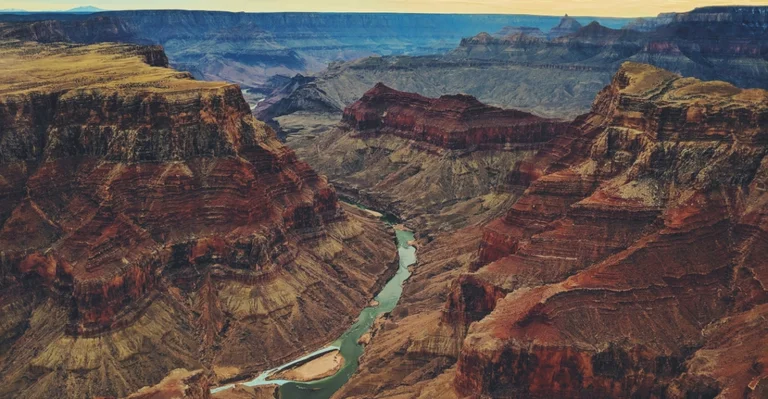
A new scientific study sheds light on how and when the Colorado River began carving the Grand Canyon, answering one of the greatest geological mysteries.
According to the research, published in Science, researchers analyzed zircon grains in sediments and volcanic ash to reconstruct the river’s ancient course. They were able to understand how its course evolved during key stages in the canyon’s formation.
The findings show that around 6.6 million years ago, the river flowed toward a large basin in northeastern Arizona, creating a broad, shallow lake known as “Lake Bidahochi.” Over time, the waters accumulated until, around 5.6 million years ago, they overflowed a low point, initiating the flow that led to the canyon’s gradual formation.
Later, the river passed through a series of basins and, around 4.8 million years ago, reached the Gulf of California in Mexico.

Today, the Grand Canyon stretches about 450 kilometers in length, up to 29 kilometers in width, and more than 1.8 kilometers in depth. It is the result of millions of years of erosion, while its rocks are as much as 1.8 billion years old.
Scientists emphasize that the process is still ongoing: the river erodes the rocks at a rate of 100–160 meters per million years, continually shaping the landscape. The study also helps fill a gap in knowledge about the period between 11 and 5.6 million years ago, when the river’s course remained unclear.
Related

Curiosities
Jordan Blocks Telegram App After Deadly Church Attack to Prevent Extremism

Curiosities
Don’t Rely Only on Mileage: When Should You Change Your Engine Oil?

Curiosities
1979 Porsche 924 returns to the United Arab Emirates Police fleet

Curiosities
Restaurant in Canada bans children under 15, decision sparks debate
Curiosities
12 curiosities from around the world you shouldn’t miss
Curiosities
Why do mosquitoes prefer some people over others? The reason has been revealed

Curiosities
Father and son break Guinness record playing ‘Hungry Hungry Hippos’ blindfolded
Curiosities
Why Are Highway Direction Signs Green in Some Countries and Blue in Others?
Curiosities
What happens when there is a bomb threat on an aircraft?
Curiosities
NASA Searches for a Secret Underground Cave on the Moon

Curiosities
Wearing boxing gloves and a special costume, this dog became Halloween’s star
Curiosities
After 28 years and 50,000 kilometers, British adventurer Karl Bushby returns home





