
Some of the world’s earliest cave art, including the oldest known hand stencil drawing, is deteriorating at an “alarming rate” due to climate change, according to a new study. Indonesia’s Sulawesi Island is home to cave art dating back more than 45,000 years. […]
The World’s Oldest Cave Art Is Disappearing Due to Climate Change
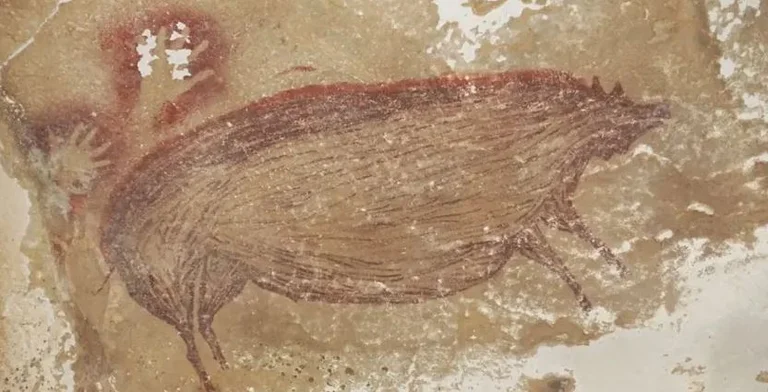
Some of the world’s earliest cave art, including the oldest known hand stencil drawing, is deteriorating at an “alarming rate” due to climate change, according to a new study.
Indonesia’s Sulawesi Island is home to cave art dating back more than 45,000 years. The ancient cave paintings include depictions of animals, hybrid human-animal figures, hand stencils drawn with red and mulberry pigments, and what is perhaps the earliest known narrative scene in prehistoric art.
For example, in Leang Tedongnge cave in Sulawesi’s Maros-Pangkep region, researchers have found hand stencil art dating back 39,900 years and rock art depicting a pig that is at least 45,500 years old.
The Maros-Pangkep region is home to 300 different limestone cave art sites. Since the 1950s, archaeologists have reported anecdotally that the ancient paintings, which have survived for tens of thousands of years, have been “wiped and peeled off the cave walls,” the study’s authors write in The Conversation.
“The cave paintings in Sulawesi and Borneo are some of the earliest evidence we have that people were living on these islands,” they wrote. “Tragically, at almost every new site we find in this region, the rock art is at an advanced stage of disappearance.”
But the reasons for this were unclear, so the team decided to investigate by analyzing some of the oldest known examples—dating to between 20,000 and 40,000 years ago—at 11 different sites in the region. Using a variety of techniques, including powerful microscopes, chemical analysis and crystal identification, the researchers discovered traces of salts in the caves. They found calcium sulfate and sodium chloride on rock flakes at three of the 11 sites and high levels of sulfur, which is a component of salts, at all the sites, suggesting that salt deposits may be causing the deterioration, according to a statement.
High humidity or high temperatures favor the formation of salt crystals; salt is carried by water into the air, and after the water evaporates, the salt is left behind as a deposit on or beneath the rock surface.
Salt deposits expand and contract as the surrounding environment heats up and cools down, causing repeated stress on the rock, the authors write in the paper. Some salt deposits can expand to three or more times their original size when heated. This repeated stress eventually causes the rock to crack and fracture. The findings suggest that over at least the past four centuries, Maros-Pangkep rock art has deteriorated increasingly, and over the past four decades that erosion has rapidly accelerated due to human-caused climate change.
“However, some of the rock art has so far managed to survive for tens of thousands of years through major episodes of climate change, from the cold of the last ice age to the onset of monsoon rains,” the study’s authors say. But climate change is now “amplifying climate extremes,” they write. Higher ambient temperatures and more severe and frequent extreme weather events are accelerating changes in temperature and humidity that drive salt formations, according to the statement.
The increasing “frequency and severity” of drought caused by the climate cycle known as El Niño and the accumulation of moisture from monsoon rains in nearby areas “provide ideal conditions” for evaporation, salt formation and the weathering of cave surfaces bearing ancient art, the authors conclude in the paper. Not counting the threat from industrial limestone quarries, “the loss of the painted limestone ‘canvas’ through salt efflorescence [formation] intensified by El Niño conditions is the most urgent threat to the preservation of rock art in this region,” the authors write in the paper published on May 13 in the journal Scientific Reports.
They call for more conservation, monitoring and research in these areas. “The extraordinarily ancient cave art in Indonesia lies within a dynamic tropical environment that makes it particularly vulnerable to the destructive impacts of climate change, adding a unique urgency to this call for further research,” they write in the paper.
Related

Curiosities
Jordan Blocks Telegram App After Deadly Church Attack to Prevent Extremism

Curiosities
Don’t Rely Only on Mileage: When Should You Change Your Engine Oil?

Curiosities
1979 Porsche 924 returns to the United Arab Emirates Police fleet

Curiosities
Restaurant in Canada bans children under 15, decision sparks debate

Curiosities
12 curiosities from around the world you shouldn’t miss

Curiosities
Why do mosquitoes prefer some people over others? The reason has been revealed

Curiosities
Father and son break Guinness record playing ‘Hungry Hungry Hippos’ blindfolded

Curiosities
Why Are Highway Direction Signs Green in Some Countries and Blue in Others?

Curiosities
What happens when there is a bomb threat on an aircraft?
Curiosities
NASA Searches for a Secret Underground Cave on the Moon

Curiosities
Wearing boxing gloves and a special costume, this dog became Halloween’s star

Curiosities
After 28 years and 50,000 kilometers, British adventurer Karl Bushby returns home





