
The dream of building cities on the Moon may be much farther from reality than previously thought. A new study by the Harvard–Smithsonian Center for Astrophysics warns that the Moon’s ice reserves would not be enough to support a large city with a permanent population. Despite recent advances in lunar exploration […]
Scientists sound the alarm: cities on the Moon are not close — the main obstacle is water
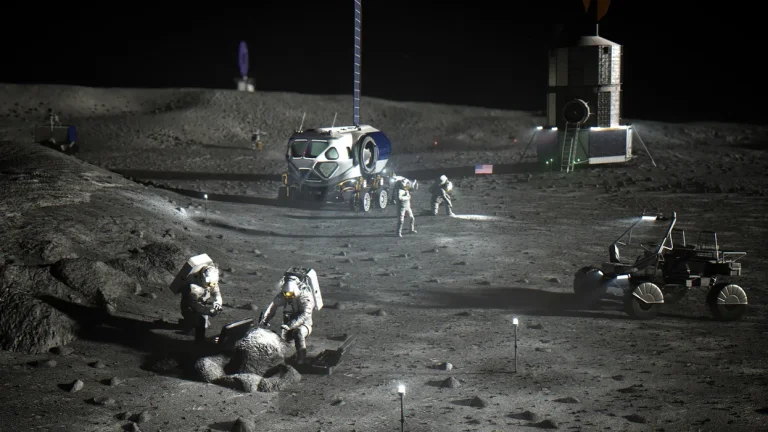
The dream of building cities on the Moon may be much farther from reality than previously thought. A new study by the Harvard–Smithsonian Center for Astrophysics warns that the Moon’s ice reserves would not be enough to support a large city with a permanent population.
Despite recent advances in lunar exploration and more accurate mapping of its surface, scientists have concluded that water, not energy, is one of the biggest obstacles to the long-term colonization of Earth’s natural satellite.
The study, titled “There Are No Cities on the Moon”, analyzed how much water and energy a large lunar population would consume, as well as how long a settlement of 100,000 or one million inhabitants could survive.
The results were published in the international journal Frontiers in Space Technology, reports Telegrafi.
Scientists have long known that water deposits exist on the Moon. Recent analyses have confirmed that a significant portion of them lies in craters that are permanently shadowed, where sunlight does not reach.
Temperatures in these areas range from around -163 to -246 degrees Celsius, allowing ice to remain preserved for exceptionally long periods. According to the study, only about one millimeter of ice is lost every billion years.
Astrophysicist Martin Elvis, who led the study, defines a “city” as a settlement with around 1 million inhabitants. Average water consumption is estimated at around 500 tonnes per person.
At these rates, a city of one million inhabitants would deplete its water reserves within just a few years if it did not recycle water.
The International Space Station (ISS) currently recycles around 98 percent of the water it uses.
According to Elvis’s calculations, if 1 billion tonnes of lunar water were recycled with the same efficiency as on the ISS, a city of one million inhabitants could be supplied for around 100 years.
For longer-term sustainability, the population would have to be limited to around 1,000 people – more of a lunar village than a city.
However, the situation would change significantly if water recycling efficiency reached 99.9 percent. In that scenario, a city of one million inhabitants could theoretically survive for around 2,000 years.
This could also be combined with other water-saving measures, such as vertical farming, or with importing water from Earth.
If water poses a serious problem, energy does not appear to be the main obstacle.
Near the Moon’s poles are the so-called Regions of High Illumination, where the Sun does not disappear completely below the horizon. The crater ridges in these areas are higher than the surrounding terrain and could be ideal for installing solar panels.
According to the study, towers around 1 kilometer high, covered with solar panels and placed on crater rims, could produce around 3 gigawatts of energy each – enough to power not only homes but also industrial activities.
The Moon also has another advantage: around 20 percent of its surface consists of silicon, one of the main raw materials for manufacturing solar cells. This would make it possible to carry out some of the production locally.
Some companies have begun considering how to harness this potential. Japanese construction company Shimizu Corporation has announced plans to install solar panels along the Moon’s equator, with the aim of producing around 13,000 terawatts of energy – more than Earth’s total electricity consumption.
The Moon’s extremely thin atmosphere would be an advantage for these systems, as the absence of weather would enable much more consistent solar power generation.
However, scientists emphasize that current exploration can analyze only a few meters beneath the surface. This leaves open the possibility that much larger ice reserves could be discovered at greater depths in the future.
For the study’s author, Martin Elvis, this issue should prompt a more serious debate about the sustainability of any future lunar project, particularly how water resources will be managed over the long term.
So, a lunar city with one million inhabitants does not appear to be on the near horizon. But if future exploration discovers new water sources and recycling technologies improve, the idea of permanent settlements on the Moon may not be as far-fetched as it seems today.
Related

Curiosities
Jordan Blocks Telegram App After Deadly Church Attack to Prevent Extremism

Curiosities
Don’t Rely Only on Mileage: When Should You Change Your Engine Oil?

Curiosities
1979 Porsche 924 returns to the United Arab Emirates Police fleet

Curiosities
Restaurant in Canada bans children under 15, decision sparks debate

Curiosities
12 curiosities from around the world you shouldn’t miss

Curiosities
Why do mosquitoes prefer some people over others? The reason has been revealed

Curiosities
Father and son break Guinness record playing ‘Hungry Hungry Hippos’ blindfolded

Curiosities
Why Are Highway Direction Signs Green in Some Countries and Blue in Others?

Curiosities
What happens when there is a bomb threat on an aircraft?
Curiosities
NASA Searches for a Secret Underground Cave on the Moon

Curiosities
Wearing boxing gloves and a special costume, this dog became Halloween’s star

Curiosities
After 28 years and 50,000 kilometers, British adventurer Karl Bushby returns home





