
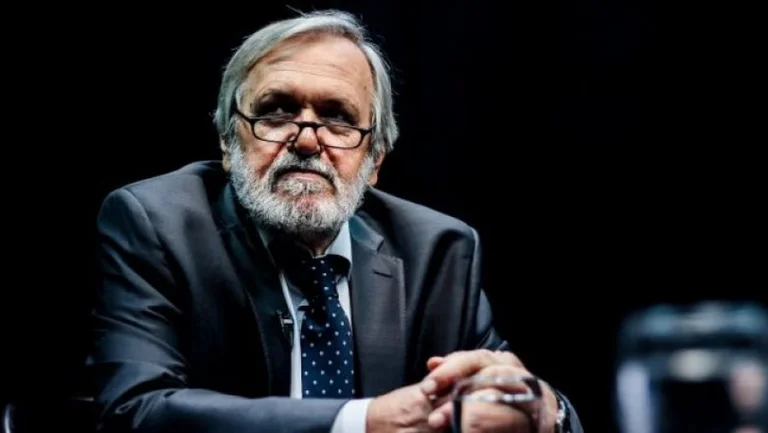
Writer Mehmet Kraja, a member of the Academy of Sciences and Arts of Kosovo, wrote that speaking and reading Albanian badly has now attained official status in Kosovo. “Kosovo is represented at the highest levels by people who do not know “how to speak, read or write Albanian,” with or without the standard.
Speaking and reading Albanian badly has now attained official status in Kosovo
They will no longer make an effort to learn Albanian, because solid knowledge of spelling and correct pronunciation will not be a criterion for any position in the state hierarchy. They will no longer hide the fact that they do not know the Albanian language, because they will use as an alibi “extreme” examples, as well as the fact that undermining the standard Albanian language and promoting “Kosovar” as an amalgam of dialect speech, flooded with Turkish and Slavic loanwords in its lexicon and syntax, phonetics and morphology, is in vogue.
Our Constitution does not say that people who speak Albanian with a Slavic accent cannot be appointed to important public positions. On the contrary, it says that Serbian must also be used where there is not a single Serb!
Meanwhile, over the last 25 years, two parallel linguistic trends have coexisted in Kosovo: one effort to establish and acquire the standard, and to advance language culture; and another insistence on obstructing this process by promoting, alongside the “Kosovar nation,” a “liberal language” too, with a schism that opposes Albania’s “ideological” linguistic norm and gives voice to Kosovo’s European modernity. Our linguists never made it clear that modernity must go hand in hand with a cultivated, graceful language, written with culture, and not a rural subdialect full of barbarisms.
We already have major problems with all kinds of linguistic calques.
And what can one say if an entire politician’s speech or reading is a complete calque!?
Meanwhile, respect to those who write in Gheg; that is their choice, but few know how to do it properly.
Strangely, we have a group of linguists who, before insisting on advancing language culture and learning the norm, and before supporting the standard in their forums, have begun loudly supporting the schism, despite the fact that this trend has its roots in the pro-Serbian dividing line of an earlier period, when “Kosovar” was supposed to serve as a paradigm against the mutual integration of Albanians.
The other great wonder happens when some of these linguists, at their scientific gatherings and in their papers, on the one hand advocate “liberalizing” the standard, while on the other hand speaking as if they were from Lushnja; they are so principled!
They are not principled either when, from the lecterns of the Seminar, they call for Turkish loanwords not to be removed from use, for instance, even when they are common barbarisms. The way things are going, one not-too-distant day some “disciple” of this circle may come along and call for Slavic barbarisms not to be removed either, nor the Slavic accent when we read Albanian, because “Kosovar” is, after all, still searching for its identity.
They are not principled either when they fail to mention that considerable efforts were made, time and again, to compile a lemmatized dictionary of Albanian written in Kosovo before 1971, apparently not to preserve the “lexical treasure,” but rather as a favor to be done for the Kosovar idiom of the Albanian language; nor are they principled when they refuse to publish the decisions of the Inter-Academic Council on the Albanian Language, while a book that mocks and ridicules the standard is published and given publicity.
Meanwhile, meanwhile, speaking and reading Albanian badly has now attained official status in Kosovo,” Kraja wrote.
Related
Opinions
Hello, Albin.
Opinions
Why Does Emotion Overwhelm Logic?!
Opinions
Serbian Nationalism on the EU Stage: Stabilitocracy at Kosovo’s Expense
Opinions
A market without a “guardian”: the vital role of the Competition Authority and the cost of its paralysis in Kosovo
Opinions
Things That Cannot Coexist
Opinions
The Mirror We Refuse to See Ourselves In
Opinions
The Ohrid Agreement: Normalization Without Recognition and an Endless Dialogue
Opinions
A PDK MP rightly raised concerns today, on World Urbanism Day
Opinions
Kosovo is growing in percentage terms, but remains behind in the economic strength of the Western Balkans
Opinions
The Legal Battle to Defend the KLA Leaders in the Appeals Chambers of the Specialist Chambers
Opinions
USA: The Supreme Power of the Free Vote
Opinions
The number-one risk for the diaspora is denationalization fueled by extremist Islamism





