
The European Union’s Growth Plan gives a significant boost to the convergence process by linking gradual access to the EU Single Market with progress in regional integration. Building our common regional market is not an alternative to European integration, but part of the path toward it. A company in the Balkans […]
Competing in Europe by Connecting with Neighbors
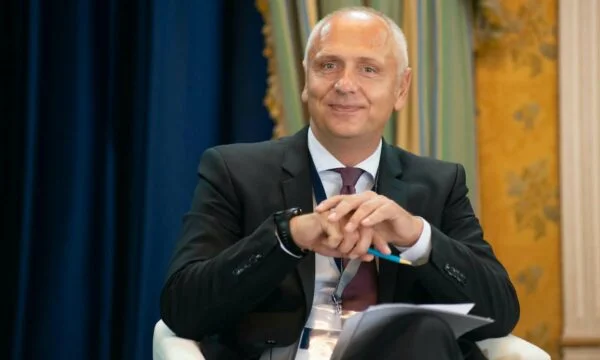
The European Union’s Growth Plan gives a significant boost to the convergence process by linking gradual access to the EU Single Market with progress in regional integration. Building our common regional market is not an alternative to European integration, but part of the path toward it.
A company in the Western Balkans can produce parts for one of Europe’s automotive industry giants, meet strict international standards, and export its products thousands of kilometers away.
But, paradoxically, the same company may encounter unnecessary obstacles when seeking to expand its activities in a neighboring country, just a few hundred kilometers away.
This is one of the paradoxes of our region. Our businesses have proved that they can compete in international markets. What we need is to make it easier for them to cooperate economically with one another.
Our Balkan Barometer survey clearly highlights this gap: seven in ten companies consider the removal of trade barriers important for regional trade, yet only 6% of them employ workers from neighboring economies.
Taken individually, the six Western Balkan economies are relatively small. Together, they make up a market of almost 17 million people. For businesses, this means more potential customers, a broader pool of skilled workers, more suppliers, and greater opportunities for investment.
For investors, this means the opportunity to serve a larger market through interconnected activities at the regional level.
This is the economic logic behind the Common Regional Market: to give businesses more room to grow, help them become more competitive, and bring the region closer to the European Union’s Single Market.
Potential
Taken individually, the six Western Balkan economies are relatively small. Together, they make up a market of almost 17 million people. For businesses, this means more potential customers, a broader pool of skilled workers, more suppliers, and greater opportunities for investment. For investors, this means the opportunity to serve a larger market through interconnected activities at the regional level.
This is the economic logic behind the Common Regional Market: to give businesses more room to grow, help them become more competitive, and bring the region closer to the European Union’s Single Market.
From supplying Europe to creating more added value
Our region is already closely connected to the European economy. In 2025, trade in goods between the Western Balkans and the European Union reached around 88 billion euros, while nearly 70% of our goods exports went to the EU market.
These are encouraging figures, but they tell only part of the story. Just as important is what we produce, how we produce it, and how much added value our companies manage to create and capture.
Many businesses in the six Western Balkan economies are already part of European supply chains, particularly in the production of automotive components, metal processing, machinery manufacturing, and other branches of manufacturing.
The next challenge is to move toward more advanced production, develop our own products and technologies, and compete in segments that create higher added value.
Regional cooperation can help us achieve this.
Recently, in Pristina, during the Civil Society Forum, entitled “Proof, Not Promises,” a young person in the audience posed a challenging question to me: What would it take for the Balkans to have its own Airbus?
But we must understand Airbus’s story correctly, both metaphorically and in practical terms. Airbus did not emerge as an industry giant. It began as a consortium, in which existing French and German companies joined forces to produce an aircraft while continuing to operate as separate businesses. It took around 30 years for Airbus to become a single company.
Therefore, the lesson for our region is not that we necessarily need to create such a giant. What we need is to make it as easy as possible for our companies, legally, financially, and technically, to participate together in tenders and compete for major contracts.
Imagine a company that manufactures automotive parts in one economy, an electronics equipment manufacturer in another, and an engineering company elsewhere in the region joining forces to compete for contracts that none of them could win alone.
The ambition exists. What stands in its way are the mechanisms and infrastructure needed to make this cooperation possible.
A component certified in one of the region’s economies should also be recognized and accepted in the others. Raw materials and materials sourced from different countries in the region should count as products of regional origin when the finished product enters the European market.
Small enterprises need simple cross-border procedures to participate in tenders together, as well as access to financial guarantees. Engineers should be able to move from one country to another as easily as the components they produce.
These measures may not seem very impressive, but they are precisely what the Common Regional Market aims to achieve.
The Balkans will not have its own Airbus simply by announcing its creation. This will become possible when the first regional consortium wins a contract that its participating companies could not secure separately. That would be concrete proof, not just a promise.
This is also the idea behind the Industrial Parks Partnership between the six Western Balkan economies and the European Union (WB6-EU Industrial Parks Partnership), which we launched in September. This initiative connects seven industrial parks and business zones in the Western Balkans with EU partners.
Our aim is to build supplier networks and value-added chains, as well as encourage the exchange of technologies and more environmentally friendly industrial practices.
We want these connections to translate into new investments. Companies interested in joining this initiative as suppliers or partners are welcome to contact us.
Industrial Parks Partnership
This is also the idea behind the Industrial Parks Partnership between the six Western Balkan economies and the European Union (WB6-EU Industrial Parks Partnership), which we launched in September. This initiative connects seven industrial parks and business zones in the Western Balkans with EU partners.
Our aim is to build supplier networks and value-added chains, as well as encourage the exchange of technologies and more environmentally friendly industrial practices. We want these connections to translate into new investments. Companies interested in joining this initiative as suppliers or partners are welcome to contact us.
A regional market that works for businesses
Companies cannot fully benefit from a larger market if doing business in different countries across the region remains complicated and costly.
A manufacturing company needs predictable delivery times. A technology company needs skilled workers. An investor needs transparent procedures and confidence that its activities in the region will operate efficiently.
Yet businesses continue to face administrative requirements, regulatory differences, transport delays, and difficulties securing financing. These obstacles increase costs and hold back investment.
We have already demonstrated what regional cooperation can achieve. The removal of roaming charges within the region, joining SEPA, which makes payments cheaper and faster, Green Lanes, which reduce border waiting times, and easier recognition of professional qualifications are concrete examples of these benefits.
The second phase of the Common Regional Market provides the framework needed to take these efforts further.
At the Regional Cooperation Council, we work with the six Western Balkan economies, the European Commission, and regional partners to turn political commitments into concrete results, from simplifying investment procedures and providing incentives for green investment to sustainable financing.
For the Leaders’ Summit this October, under Montenegro’s chairmanship of the Berlin Process, we are preparing new concrete outcomes of regional cooperation to be presented to leaders for approval.
We must also listen to businesses: companies know better than anyone where obstacles continue to exist, and our monitoring of the Common Regional Market is specifically intended to identify them.
The objective is clear: to make it easier and more attractive to invest, do business, and expand across the region.
Related

Opinions
Hello, Albin.
Opinions
Why Does Emotion Overwhelm Logic?!

Opinions
Serbian Nationalism on the EU Stage: Stabilitocracy at Kosovo’s Expense
Opinions
A market without a “guardian”: the vital role of the Competition Authority and the cost of its paralysis in Kosovo

Opinions
Things That Cannot Coexist
Opinions
Speaking and reading Albanian badly has now attained official status in Kosovo

Opinions
The Mirror We Refuse to See Ourselves In
Opinions
The Ohrid Agreement: Normalization Without Recognition and an Endless Dialogue
Opinions
A PDK MP rightly raised concerns today, on World Urbanism Day
Opinions
Kosovo is growing in percentage terms, but remains behind in the economic strength of the Western Balkans

Opinions
The Legal Battle to Defend the KLA Leaders in the Appeals Chambers of the Specialist Chambers
Opinions
USA: The Supreme Power of the Free Vote





