
Rochester is a small city in the northeast of New York State, in the United States of America. RIT is one of the city’s two large universities. Surely, of the roughly 30,000 students wandering around the vast campus, I will be the only one who, on September 16 […]
On September 16, The Hague Will Deliver Its Verdict—Not Mine
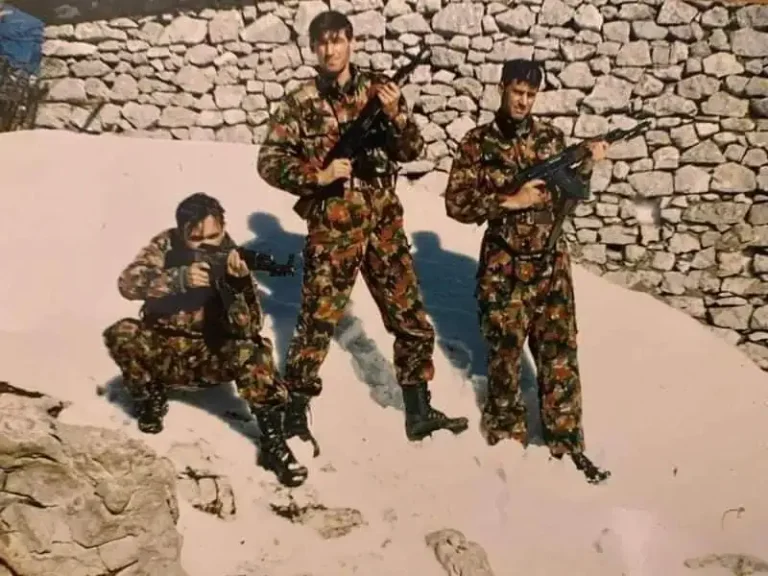
Rochester is a small city in the northeast of New York State, in the United States of America. RIT is one of the city’s two large universities. Surely, of the roughly 30,000 students wandering around the vast campus, I will be the only one who, on September 16, will wake up at 4 a.m. to await the verdict of a panel of judges at the Specialist Chambers on four liberators of my country: Hashim Thaçi, Kadri Veseli, Rexhep Selimi, and Jakup Krasniqi.
The fact that I will be awake while the entire campus sleeps on that historic Wednesday for Kosovo does not mean that the court’s verdict matters more to me than it does to these boys and girls who may never have heard of those men. Perhaps that verdict matters even less to me precisely because I know the four men accused in The Hague well, and everything they left behind for my generation in Kosovo.
I was born six years after the war. I have never heard a NATO plane flying over Kosovo’s skies. I have not seen Serbian forces enter an Albanian village. I have not taken the road as a war refugee. And I have never found myself in a position to decide whether I was brave enough to pick up a rifle and join the Kosovo Liberation Army.
I inherited something much easier. Freedom.
I grew up seeing Hashim Thaçi as the Declaration of Independence’s signatory, Prime Minister, and President.
On September 16, the Specialist Chambers are expected to tell us whether he and his comrades were war criminals or not.
I already know that whatever their decision may be, it will not be mine.
To me, Hashim Thaçi and his comrades are innocent.
When the Court convenes to decide Thaçi’s fate, in his eyes I will see the young man who joined a project that promised neither ceremonial escorts, meetings in Washington, nor photographs with heads of state.
Yes, all it offered was a very real chance of being killed.
That project began in a Kosovo stripped of its autonomy, with citizens who had no jobs, who were killed, massacred, and driven from their country.
In March 1999, Milošević’s brutal violence in Kosovo drew international attention. NATO entered the war.
This makes the place from which I will follow Thaçi’s final trial, along with the others, all the more remarkable.
I will be a young man studying in New York because I was fortunate enough to be born in a Kosovo where you stamp your passport and leave with a suitcase, and not in one where I would have been among my 1 million compatriots in refugee columns.
I can criticize my country. I can criticize my government. I can become a journalist, poet, painter, or programmer. I can get on a plane—leave to study—and return home again. I can love anyone. I can walk whenever and wherever I want without a worry.
These may all be ordinary things. That is precisely what makes them worth more than anything else.
The generation before me, that of Thaçi, Veseli, Selimi, and Krasniqi, took up arms and fought precisely because they hoped that one day our lives could become ordinary.
This is the legacy through which I understand the KLA.
And this is also why a trial cannot decide for my people and their history.
If Thaçi and the others are acquitted, I will celebrate.
Yes, his acquittal will not make the KLA a liberation army.
It is one.
It will not make the cause of independence just.
It has been just since it began.
It will not make those accused by the prosecution emblematic figures of our history.
They already are.
And if they are convicted?
Of course, one cannot expect calm from a people living with the legacy I have described. A conviction would have extraordinary consequences for all of Kosovo and, naturally, the evidence and reasoning behind it would need to be examined seriously.
But there are things a conviction would not be able to do.
It cannot rebuild my family’s burned-down house in the village.
It cannot raise from the grave any of the more than 1,000 children killed during the war.
It cannot erase the trauma of 20,000 people who were sexually assaulted.
It cannot undo Milošević or his fascist regime.
It cannot make the resistance meaningless.
And, even less so, it cannot make me feel ashamed of my ancestors and their sacrifices.
This may seem pathetic. Perhaps it is. For our generation, history is rarely an academic matter. It sits at our dining tables, waves from flags around the country, hangs in photographs on walls and in the names of schools and streets. It is buried in every cemetery.
My generation has been asked to remember all of this without ever having experienced it.
Fortunately, though.
I refuse to accept freedom as an inheritance without always keeping in mind the price that was paid for it.
This is also why I see the September 16 trial differently from the international judges on the panel, even though, in my judgment, it is worthless.
They bear the burden of giving a legal answer, finding the truth amid the many clouds of confusion created by that scandalous prosecution.
I bear the burden of not forgetting the historical answer.
On September 16, when it is 10:00 a.m. in Kosovo, the Albanian people will gather in the streets to await the decision together.
In The Hague, our liberators will stand to hear other people decide whether they can return to the country whose declaration of independence bears the signature of most of them.
I hope they will return home.
I want them to return home.
But if they do not, I will not accept that a courtroom thousands of miles from Kosovo can tell me that the history I inherited must be read backwards.
I will continue to believe that Kosovo had the right to resist.
I will continue to see the KLA emblem as representing a force that fought for my freedom and that of my people.
The judges have six years’ worth of testimony and evidence, whatever it may be, on which to base their decision.
I have a lifetime in a free Kosovo to explain mine.
On September 16, they will announce their decision about the four men.
They will not announce mine.
Related
Opinions
Hello, Albin.
Opinions
Why Does Emotion Overwhelm Logic?!
Opinions
Serbian Nationalism on the EU Stage: Stabilitocracy at Kosovo’s Expense
Opinions
A market without a “guardian”: the vital role of the Competition Authority and the cost of its paralysis in Kosovo

Opinions
Things That Cannot Coexist
Opinions
Speaking and reading Albanian badly has now attained official status in Kosovo

Opinions
The Mirror We Refuse to See Ourselves In
Opinions
The Ohrid Agreement: Normalization Without Recognition and an Endless Dialogue
Opinions
A PDK MP rightly raised concerns today, on World Urbanism Day
Opinions
Kosovo is growing in percentage terms, but remains behind in the economic strength of the Western Balkans
Opinions
The Legal Battle to Defend the KLA Leaders in the Appeals Chambers of the Specialist Chambers
Opinions
USA: The Supreme Power of the Free Vote





