
Many know Mata Hari, but few know exactly which parts of her story are fact and which are fiction. What we do know is that she was widely traveled, spoke more than 7 languages fluently, and that during the First World War, her beauty […]
Sex, War and Betrayal: The Infamous Story of Mata Hari
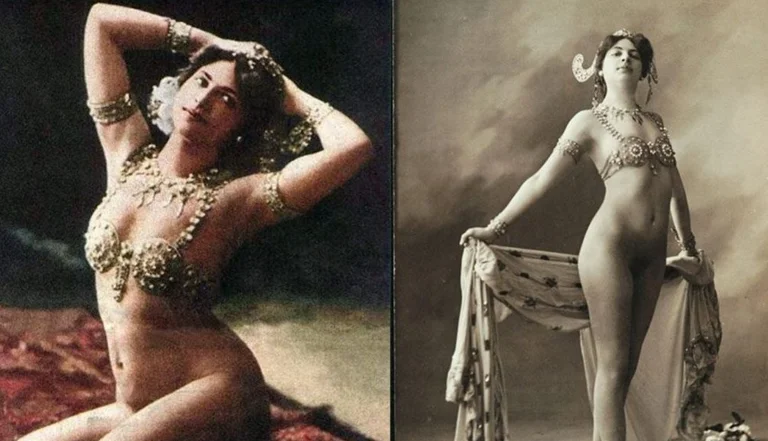
Many know Mata Hari, but few know exactly which parts of her story are fact and which are fiction. What we do know is that she was widely traveled, spoke more than 7 languages fluently, and that during the First World War, her beauty and romantic escapades trapped her so deeply in a spy network that in the end even her own fame could not save her from death.
The details of Mata Hari’s life before her alleged wartime crimes are more tragic than titillating. Born Margareta Zelle on August 7, 1876, in Leeuwarden, Holland, her mother died when Zelle was only 14. Her father remarried and sent the girl
to live with other family members along with her 3 younger brothers.
After being expelled from school at the age of 16 for having sexual relations with the headmaster, she left to live with her uncle in The Hague. Just two years later, she answered a lonely-hearts ad placed by 39-year-old Dutch army captain Rudolf MacLeod, who lived in Indonesia (the former Dutch East Indies).
The two married in 1895, but their union was not very happy. MacLeod often drank and had a mistress—something that did not sit well with his young wife, who in turn took a lover of her own. At this point, she also began studying Indonesian culture, which would prove very valuable later on. The couple had two children, who fell seriously ill in 1899.
Their son, Norman, died that year at the age of 2, while his sister Jeanne survived. The cause
of Norman’s death remains unknown, although it is said that he and Jeanne had contracted syphilis because of their parents’ frequent infidelity. However, the couple claimed that the children had been poisoned by one of MacLeod’s enemies.
MacLeod would soon be discharged from the army, and the couple returned to Holland, where they divorced in August 1902. Jeanne stayed mostly with her mother, but one day MacLeod failed to return her after a scheduled visit. Unable to afford a legal battle for custody of her daughter, Zelle went to Paris in 1903 without her.
The Paris years
At first, Zelle turned to prostitution to support herself, but soon found work as a horse rider in a circus. To make ends meet, she also worked as an artist’s model, and in 1905 she had some success as a dancer. It was at this point that she adopted the stage name Mata Hari—claiming to be an Indonesian Hindu princess—while perfecting her provocative and almost religious “secret dance,” which we know today as striptease.
After her debut at the “Musée Guimet,” a museum dedicated to Asian art, Mata Hari’s name became known throughout Europe. Men from all over the world desired her, but she had eyes only for army officers—a taste that would also determine her tragic fate.

The war
Because Holland remained neutral during the First World War, Mata Hari had no difficulty crossing national borders. And that is exactly what she did—and very often—which is one of the reasons her name appeared on the list of suspected spies. What happened next depends on your source of information. It remains unclear whether she was definitely a German or French spy—and especially with whom she first agreed to work, and for what reason.
What we do know is that in 1914, her personal belongings (furs and several costumes) were confiscated at the German border, and that at that time a German consul gave her money to obtain information from the many French army officers she slept with. It is also believed
that a French officer made her the same offer in 1916, which she accepted to raise money for a Russian lover wounded in the war.

Arrest and trial
When a ship she was on entered the English port of Falmouth, the police arrested Mata Hari in 1916 and took her to London, where she was questioned by Sir Basil Thomson of Scotland Yard. Meanwhile, even though she was released from custody, things quickly began to go downhill because of counterespionage accusations. In January 1917, an official at the German embassy in Madrid sent a coded message to Berlin describing the activities of a spy named H-21.
The French discovered this message and identified H-21 as Mata Hari. Some believe German intelligence knew that the code had already been broken, thus sealing her fate. Nevertheless, Mata Hari’s trial, which was to be held in a secret military tribunal, was scheduled for July. The charges included spying for the Germans, making her responsible for the deaths of around 50,000 soldiers. For her part, Mata Hari admitted to having received money from the German consul, but said she had done none of the things he had asked her to do. She also added that she considered the payment compensation for the money confiscated earlier. Despite these claims, the French did not believe she was innocent, and presented the invisible ink she had with her as evidence that she was a spy.

Mata Hari insisted that the suspicious ink was part of her cosmetics, but this does not seem to have helped her. The day after the trial, the defense was not allowed to question any of the witnesses who might have helped Mata Hari’s case. She was able to write letters only to the Dutch consul, claiming her innocence: “My international connections are due to my work as a dancer, and nothing else …. Because I really do not spy, it is terrible that I cannot defend myself.”
Execution and legacy
Regardless of the truth about Mata Hari’s guilt or innocence, her fate was sealed: death by execution, to be carried out on October 15, 1917. As with her life, the details of her execution are shrouded in mystery. Some
say she blew a kiss to the firing squad before they opened fire. Others insist she opened her dress and revealed herself to the firing squad shortly before her death—her final farewell to men in uniform.
Perhaps the most credible is the eyewitness account of this journalist: “She displayed extraordinary courage, with a slight smile on her lips, just as in the days of her great triumphs on stage.” No one came to claim her body. Historians still debate the facts today—whether Mata Hari really was a double agent, or, after all, a spy.
With each new version of her story more complicated than the last, it seems that Mata Hari was, if nothing else, a victim of sexual politics: She was not a faithful, self-sacrificing woman, so she was not to be
trusted. As Brazilian writer Paulo Coelho, who wrote his own book about this figure, put it: “Mata Hari was one of our first feminists, defying the expectations of the men of her time and choosing instead an independent and unusual life.”
The French government will declassify the file on Mata Hari in 2017. Until next year, “we cannot know the whole truth,” Evert Kramer, curator of a large collection of Mata Hari memorabilia at the Fries Museum in Leeuwarden, told the British “Independent.” But “even then,” he added, “I doubt the whole story will be revealed.” / Bota.al
Related

History
What Lincoln and the technological revolution he led can teach us today
History
Exhibition “Luigj Gurakuqi in the Documents of the Central State Archive” Opens, Honoring His Contribution to Albanian National History
History
1941: When leaders of the Sanjak regions sought protection from Tirana
History
Was King Arthur, after all, real?
History
The 1973 oil crisis forced Nixon to rethink time
History
The Life and Work of Murat Bey Toptani
History
The Forgotten Photograph That Rewrites the History of the Second World War

History
The Pastor Who Saw Hiroshima Burning

History
An American physicist’s account of the atomic bombing of Nagasaki
History
Albania Judged by an English Lady
History
John Kantakouzenos’ Campaigns Against the Albanians
History
Albania as Judged by an Englishwoman





