
“It’s difficult to make predictions – especially about the future,” Yogi Berra, the legend of the [baseball club] New York Yankees, once said. Yogi was right. The corridors of history are filled with optimists and pessimists doing their best to sell us the future. Or to frighten us into slowing the future down. […]
What Lincoln and the technological revolution he led can teach us today
“It’s difficult to make predictions – especially about the future,” Yogi Berra, the legend of the [baseball club] New York Yankees, once said. Yogi was right. The corridors of history are filled with optimists and pessimists doing their best to sell us the future. Or to frighten us into slowing the future down.
In the mid-19th century, America stood on the brink of the worst man-made catastrophe in our history: the Civil War. We were also on the brink of the most transformative era in our history: the Industrial Revolution. A technological revolution that would transform our young nation into the world’s superpower within 50 years. And it would create an economy – and millions of jobs – unimaginable even to the boldest futurists.
The story begins with Abraham Lincoln, who was the first president to hold a patent. He was also the first president to be connected by telegraph, using the newly established U.S. Military Telegraph Corps to lay more than 15,000 miles of telegraph wire transmitting what Lincoln described as “lightning messages” – from the battlefield to his War Department near the White House, giving the Union a major communications advantage over its Confederate rivals.
Before becoming president, Lincoln was also one of the best trial lawyers in Illinois, and one of his trials would pave the way for the beginning of the Industrial Revolution.
On May 6, 1856, the steamboat “Effie Afton” crashed into the supports of the Rock Island Bridge – the first railroad bridge across the Mississippi River. No one was killed, but the steamboat was destroyed and the bridge was badly damaged. The steamboat’s owners filed a $930,000 lawsuit. They also wanted the bridge torn down, claiming it was a hazard to navigation.
This was more than just a battle between two companies. It was a battle between two industries – one old and one emerging: steamboats versus railroads. A loss in court would affect the economic life of major American cities. Steamboat cities like St. Louis had a lot to lose; growing railroad cities like Chicago had a lot to gain.
Lincoln intervened to defend the railroads in the 1857 trial, in the case of Hurd v. Railroad Bridge Company. He had never attended law school, but had handled more than five thousand court cases. Lincoln cross-examined the boat’s pilots, but he also wanted to show that bridges and steamboats could safely coexist. In Lincoln’s mind, the value of railroads was on trial. America’s future itself was also on trial.
In his closing argument, Lincoln maintained that he was not against steamboats, but against the powerful steamboat lobby, determined at all costs to oppose any bridge construction over the Mississippi. Lincoln’s essential point was this: “Railroads have as much right to go from East to West as steamboats have to go from North to South.”
The jury agreed, and, on appeal, so did the Supreme Court. Lincoln received $400 for his work.
Lincoln did not stop there in his support for railroads. He worked to include the idea of a transcontinental railroad in the 1860 Republican platform. As president, he supported the bills of 1862 and 1864, which provided subsidies for its construction.
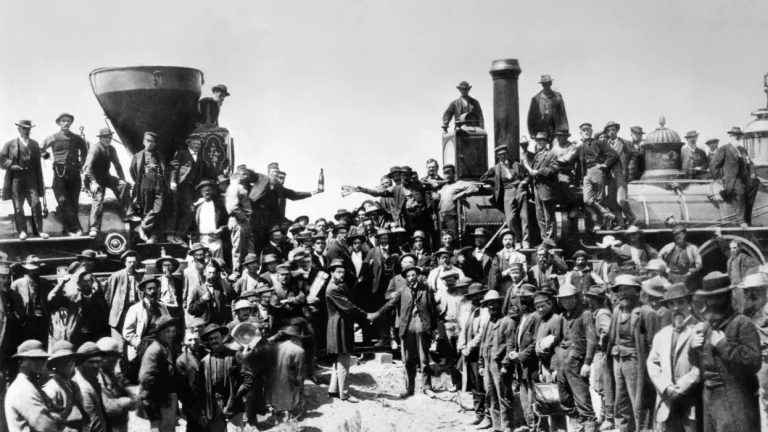
Lincoln did not live long enough to see that Golden Spike driven into the ground at Promontory, in Utah Territory, in 1869 (to complete the first U.S. transcontinental railroad). But it would not have happened without him.
It took more than legislation to make the transcontinental railroad a reality.
“The railroad required minds, muscle and sweat in quantities and proportions never before brought together on a single project,” the late Stephen Ambrose wrote in Nothing Like It in the World. “It could not have been done without skilled and ambitious engineers, without workers who came to America from every inhabited continent, without the timber and iron found in America, without capitalists willing to take great risks for great rewards, without men willing to challenge everything at every level in order to gain everything.”
America was transformed almost immediately.
“Before the transcontinental railroad, it took six months and a lot of money to get from San Francisco to New York overland – or you sailed to Panama at great risk, or went all the way around South America and back up. And it took months and a lot of money,” Ambrose added. “A week after the Golden Spike was driven, a man or woman could go from New York to San Francisco in seven days. And at a far lower cost than by ox- or horse-drawn wagons, sailing ships or steamboats.”
The transcontinental railroad also transformed the telegraph, replacing a network with multiple wires with a single-wire system – thanks to the right-of-way created by the railroad’s construction. It was a physical improvement in telecommunications unlike anything America had ever seen before – or since. And it enabled stationmasters to manage train schedules and operations, making the movement of goods across the country more efficient. And safer.
There were also major cultural changes.
“Before the railroads, nobody wore a watch. Nobody cared what time it was,” Ambrose wrote. “But if you’re going to have trains running in both directions, you have to have the same time in Cheyenne as in Omaha. The railroads required standard time, and Congress approved it in 1879. And we became obsessed with time. And we still are.” (The railroad industry adopted Railway Standard Time in 1883, and Congress adopted Standard Time in 1918.)
Not everyone welcomed these changes. What had once been a sparsely populated agrarian nation was becoming a more densely populated and diverse industrial power. For some, these were exciting times – for others, frightening ones.
There were political and cultural fears, too. Would large urban centers like New York and Chicago wield disproportionate power in America? And what would happen to our civic and moral foundations? And how might this change America’s position in the world?
One thing we know: America’s industrial output did not rival that of any single European country in 1865. By the end of the 19th century, America had surpassed them all. Our vast natural resources – coal, iron, ores, copper and timber – helped. Our population was also growing, filled with workers and consumers with money to spend.
But our greatest natural resource was – and remains – our culture of invention and innovation. Our culture of risk-taking and competition.
The foundational industry driving the Industrial Revolution was the steel industry. In 1870, America produced 77,000 tons of steel. By 1900, that figure had risen to 11.4 million. One man, more than anyone else, was responsible for this: a Scottish immigrant named Andrew Carnegie.
The steel industry needed huge amounts of capital to expand, prompting a legal innovation to meet the needs of the times: the modern corporation.
“Unlike traditional partnerships, corporations offered limited liability – protecting investors from being personally liable for debts or lawsuits. This protection encouraged investment on the scale needed to finance the industrial revolution,” Bill McClay wrote in Land of Hope.
Then came an innovation in finance. Local banks did not have the capital needed to finance these massive projects, and so investment banking was born.
America’s rapid industrialization caused real disruption, ushering in the Progressive Era of the early 20th century – and labor and antitrust reforms. But it reshaped most aspects of American life for the better. By 1950, just a century later, the revolution had created the world’s largest middle class, produced the “Arsenal of Democracy” in World War II that saved the world from tyranny, and increased life expectancy and prosperity in ways that even the greatest optimists of the 1850s could not have dreamed of – ushering in the age of electricity, combustion engines, petroleum, air conditioning and commercial air travel.
America’s GDP in 1850 was $2.6 billion; by 1950 it was $300 billion. America’s real GDP per capita, adjusted for inflation, rose from $3,000 per person to $16,000. And that does not take into account what happened to life expectancy in America. In 1850, average life expectancy was 40 years. By 1950 it was 68.
As Yogi Berra well understood, predictions are difficult – especially about the future. But the past – and the lessons learned from the technology visionary Abraham Lincoln and the Industrial Revolution – may be our best window into our future. /Telegrafi/
Related
History
Exhibition “Luigj Gurakuqi in the Documents of the Central State Archive” Opens, Honoring His Contribution to Albanian National History

History
1941: When leaders of the Sanjak regions sought protection from Tirana

History
Was King Arthur, after all, real?
History
The 1973 oil crisis forced Nixon to rethink time

History
The Life and Work of Murat Bey Toptani
History
The Forgotten Photograph That Rewrites the History of the Second World War
History
The Pastor Who Saw Hiroshima Burning
History
An American physicist’s account of the atomic bombing of Nagasaki
History
Albania Judged by an English Lady

History
John Kantakouzenos’ Campaigns Against the Albanians
History
Albania as Judged by an Englishwoman

History
Why and who killed Hasan Riza Pasha?





