
Miss Edith Durham is an English lady who speaks more than five languages and has seen many countries. She has traveled six times in the Balkans. On her last trip, she traveled from Monastir to Shkodra, passing through Korça, Kolonja, Leskovik, Përmet, Tepelena, Vlora, Berat, Elbasan, Durrës, Kruja, Orosh, not to mention the smaller places. She spoke with many […]
Albania Judged by an English Lady
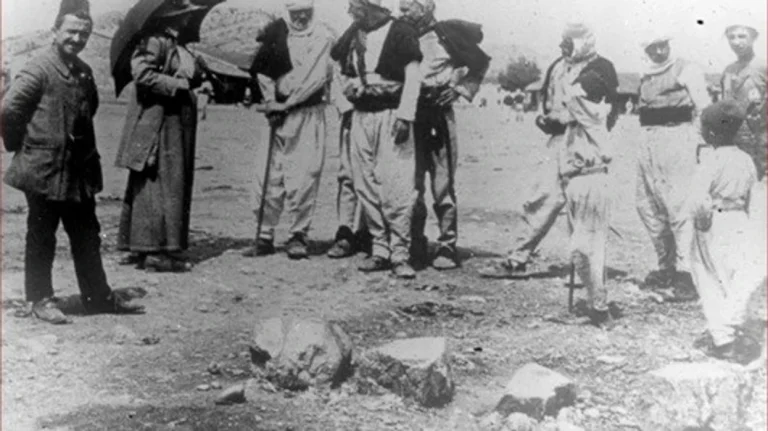
Miss Edith Durham is an English lady who speaks more than five languages and has seen many countries. She has traveled six times in the Balkans. On her last trip, she traveled from Monastir to Shkodra, passing through Korça, Kolonja, Leskovik, Përmet, Tepelena, Vlora, Berat, Elbasan, Durrës, Kruja, Orosh, not to mention the smaller places. She spoke with many people, visited Bektashi tekkes, Orthodox monks’ monasteries, and Catholic priests’ parishes. And what she saw, noticed, understood and thought, she tells us in a 330-page book that was published recently in London.
Miss Edith Durham traveled for pleasure, not for work. But on her journey she met some Englishmen sent by a London committee (“Balkan Committee”) to distribute aid among the Bulgarians who had suffered from the recent disturbances. These Englishmen asked the lady to join them in distributing the funds of the Balkan Committee, and so Miss Edith Durham undertook to travel through the villages around Resen.
From what she saw in “Macedonia,” Miss Edith Durham did not form a high opinion of the “Macedonians.” She is far too perceptive a lady to believe the lies and nonsense of the newspapers. She saw the Bulgarians, not as they want to appear, but as they are—and they are as bad as can be.
Miss Durham says: “I was not fortunate in the ‘patriots’ I met among the Bulgarians. They quite convinced me that, if I were the ruler of Ohrid, the people to whom I would have given the city are the Bulgarians” (146).
Further on (p.164) she gives us a fine portrait of a Bulgarian “patriot.” One night, this man approached Miss Durham and complained to her of his troubles: He was a fervent patriot, and the Committee had tasked him with killing three people in a village; unfortunately, a gun makes a great noise, and poison could not be found since the government had banned its sale; but, said the crafty patriot, “Madama” (meaning the English lady) was friends with the doctor and could get the necessary poison through him. Needless to say, Miss Durham sent this extraordinary patriot packing at once.
Another time, a Bulgarian “patriot” boasted to Miss Durham, with great pride, that he was the one who had poisoned the water drunk by some soldiers in a village … And the most laughable part is that when Miss Durham told him she thought this act was neither good nor pleasing, the poor fellow was astonished.
For the Bulgarians have strange ideas about civilization. They believe that civilization will make them “stop paying taxes.” And, says Miss Durham with a subtle sneer, when I told them that we pay taxes in England too, they were all astonished.
Nor are the poor “Macedonians” to blame; until now, no one has taken the trouble to educate their minds. Their ignorance is appalling.
In one village, Miss Durham says, she could not get the villagers to understand that some English or Italian gentlemen would come to travel around the country and see whether the Turkish government was doing anything wrong. The poor villagers had heard of no foreigners other than the Russians. Then the dragoman told them that those who were coming were “kaur gentlemen”—that is, infidels, unbelievers—and finally they understood that the gentlemen would not be Turks and were amused. “The villager,” adds the English authoress, “knows only one thing: that his life is ruined under the present state of affairs. Oppressed by the Government and terrified by the Committee, he raises his head, and will keep doing so until something of his own remains” (p.166).
We would need an entire issue of Albania to summarize, in however few words, Miss Durham’s observations on the Bulgarians’ thick-headedness. In one place, she had told some Bulgarians who were serving her not to put a cushion on the horse’s back. This instruction—which, the authoress says, an Albanian or a Montenegrin would have understood without being told twice—she repeated to the Bulgarians for twenty days, and yet the next day the horse was still being led with the cushion! These things may seem small, but they are of great importance, because by noticing such things one comes to understand whether one is dealing with a perceptive or a dull-witted people.
Whenever Miss Durham sees a perceptive person in these regions, she says, he will be either an Albanian, a Greek or a Vlach. The Bulgarians in these regions appeared to be among the lowest specimens of the human race.
As for the “Christianity” of the “Macedonians,” the English authoress gives us a picture that says much about their Christianity: She places before our eyes the face of the Bishop of Ohrid who, along with many vulgar and tasteless words he said to her, even dared to frighten Miss Durham with the fate of Miss Stone, saying that he, the thieving bishop, was capable of making Bulgarians kidnap the English lady and hold her as a slave to extort money.
Unfortunately for the thieving bishop, he found someone who could answer him; and besides giving him the necessary reply, Miss Durham, with her book, will also help the world understand what kind of “Christians” the “Macedonians” are. As she rightly says: The West wastes its time and concern on such people!
As you know, foreign newspapers spend their time talking about the “merciless massacres” (English “atrocity,” French “massacre”) that allegedly take place in “Macedonia.” This is how Miss Durham judges those misdeeds: “When a Muslim,” she says, “kills a Muslim, it is of no importance; when a Christian kills a Muslim, it is a just act; when a Christian kills a Christian, it is a mistake that is better left unmentioned; only when a Muslim kills a Christian do we arrive at a merciless massacre” (p.81).
Miss Durham says elsewhere that one thing is certain: in many places, had the Muslims wanted to, they could easily have wiped out all the Christians.
Let us leave the Bulgarians now and go with the authoress through Albania.
Miss Durham made this journey with an Albanian whose business required him to travel from one end of Albania to the other. The first city where they stopped was Korça, which the English lady praises as a “civilized” city and “the most peaceful of all the cities of European Turkey.” Of the Albanian girls’ school, where she was received with great honor, she says that “it is such a modern school that she felt as if she had suddenly been transported back to Europe. The houses in Korça that I saw were all Albanian houses; very fine houses, beautifully built and comfortable—each of which asked me to tell England that there are better people than the Bulgarians to liberate them” (p.213).
A few words about Kolonja, whose reputation is that of “a nest of thieves,” but where “I was received quite well”—and then Leskovik, which, a small village in the district of Konitsa twenty years ago, has now become the seat of a kaymakam and a center of patriotism. Miss Durham praises Leskovik as a peaceful place with fine stone houses that make it resemble some small English towns.
From Leskovik, Miss Durham and her traveling companion went to Postenan, where they stayed for a few days. Postenan is a village between Leskovik and Përmet. Here the authoress gives us a fine picture of rural life in Toskeria, and praises the “kingly courtesy” of the Albanians of Postenan.
In Përmet, the kaymakam—a contemptible lout—spoke with Miss Durham about Albanian affairs. “Here in Përmet,” said the lout, “the locals are all Greeks.” “But they speak Albanian, don’t they?” Miss Durham replied. “Unfortunately!” said the kaymakam. “They must have learned Albanian somewhere. There are also many who believe they are Albanians. How dreadful! But with time and Greek schools, things will be put right.” In Përmet, an Albanian gentleman took Miss Durham to the Bektashi tekke, and the English lady’s meeting with the Baba, their exchanged words and her tour of the tekke are among the most beautiful and noteworthy pages in the book.
As they set out for Tepelena, a terrible downpour began and forced the travelers to go to Dragut’s inn to spend the night. Thus Miss Durham had the good fortune to learn what a Tosk inn is like—I say “good fortune,” because a traveler who wants to see and properly observe a place like Albania ought to understand what inns are, since they play a major role in the everyday life of our country. The next morning, when the innkeeper demanded payment, he had the audacity to ask for no less than … one mejidiye for the “room” alone, which had neither carpet nor bed: but innkeepers are the boldest people in Toskeria, and what traveler can boast of not having been cheated by innkeepers?
Miss Durham devoted several pages of her book to Tepelena. She describes the ruins and poverty that have overtaken this place, which once enjoyed such splendor. The locals told her that no foreigner had passed through there for many years. They believed even more: in 1809, Lord Byron had gone to Tepelena, and from then on—for over a hundred years—no one from England had set foot there except Miss Durham.
The limited space of the periodical compels us to be brief. We shall therefore not linger long either in Vlora, which Miss Durham visited from Tepelena, or in Berat, which she visited from Vlora. Everywhere, Turkish subordinates—liars, hypocrites, wretches, spies; everywhere, words from government officials such as: “there are no Albanians here, only Greeks and Turks”; “the roads will be built next year”; “next year we will have many schools here”—“schools of every kind except Albanian schools, it goes without saying,” adds the English authoress. Vlora seems to Miss Durham a place that will prosper one day, when trade and communications are unrestricted and easy. She writes at length about Berat, praising the beauty of its bazaar and the city’s antiquity.
On the road from Vlora to Berat, after crossing the village called Lart, Miss Durham arrived at the monastery of Pojan. It was Easter Sunday, and the monastery courtyard was full of Albanian villagers, “tall men dressed in fustanellas dazzlingly white,” and graceful village women. The monastery’s abbot, “a tall and proud Albanian, a kind of church pasha,” welcomed the authoress warmly, and she stayed there for one night. After lunch, she began to paint the monastery’s old church when a villager who knew a little Italian approached her and said: “Signorina, we are uneducated Albanians who have come from the village. We would like to see what you are doing, because we have never seen such a thing before. But if it troubles you, we will leave at once” (p.263). “In all civilized regions,” Miss Durham adds, “an artist is welcomed; but rarely have I seen such an honorable reception, and I could do nothing but wish them good evening. When I asked whether they had any ‘antiquities’ to sell, they were very pleased, and as soon as the afternoon service in the church was over, they invited me to return to the village with them” (p.263).
Let us stop here for now. In an upcoming issue, you will find Miss Durham in Elbasan.
The Berat police had received a telegram saying that “two persons with subversive sentiments” were on their way to Elbasan. And so, when Miss Durham arrived in Albania’s capital, as soon as she dismounted she found the policemen ready. But, says the authoress, “Gegeria is governed in a very different way from Toskeria. The two policemen who came to meet me behaved with great courtesy” (p.277). They said that Miss Durham and her traveling companion were very tired, and therefore they would ask them the next day what they had come to ask.
The mutasarrif recently sent to Elbasan is an Albanian. Miss Durham spoke with him and praises him as a wise and good man. “Other nations are old,” said the mutasarrif; “and my poor Albania is nothing but a child among them. It has much to learn” (278).
But let us leave the mutasarrif and see the impression the locals made on Miss Durham. “Elbasan’s thirst for learning is very pathetic. You can find people who strive bravely, without help, with French and even German grammars. When one considers that not a single book can enter Turkey except in secret … and that before these people (the Albanians) can publish a book, they must learn a foreign language, the number of locals who are educated and well brought up is astonishing” (p.281).
Related
History
What Lincoln and the technological revolution he led can teach us today
History
Exhibition “Luigj Gurakuqi in the Documents of the Central State Archive” Opens, Honoring His Contribution to Albanian National History
History
1941: When leaders of the Sanjak regions sought protection from Tirana
History
Was King Arthur, after all, real?

History
The 1973 oil crisis forced Nixon to rethink time
History
The Life and Work of Murat Bey Toptani
History
The Forgotten Photograph That Rewrites the History of the Second World War
History
The Pastor Who Saw Hiroshima Burning

History
An American physicist’s account of the atomic bombing of Nagasaki
History
John Kantakouzenos’ Campaigns Against the Albanians
History
Albania as Judged by an Englishwoman
History
Why and who killed Hasan Riza Pasha?





