
Typical of many of the brief references to Albanians in Byzantine chronicles is the following text by the Byzantine emperor John VI Kantakouzenos (John VI Kantakouzenos, 1347-1355), whose History covers the years 1320-1356. Here, as in other texts, the Albanian tribes are described as savage and unruly nomads, who lived in mountainous areas during the summer months and migrated to the lowlands in winter […]
John Kantakouzenos’ Campaigns Against the Albanians
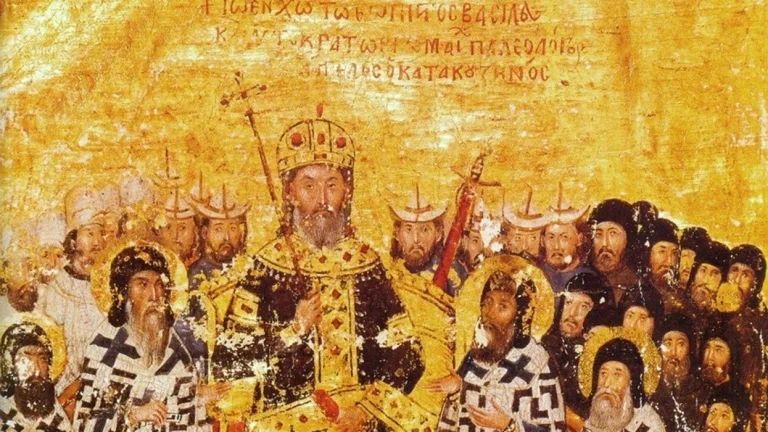
Typical of many of the brief references to Albanians in Byzantine chronicles is the following text by the Byzantine emperor John VI Kantakouzenos (John VI Kantakouzenos, 1347-1355), whose History covers the years 1320-1356. Here, as in other texts, the Albanian tribes are described as savage and unruly nomads, who lived in mountainous areas during the summer months and migrated to the lowlands in winter.
While the emperor was spending about eight days in Ahrid (Ohrid), the Albanian nomads living in the region of Deabolis (Devoll) appeared before him, as did those from Koloneia (Kolonja) and the area around Ohrid.[2] They paid homage to the emperor and willingly offered him their services. Those who lived farther away, on the borders of the Byzantine Empire, were ordered by letter from the emperor to hurry to Thessaloniki to pay homage, which they did somewhat later.
While the emperor was staying in Thessaly,[3] the unruly Albanians living in the mountains of Thessaly appeared before him. According to their tribal leaders, they were called Malakasians, Bujans, and Mesariotes, and numbered 12 thousand. They paid homage to the emperor and promised to serve him, as they feared they would be exterminated by the Byzantines at the onset of winter, since they lived not in cities but in the mountains and in inaccessible areas. Since they had to abandon these regions in winter because of the cold and snow, which falls in extraordinary quantities in these areas, they believed they would easily fall prey to them.
A short time later, the governors of the western parts of the empire reported that the Albanian nomads from Balagrada (Berat) and Kanina,[4] who were quick to take up arms and restless by nature, had broken their treaties with the emperor, savagely attacking and plundering the cities there. They had dared to do the same before, when a large number of people banded together and plundered the cities, until the emperor sent an army against them, forcing them to calm down and cease wronging the inhabitants of the cities in the West.
But when summer came, as soon as the emperor’s army dispersed and the soldiers returned to their homes, they could no longer be kept under control and began to devastate the cities with plundering and open attacks. Now many of them banded together and wrought great destruction in Berat, Kanina, Kleisoura (Këlcyrë), and a fortress called Skreparion (Skrapar). After repeated attacks, they also captured Timoros (Tomori), a fortress in the west of the country not far from Berat, and fortified themselves in it. For these reasons, the emperor decided to undertake a campaign against them.[5]
Since Duke John,[6] the ruler of Acarnania, had already died by then, the emperor hastened to reach the West, hoping to bring Acarnania under his control. While making preparations, he thought it would be a good idea to bring an auxiliary force of Turkish infantry from Ionia to suppress the Albanians. Since the latter lived in high, inaccessible mountainous areas, with many hidden paths and shelters, they could not be defeated by cavalry, especially as in summer they climbed to the mountain peaks where, because of the natural terrain, even infantry had difficulty, as the defenders could shoot down from above. Therefore, he sent an envoy to Umur[7] and requested an auxiliary force of infantry. Umur gladly welcomed the emperor’s representatives, considering it an honor to do something for him, and immediately sent the troops to Thessaloniki.
A little later, the emperor himself arrived there with his Byzantine forces, took the Turkish allies with him, and marched through Thessaly against the Albanians. Devastating their lands, he advanced as far as Epidamnos (Durrës), and many Albanians were killed. When they heard of the emperor’s advance, assuming his army consisted only of Byzantine cavalry, they withdrew into the mountains and their inaccessible areas, believing they would thereby escape extermination. However, they were attacked by the Turkish light troops and archers, who performed admirably in difficult terrain, and were easily defeated, not only because they were unarmed, but also because they were panicked by the barbarians’ sudden attack.
Many Albanians were killed or taken prisoner. Those who managed to escape left behind their wives, children, and possessions and took refuge in remote areas. The Turks enslaved their women and children, although other members of their tribes, who maintained good relations with the emperor, managed to rescue some of them by ransoming them from the Turks. The emperor himself also allowed many of them to be ransomed, when their relatives came to him and pleaded for their release. Indeed, he would have allowed even more to be ransomed, perhaps all of them, had their relatives come in time, while the Turks were still under his command. But since the petitioners arrived after the Turks had left, he was able to rescue only some of the captives. Most of them were sent to the East as slaves.
The Byzantines themselves do not enslave people. They are not permitted to do so, unless they are barbarians who refuse to believe in the salvation of Christ, our Savior. Nevertheless, they took possession of innumerable herds of livestock, not to mention many household goods and other items. It was even said, and the reports were later confirmed, after those affected by the calamity appealed to the emperor and presented their losses, that the Byzantine forces had seized three hundred thousand head of cattle, five thousand horses, and one million two hundred thousand sheep.
The soldiers, of course, were unable to take so many animals with them, so they simply drove the owners away and left the animals without herdsmen, to fend for themselves. The inhabitants of the cities that had previously been plundered by the Albanians came out and took possession of as many animals as they wanted, with no one stopping them. The former owners too, having promised submission and loyalty to the emperor, were allowed to reclaim many of the animals they found roaming freely in gorges and valleys. They also bought many animals from the soldiers, who asked for one gold coin for every five hundred sheep or every hundred head of cattle.
Although it had formerly been customary among the troops to set aside one fifth of the spoils, whether large or small, as tribute for the emperor, and an equal share for the Great Domestic (Domestikos), who was the commander-in-chief of the entire army, almost no one observed this custom and no one compelled the soldiers to divide up one fifth of their gains. They were allowed to take as much of the spoils as they wanted, as though they flowed freely in unlimited quantities.
Such were the acts of violence previously committed by the Albanians against the inhabitants of the West, and such was the punishment for their injustices. The cities that had previously suffered at their hands benefited doubly, to their great joy. On the one hand, they were freed from Albanian attacks and, on the other, had the opportunity to benefit from the emperor’s presence and protective care. For this reason, they were even happier and celebrated as never before. From the time of Emperor Manuel Komnenos[8] until that of Emperor Andronikos Palaiologos,[9] no other Byzantine emperor had ever visited them or shown them such care. While he was there, they regarded the emperor as a supernatural being.
After the Albanians were defeated, the emperor sent his Turkish allies home. They passed through Thessaly and Boiotia to Thessaloniki, and from there sailed back to Ionia.
Related
History
What Lincoln and the technological revolution he led can teach us today
History
Exhibition “Luigj Gurakuqi in the Documents of the Central State Archive” Opens, Honoring His Contribution to Albanian National History
History
1941: When leaders of the Sanjak regions sought protection from Tirana
History
Was King Arthur, after all, real?
History
The 1973 oil crisis forced Nixon to rethink time
History
The Life and Work of Murat Bey Toptani
History
The Forgotten Photograph That Rewrites the History of the Second World War
History
The Pastor Who Saw Hiroshima Burning
History
An American physicist’s account of the atomic bombing of Nagasaki
History
Albania Judged by an English Lady
History
Albania as Judged by an Englishwoman
History
Why and who killed Hasan Riza Pasha?





