
On 9 August 1945, a plutonium bomb was dropped on the Japanese city of Nagasaki, bringing the Second World War to an end. In an interview with the BBC 30 years later, the American physicist who helped assemble the bomb explained why the explosion could not be stopped – and spoke about plans for more … […]
An American physicist’s account of the atomic bombing of Nagasaki
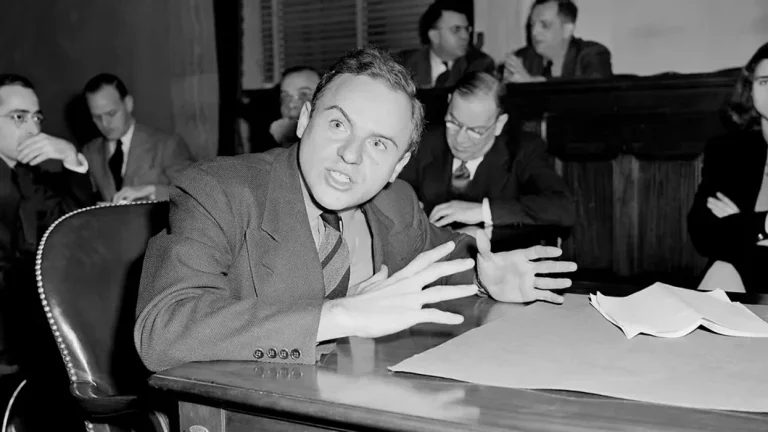
On 9 August 1945, a plutonium bomb was dropped on the Japanese city of Nagasaki, bringing the Second World War to an end. In an interview with the BBC 30 years later, the American physicist who helped assemble the bomb explained why the explosion could not be stopped – and spoke about plans for more …
By: Fiona Macdonald / BBC (title: ‘I didn’t think of stopping at any time’: A US physicist’s inside account of Nagasaki’s atomic bombing in WW2)
“It wasn’t because of a lack of concern for humanity – it was because of concern for humanity. Perhaps that was the sin.”
Thirty years after taking part in the atomic bombing of Nagasaki on 9 August 1945, American physicist Philip Morrison spoke openly to the BBC about the decisions made in the days and weeks before the unprecedented nuclear explosion.
Morrison played a key role in the Manhattan Project, the Allies’ highly secret programme to develop the first nuclear weapons, working at the Los Alamos laboratory. The laboratory was run by his former professor, J. Robert Oppenheimer. Present at the Trinity test of the first atomic bomb – on 16 July 1945 – Morrison held its plutonium core in his lap during the car journey to New Mexico. He then travelled to the small island of Tinian, just south of Saipan, to help assemble the plutonium “Fat Man” bomb – used at Nagasaki – overseeing its loading onto a B-29 aircraft on 9 August, just three days after the bombing of Hiroshima.
It was on Tinian that American forces built what Morrison described as “the largest airport in the world.” “A great coral ridge was cut down by half to fill a broken plain and build six runways … each nearly two miles [3.9 kilometres] long,” he said in his testimony before a Senate committee in December 1945.
The scale of destruction
In his testimony, Morrison also revealed the extent of preparations for firebombing Japanese cities. “In the harbour, tankers loaded with thousands of tons of aviation gasoline were there every day … Along the great runways the giant airplanes moved … Once every 15 seconds, another B-29 took off. For an hour and a half this went on … A thousand B-29s, time and again, burned many square miles of a city – in a single raid.”
By contrast, he said: “The atomic bomb was something else.”
“There were no shiploads of incendiaries. Instead of all the ordnance specialists and their bomb depots, there were about 25 people from Los Alamos, a few Quonset huts [prefabricated corrugated-steel structures] converted into testing laboratories, and a barricaded building. The attack began after midnight. The field was deserted … And an airplane roared down the runway, took off, and headed for the enemy cities,” he said.
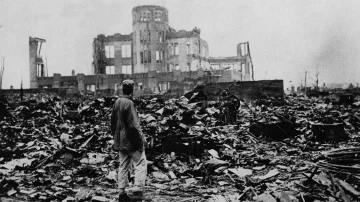
Although estimates vary, 40,000 people are thought to have been killed by the initial explosion in Nagasaki, while more than 100,000 deaths – over the next five years – are directly attributed to the bombing. In Hiroshima, at least 80,000 people died immediately, while the total death toll rose to around 140,000 due to severe burns, injuries and acute radiation sickness.
Morrison later inspected the catastrophic destruction in the two Japanese cities – as part of the official scientific damage-assessment team – and recalled one moment in Hiroshima in particular. “A Japanese official stood among the ruins and told us: ‘All this from one bomb; it is unbearable,’” he said. “One airplane, with one bomb, had destroyed many square miles of a city, and had destroyed even more, with even less chance of resistance or rescue than the attack by a thousand airplanes.”
However, he had hoped that the atomic bomb would not have to be used in combat, and had led a group of young Los Alamos physicists who advocated a public demonstration of the bomb before any use of it in Japan. Morrison – who was 30 when he supervised the assembly of “Fat Man” on Tinian – wanted to “invite an international delegation to the desert,” he told the BBC’s Melvyn Bragg in 1975. “But in the circumstances of war, that was an impossible wish.”
“Irresistible momentum”
The physicist described a sense of irresistible momentum, even when it became clear that the Nazis would be defeated. Nevertheless, he explained: “The war was still going on. We were heading towards an extraordinary battle in the Pacific … so it would have been impossible to stop.”
The only factor that could have changed this, Morrison believed, was US President Franklin D. Roosevelt, who died in April 1945. “The only chance to change the American attitude significantly, I would say, would have been Roosevelt’s survival … [he] died in the middle of the development process, before we knew the bomb would work, before it had been decided how the bombs would be used,” Morrison said.
“He was the only person, I think, who had both enough prestige and enough power within the government to turn back this terrible momentum,” he said.
When Harry S. Truman became president, he was not even aware of the project and learned about it only in the hours after taking the oath of office. A little more than three months later, he would order the bombings.
“It is true that he made the decision, but I think it is fair to say that the decision made him,” Morrison maintained. “It would have been a truly courageous step on his part to change what was being done and stop it after all those years … that possibility essentially disappeared with Roosevelt’s death.”
According to Morrison, the same irresistible force was at work in the decision to drop two bombs – one after the other. “They were not considered the first bomb and the second bomb. The orders issued to the commanders were: ‘Drop the first bomb and then drop the second bomb as soon as you can.’ It would have taken a strong man in Washington to see the enormous effects of the first bomb … and say: ‘All right, let’s wait a little with the second bomb.’ It would have required consideration at the highest levels, the ability to intervene in the complicated links of the chain and convey the right orders to the right generals,” he said.
So both bombings went ahead – and more were planned, Morrison revealed. “The initial decision was that we would continue for a year dropping these bombs, if necessary … I was told to draw up a plan for this,” he told Bragg. “I had a plan, a scheme and a schedule, a man to replace me and the necessary arrangements for going and coming back.”
It is uncertain whether he would have been able to keep doing this, since he and the other Los Alamos scientists had seen the consequences. “Intellectually, we knew very well both the short-term effects and … the long-term effects we feared it could have. But we knew this only from reading a book and looking at figures,” he told Bragg. “And the difference between the figures … and seeing the reality of life, the reality of death, is a very great difference for anyone, for the whole world. So I think we knew, but we didn’t feel it.”
He recalled the reaction at the Pacific island base on the night of the Hiroshima bombing. “There was a big party that night, but most of the scientists didn’t go. The Air Force people, the soldiers, were drinking. They knew the war was coming to an end. It seemed, it felt, like a great victory.” Nevertheless, Morrison recalled, the scientists “sat together, somber, and thought … about the end of the world.”
But in the period before the bombings, Morrison did not feel that he should withdraw from the Manhattan Project. “Despite a firm and persistent opposition to this, I don’t see how I could have acted differently. At no time did I think of stopping.”
When asked whether the Allies would have dropped the atomic bomb on Berlin if it had been ready before the Nazis were defeated, he said: “Oh, absolutely, immediately … We feared the Germans above all, and they were our enemy,” Morrison said.
After the war, Morrison became a professor at the Massachusetts Institute of Technology [MIT], campaigning against the proliferation of nuclear weapons and at the forefront of the “no third bomb” movement. “It goes without saying that, like most of the scientists on the project, I am fully convinced that another war cannot be allowed,” he said in his Senate testimony in 1945.
And he believed the Allies should have done one thing in particular. “I firmly believe that an adequate warning should have been given,” he said. “Looking back, there is no justification for the fact that a proper and appropriate warning was not given.” /Telegrafi/
Related
History
What Lincoln and the technological revolution he led can teach us today
History
Exhibition “Luigj Gurakuqi in the Documents of the Central State Archive” Opens, Honoring His Contribution to Albanian National History
History
1941: When leaders of the Sanjak regions sought protection from Tirana
History
Was King Arthur, after all, real?
History
The 1973 oil crisis forced Nixon to rethink time
History
The Life and Work of Murat Bey Toptani
History
The Forgotten Photograph That Rewrites the History of the Second World War
History
The Pastor Who Saw Hiroshima Burning
History
Albania Judged by an English Lady
History
John Kantakouzenos’ Campaigns Against the Albanians
History
Albania as Judged by an Englishwoman
History
Why and who killed Hasan Riza Pasha?





