
Miss Edith Durham is an Englishwoman who speaks more than five languages and has seen many countries. She has travelled six times in the Balkans. On her last journey, she travelled from Monastir to Shkodra, passing through Korça, Kolonja, Leskovik, Përmet, Tepelena, Vlora, Berat, Elbasan, Durrës, Kruja, Orosh, not to mention the smaller districts. She spoke with many […]
Albania as Judged by an Englishwoman
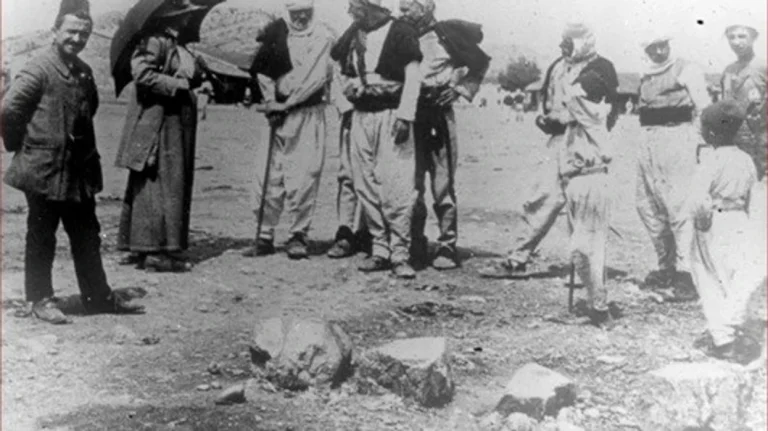
Miss Edith Durham is an Englishwoman who speaks more than five languages and has seen many countries. She has travelled six times in the Balkans. On her last journey, she travelled from Monastir to Shkodra, passing through Korça, Kolonja, Leskovik, Përmet, Tepelena, Vlora, Berat, Elbasan, Durrës, Kruja, Orosh, not to mention the smaller districts. She spoke with many people, visited Bektashi tekkes, Orthodox monks’ monasteries, and Catholic priests’ parishes. And what she saw, what she observed, understood and thought, she tells us in a 330-page book that has just appeared in London.
Miss Edith Durham travelled for pleasure, not for work. But on her journey she encountered some Englishmen sent by a committee in London, the “Balkan Committee,” to distribute aid among the Bulgarians who had suffered in the recent disturbances. Those Englishmen asked the lady to join them in distributing the Balkan Committee’s money, and so Miss Edith Durham undertook to travel through the villages in the districts of Resen.
From what she saw in “Macedonia,” Miss Edith Durham did not form a high opinion of the “Macedonians.” She is far too perceptive to believe the lies and fabrications of newspapers. She saw the Bulgarians, not as they wish to appear, but as they are—and they are as bad as can be.
Miss Durham says: “I was unfortunate in the ‘patriots’ I met among the Bulgarians. They quite convinced me that if I were the lady of Ohrid, the people I would have given the city to are the Bulgarians” (146).
Further on (p.164), she gives us a fine picture of a Bulgarian “patriot.” One night, this man approached Miss Durham and told her his troubles: He was a fervent patriot, and the Committee had given him the task of killing three people in a village. Unfortunately, guns make a terrible noise, and poison cannot be found since the government banned its sale; but, said the shrewd patriot, “Madam” (meaning the Englishwoman) was friends with the doctor and could obtain the necessary poison through him. Needless to say, Miss Durham immediately sent this extraordinary patriot packing.
Another time, a Bulgarian “patriot” boasted to Miss Durham, with great arrogance, that he was the one who had poisoned the water drunk by some soldiers in a village … And the most laughable thing was that when Miss Durham told him she did not think this was a good thing or approve of it, the poor man was astonished.
The Bulgarians have strange ideas about civilization. They believe that civilization will make them “no longer have to pay taxes.” And, Miss Durham says with subtle irony, when I told them that we pay taxes in England too, they were all astonished.
The poor “Macedonians” are not to blame; until now, no one has taken care to enlighten them. Their ignorance is appalling.
In one village, Miss Durham says, she could not get the villagers to understand that some English or Italian gentlemen would come to tour the country and see whether the Turkish government was doing anything bad. The poor villagers had heard of no other foreigners except the Muscovites. Then the dragoman told them that those who were coming were “kaur gentlemen—that is, infidels,” and at last they understood that the gentlemen would not be Turks and were delighted. “The villager,” adds the English authoress, “knows only one thing: that his life is ruined under the present state of affairs. Oppressed by the Government and terrified by the Committee, he raises his head, and will keep raising it as long as anything of him remains” (p.166).
It would take an entire issue of Albania to summarize, in even a few words, Miss Durham’s observations on the Bulgarians’ obtuseness. In one place, she told some Bulgarians who were helping her not to put a cushion on the horse’s saddle. This instruction—which, the authoress says, an Albanian or a Montenegrin would have understood the first time—she repeated to the Bulgarians for twenty days, and yet the next morning the horse was still being led with the cushion! These things may seem small, but they are very significant, because by observing such things one can understand whether one is dealing with a perceptive or a dull-witted people.
Whenever she sees an intelligent person in these regions, Miss Durham says, they will be either Albanian, Greek or Vlach. The Bulgarians of these regions seemed like specimens from the lowest strata of the human race.
As for the “Christianity” of the “Macedonians,” the English authoress gives us a telling picture of their Christianity: She puts before our eyes the face of the bishop of Ohrid, who, along with many vulgar and tasteless words, dared to threaten Miss Durham with the fate of Miss Stone, saying that he, a thieving bishop, could get Bulgarians to kidnap the Englishwoman and hold her captive for ransom.
Unfortunately for the thieving bishop, he found someone who could answer him; and besides giving him the necessary reply, Miss Durham, through her book, will also show the world what kind of “Christians” the “Macedonians” are. As she rightly says: The West wastes its time and concern on such people!
As you know, foreign newspapers spend their time writing about the “merciless massacres” (English “atrocity,” French “massacre”) that supposedly take place in “Macedonia.” This is how Miss Durham judges those crimes: “When a Muslim,” she says, “kills a Muslim, it is of no importance; when a Christian kills a Muslim, it is a just act; when a Christian kills a Christian, it is a mistake best left unmentioned; only when a Muslim kills a Christian do we arrive at a merciless massacre” (p.81).
But elsewhere Miss Durham says that one thing is certain: in many regions, if the Muslims had wished, they could easily have wiped out all the Christians.
Let us leave the Bulgarians now and go with the authoress through Albania.
Miss Durham made this journey with an Albanian whose business compelled him to travel throughout Albania. The first city where they stopped was Korça, which the English lady praises as a “civilized” city and “the most peaceful of all the cities of European Turkey.” Of the Albanian girls’ school, where she was received with great honour, she says that “it is such a modern school that she felt as though she had suddenly been transported back to Europe. The houses of Korça that I saw were all Albanian houses; and very good houses, beautifully built and comfortable—each of whose owners asked me to teach England that there are better people than the Bulgarians to liberate” (p.213).
A few words about Kolonja, which has earned a reputation as “a den of thieves,” but where “I was received very well”—and then Leskovik, which, a small village in the district of Konitsa twenty years ago, has now become a kaymakam’s administrative centre and a centre of patriotism. Miss Durham praises Leskovik as a peaceful place, with good stone houses that make it resemble some small English towns.
From Leskovik, Miss Durham and her travelling companion went to Postenan, where they stayed for a few days. Postenan is a village between Leskovik and Përmet. Here the authoress gives us a fine picture of rural life in Toskëria, and praises the “kingly courtesy” of the Albanians of Postenan.
In Përmet, the kaymakam—a vile, uncouth fellow—spoke to Miss Durham about Albanian affairs. “Here in Përmet,” said the uncouth fellow, “the locals are all Greeks.” “But they speak Albanian, don’t they?” Miss Durham replied. “Unfortunately!” said the kaymakam. “They must have learned Albanian somewhere. There are also many who believe they are Albanians. How dreadful! But in time, with Greek schools, things will be put right.” In Përmet, an Albanian gentleman took Miss Durham to a Bektashi tekke, and the English lady’s meeting with the Baba, their exchange of words, and her tour of the tekke are among the most beautiful and noteworthy pages in the book.
As they set off for Tepelena, a terrible downpour began, forcing the travellers to spend the night at Dragut’s inn. Thus Miss Durham had the good fortune to discover what an inn in Toskëria is like—“good fortune,” I say, because a traveller who seeks to see and observe a place like Albania properly should also understand what inns are, for they play a major part in the everyday life of our country. The next day, when the innkeeper demanded payment, he had the audacity to ask no less than … one mejidi for the “room” alone, which had neither floor mats nor a bed: but innkeepers are the boldest people in Toskëria, and what traveller can boast of not having been fleeced by innkeepers?
Miss Durham devoted several pages of her book to Tepelena. She describes the ruins and poverty that have befallen this place, which once enjoyed such splendour. The locals told her that for many years not a single foreigner had passed through. They believed even more: Lord Byron had gone to Tepelena in 1809, and since then—for over a hundred years—not a soul from England had set foot there, except Miss Durham.
The limited space in our periodical compels us to be brief. We shall therefore not dwell long either on Vlora, which Miss Durham visited from Tepelena, or on Berat, which she visited from Vlora. Everywhere, Turkish officials who were deceitful, hypocritical, vile, spies; everywhere, such words from government men: “there are no Albanians here, only Greeks and Turks”; “the roads will be built next year”; “next year we will have many schools here”—“what sort of schools, other than Albanian schools, is understood,” adds the English authoress. Vlora seems to Miss Durham a place that will prosper once trade and communications are free and easy. She writes much about Berat, praising the beauty of its bazaar and the city’s antiquity.
On the journey from Vlora to Berat, after passing through the village called Lart, Miss Durham arrived at the monastery of Pojan. It was Easter Sunday, and the monastery courtyard was full of Albanian villagers, “handsome men dressed in fustanellas dazzlingly white,” and beautiful peasant women. The monastery’s abbot, “a tall, proud Albanian, a kind of church pasha,” welcomed the authoress warmly, and she stayed there one night. After lunch, she began to paint the monastery’s old church, when a villager who knew a little Italian approached and said: “Signorina, we are uneducated Albanians from the village. We would like to see what you are doing, because we have never seen such a thing before. But if it troubles you, we will leave at once” (p.263). “In all civilized lands,” Miss Durham adds, “an artist is welcomed; but rarely have I seen a welcome paid with such respect, and I could only say good evening to them. When I asked whether they had any ‘antiques’ to sell, they were delighted, and as soon as the afternoon service in the church was over, they invited me to return to their village with them” (p.263).
Let us stop here for now. In a future issue, you will find Miss Durham in Elbasan.
The police of Berat had received a dispatch stating that “two persons with subversive intentions” were on their way to Elbasan. And so, when Miss Durham arrived in Albania’s capital, the policemen were ready as soon as she dismounted from her horse. But, says the authoress, “Gegëria is governed in a very different manner from Toskëria. The two policemen who came to meet me behaved very courteously” (p.277). They said that Miss Durham and her travelling companion were very tired, and therefore they would ask them the next day what they had to ask.
The mutasarrif recently sent to Elbasan is an Albanian. Miss Durham spoke with him and praises him as a sensible and good man. “Other nations are old,” said the mutasarrif; “my poor Albania is only an infant among them. It has much to learn” (278).
But let us leave the mutasarrif and see what impression the locals made on Miss Durham. “Elbasan’s thirst for learning is very pathetic. You may find people bravely struggling, without help, with French or even German grammars. When one remembers that not a single book can enter Turkey except secretly … and that before these people (the Albanians) can study a book, they must learn a foreign language, the number of well-educated and well-raised local people is astonishing” (p.281).
Everywhere else in Albania, Miss Durham was told that “the roads will be built next year.” But, the authoress writes, Elbasan does not merely talk. It is the only place where no one told me that the roads would be built next year. The road to Ohrid is already under construction, and with such energy that I wondered whether it would be sustained to the end. Elbasan wants roads to Durrës and Berat as well, and hopes to increase the country’s trade. It already has a soap factory making very good soap that is sold in the districts … Elbasan dreams of a great future, and its location would make it remarkably well suited to be the country’s capital” (p.282).
One of the finest passages in the book is the account of a short excursion to Shpat. The conversation with an old man from Shpat is noteworthy, and only the limits of our space prevent us from translating it. Perhaps one day we will find room for it and print it in Albania.
In Peqin, a small town or large village between Elbasan and Durrës, Miss Durham made the mistake of saying that “the town is small,” to which the innkeeper replied slyly: “A small lira is small too, but it is good.” What can you do with innkeepers! …
At the inn in Durrës, Miss Durham observed something that shows that “Albanians are fond of animals. I never saw even the roughest Albanians torment an animal for amusement, something that often happens in southern Italy.” — “The inn, like some old English inn, is built all around a courtyard, with several large balconies, on one of which lived a large pet billy-goat called Napoleon, with long horns and a thick Roman nose, whom the servants would often stop and kiss as they passed. When he wanted to drink, he would bleat loudly, and then someone would lead him down into the courtyard to drink from the horses’ trough” (p.299).
Tirana, with “a very charming bazaar,” peaceful, with houses surrounded by beautiful gardens, pleased Miss Durham in a particular way. She praises the schoolmistress, who is “distinguished and intelligent, like all the Albanian schoolmistresses I have met” (p.302).
“Kruja,” says Miss Durham, “was very friendly. The police and everyone else were Albanians, and they were delighted to see me … Kruja is the only place that did not ask me for my passport to stamp it. Friends are not asked for passports. The policeman was sorry when I offered to show mine.” When Miss Durham passed through, St George’s Day was approaching, and the people of Kruja asked the English lady to stay for that feast, the greatest celebration of the place. “But,” asked Miss Durham, “I thought you were all Muslims here.” “So we are,” the people of Kruja said, “but of course we don’t let St George’s Day go unobserved” (pp.305–6).
The English traveller passed through Lezhë, Shëngjin and Shkodra without anything noteworthy happening. And finally, with a letter from the princess of Mirdita recommending the traveller to the Abbot—there are the mountains of Mirdita!
At the village of Kallmet, the first where Miss Durham stopped in Mirdita, “we all arrived at a pretty little house on the top of a hill, with a large wooden cross on one side and a small old priest at the door—a pleasant old man who spoke just enough Italian to make himself understood … He invited me to sit on the divan and take off my shoes, and asked me to put on his, as they were warm, and wanted me to take off my metal belt. In these regions, where everyone carries a heavy belt full of cartridges and weapons, the first thing one does on entering a friend’s house is to be relieved of that burden. But my silah was made in such a way that it could not be removed. The poor old gentleman believed—and that belief hurt my heart—that my refusal to take off my silah was because it was full of money and I did not trust him, and he was so distressed that, as a token of trust, I was compelled to remove it. I, on the contrary, have enough trust to leave everything I own, not only in the hands of a worthy old priest, but of any Montenegrin or Albanian highlander, if he lives far enough away in the wilderness not to have been corrupted by civilization and if he has welcomed me kindly” (p.320) …
“The good old man assured me that he welcomed me as he would have welcomed the King of England if he had stopped on his way to Orosh … He expressed great admiration for Queen Victoria, mentioned that the Mirdites had fought alongside the English in the Crimean War, and was passionately and fiercely opposed to the Russians. Of all things, he most wanted to hear about the Japanese. A little nun came to lay the table, and, in a most curious coincidence, two of the European plates happened to have Japanese faces painted on them. He did not know this, and was greatly pleased” (p.320). When Albania came up, “Ah, la povera Albania!” cried the priest, “è morta, ma,” he added, smiling to himself, “non ancora sepolta.” (Ah, poor Albania! She is dead, but … not yet buried) … “We had a very cheerful dinner, with roast lamb, macaroni and cheese, very well cooked by the little nun, who shared her clean room with me for the night. The next day, the good old man took me to show me his garden, full of roses” (p.321).
Here Miss Durham rightly observes how difficult it is to maintain a school in such villages. For in these mountains, do not imagine, you people of Toskëria, that a “village” is a group of houses situated close together, as in Toskëria: here the houses are so far apart that they can barely be seen. This distance prevents the boys from gathering every day to learn. Despite this, near the parish or the house where the priest of Kallmet lives, they have established a new school, a schoolteacher has arrived, and eight or nine bright boys are learning.
“Orosh,” says Miss Durham, “is astonishing. It is situated among a people who are perhaps the least known and most isolated in Europe, and there stands one of the most civilized houses in all Albania, the home of a man who is one of the finest personalities of the Near East, Monsignor Abbot of the Mirdites, who, generous in spirit and hand, cultivated and learned, has devoted himself to the service of his fierce brothers and lives in the wilderness, cut off from the outside world … The Abbot is his own engineer and architect” (p.324). He himself drew the plans for his house, the school and the church, a beautiful church in its whiteness—which reminds me of some village churches in the Alps of France, some churches perched on mountain cliffs. Monsignor Abbot has travelled widely; in his youth he had been involved in the national movement of 1879 and had been forced into exile. He lived in Newfoundland and British India, where he learned Shakespeare’s language well. It is true that Monsignor Abbot is known, at least by reputation, to all Albanians, and perhaps these things we are repeating here, from Miss Durham’s book, are superfluous. Nor shall we recount his efforts to put an end to those terrible blood feuds that are one of Albania’s great scourges. Miss Durham gives a noteworthy account of the peace-making power that the splendid abbot wields among the Mirdites.
In a few other lines, Miss Durham tells us of her return and her journey to Cetinje. Here the book ends.
There the book ends. A book full of truth and light. Miss Durham is not one of those travellers who speak about Albania without having set foot in our country. She writes what she saw, and what she saw, she saw well.
Her opinions are noteworthy. For example, the governments are pressuring the Sultan to provide assistance for those Bulgarians who fled to Bulgaria during the disturbances to return. Miss Edith Durham points out the folly of this policy; she rightly says that Albanians should be given room to breathe: why put back side by side people who separated because they could not live together? The Bulgarians who fled will be happier receiving money in compensation for the land they lost and remaining in Bulgaria. What sense is there in forcibly bringing them back to a place where they do not want to live?
Nor do the lies hold up before the respected authoress. She rightly observes that along the lakes, those who call themselves “Bulgarians” look nothing like ordinary Bulgarians. The latter are so dull, the former so clever: their faces look more Albanian than Bulgarian, and, Miss Durham says, their intermingling with Albanian blood cannot be denied. She relates the noteworthy story of a “Bulgarian patriot” who spoke nothing but Bulgarian when sober, but … when drunk, he would burst into Albanian song. In other words, this man was as Bulgarian as actors playing Hindus, Arabs, and so on, according to the role.
“As for Greece, its name is heard only with harsh curses throughout the many regions of Albania I visited. The Albanians want autonomy and Austria. Toskëria, having suffered more from the Turkish government than Gegëria, seems more ready to welcome Austria. Gegëria prefers autonomy, but may welcome Austria if it cannot do better” (p.200). In any case, whoever reads Miss Durham’s book will understand that, whatever faults the Albanians may have, they are victims of Turkish treachery. As a foreign consul in Vlora rightly said: “Les Turcs ont assassiné l’Albanie”—“The Turks have slaughtered Albania.”
Related
History
What Lincoln and the technological revolution he led can teach us today
History
Exhibition “Luigj Gurakuqi in the Documents of the Central State Archive” Opens, Honoring His Contribution to Albanian National History
History
1941: When leaders of the Sanjak regions sought protection from Tirana
History
Was King Arthur, after all, real?

History
The 1973 oil crisis forced Nixon to rethink time
History
The Life and Work of Murat Bey Toptani
History
The Forgotten Photograph That Rewrites the History of the Second World War
History
The Pastor Who Saw Hiroshima Burning

History
An American physicist’s account of the atomic bombing of Nagasaki
History
Albania Judged by an English Lady
History
John Kantakouzenos’ Campaigns Against the Albanians
History
Why and who killed Hasan Riza Pasha?





