
In the spring of 1941, the Sanjak found itself at one of the most uncertain moments in its modern history. The Kingdom of Yugoslavia had collapsed, its territories were being divided among the occupying powers, while the local population faced the question of which administration it would live under and who would guarantee its security. Documents […]
1941: When leaders of the Sanjak regions sought protection from Tirana
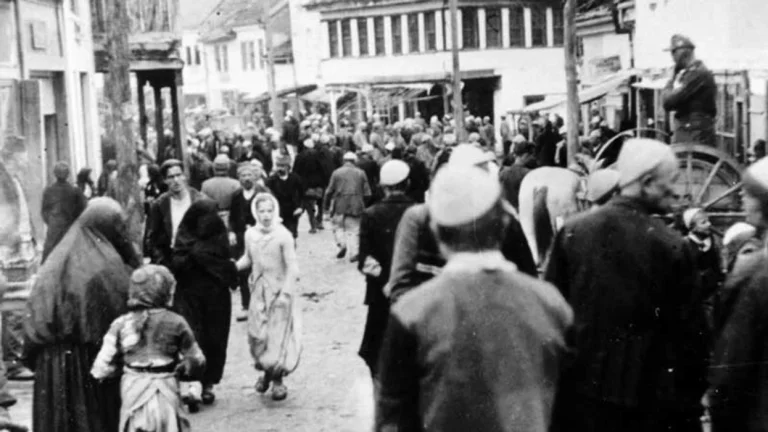
In the spring of 1941, the Sanjak found itself at one of the most uncertain moments in its modern history. The Kingdom of Yugoslavia had collapsed, its territories were being divided among the occupying powers, while the local population faced the question of which administration it would live under and who would guarantee its security.
Documents published by various authors show that, under these circumstances, local leaders from Bihor, Rožaje and other parts of the Sanjak sought solutions in several directions. Some delegations went to Zagreb, others to Tirana. Their demands were not only territorial. They included the protection of the population, weapons, administration, education and assistance for destroyed settlements.
These documents are also of particular interest to a debate that continues in historiography: can all these initiatives be described simply through the formula of “Greater Albania,” or was the political reality of 1941 much more complex?
The delegation from Upper Bihor in Tirana
One particularly interesting account appears in Fehim Xhogoviq’s [Džogović] book, Bijela knjiga žrtava Sandžaka 1941-1945 [The White Book of the Victims of the Sanjak (1941-1945)], volume III, devoted to the municipality of Petnjica.
Referring to Salija Adrović’s monograph, Gornji Bihor [Upper Bihor], Xhogoviqi writes that a delegation from Upper Bihor went to Tirana to seek “protection from the Chetniks and, possibly, the unification of this region with Albania.”
The delegation included Dule Agoviq, Smajo Cikotiq, Hajriz Hadroviq, Shuqo Hadroviq, Hasin Koqan, Meta Kozhar, Rashit Liqina, Mujo Mehoviq, Seno Novaliq, Nushko Ramdedoviq, Huso Skenderoviq, Neko Shabotiq, Hajradin Shkrijel and Salko Shkrijel.
The response the delegates reportedly received is just as interesting. They were told that they would receive assistance, but that they were not the ones who would decide on territorial unification, and that a way to coexist had to be found.
This account is important because it shows that as early as 1941, two issues were intertwined in Upper Bihor: the security of the population and the political status of the territory.
Rožaje and the 27 villages of the Sanjak
An even more direct document can be found in the archival materials published by researcher Gjet Ndoj in the book Qeverisja e Shqipërisë gjatë Luftës II Botërore (1939-1944).
The document is entitled “Albanian claims left under Montenegro” and concerns representatives from Rožaje and the 27 villages of the Sanjak.
On November 4, 1941, their representatives were in Tirana. The list of demands is extraordinarily significant. They sought the unification of their regions with Albania, the dispatch of Albanian civil servants, the opening of Albanian-language schools and the dispatch of 20 teachers. They also requested that their regions be administratively attached to the sub-prefecture of Rožaje.
But the demand that most clearly reveals the security situation was the one for weapons: “We earnestly request that we be given, as soon as possible, 1,500 rifles with sufficient ammunition”!
According to the document, the weapons were requested so that the population would be prepared to defend the territory.
The representatives also requested assistance for people suffering from hunger, lack of shelter, cold and illness, as well as aid to rebuild burned homes.
The document concludes by stating that, in coming to Tirana, the delegates had left their population in difficult conditions and under threat of new attacks.
The source is particularly important because Gjet Ndoj also provides the reference for the original document: Central State Archive, Fund 149, File 1184, pages 24-26, November 4, 1941.
More than one political orientation
Other documents from 1941 show that the Sanjak did not have a single political orientation.
Fehim Xhogoviqi also mentions a five-member delegation that went to Zagreb on May 15, 1941, and submitted a petition for union with Bosnia, claiming to represent ten districts, including Berane, Bijelo Polje, Sjenica, Novi Pazar, Tutin and Rožaje. This is very important. It would be historically inaccurate to say that “the Sanjak sought Albania” or, in the opposite direction, that “the Sanjak sought Bosnia.”
The sources attest to different actors, different orientations and local interests that did not always coincide. That is precisely why the documents should be read before labels from later historiography are applied to them.
From Bihor and Rožaje to Sjenica and Bijelo Polje
In his study Stara Raška pod italijanskom okupacijom 1941-1943 [Old Raška under Italian Occupation, 1941-1943], Serbian historian Milutin Zhivkoviq [Živković] discusses these developments under the framework of “Muslim leaders and ‘Greater Albania’.” However, the documentation he himself presents allows for a more nuanced reading.
At a later stage, Bedri Pejani proposed creating a force of 120,000-150,000 people in Kosovo and extending the borders of the Albanian state to include the entire Mitrovica district, Sjenica, Rožaje and Bijelo Polje. Here, too, a distinction must be made: the document mentions Bijelo Polje, not Bihor as a territorial designation. Nevertheless, the inclusion of Bijelo Polje is significant for the history of Bihor because of the city’s role as an administrative and urban center closely connected to the region.
Security and territory
When these documents are read together, a more complex picture of 1941 emerges.
In Upper Bihor, protection from the Chetniks was sought and the possibility of unification with Albania was considered. In Rožaje and 27 villages of the Sanjak, people sought 1,500 rifles, Albanian-language schools, teachers, administration, humanitarian aid and a change in territorial status. In other parts of the Sanjak, there were orientations toward Bosnia.
Thus, territorial demands cannot be separated from the question that people at the time considered vital: Who would protect the population after the breakup of Yugoslavia? This question takes on particular significance when viewed in light of what would happen just two years later.
In January 1943, Lower Bihor would experience one of the gravest tragedies suffered by the Muslim population of this region during the Second World War. The documents from 1941 show that fear of attacks and the search for a broader system of protection had begun much earlier.
Therefore, the historical connection should not be constructed using the simplistic formula that the Bihor massacre created a political orientation toward Kosovo or Albania. The documents show the opposite: political orientations existed earlier; the experience of violence and insecurity increasingly added a dimension of protection and survival to them.
This is precisely why the documents from 1941 deserve to be reread today. They tell us not only where some of the Sanjak’s actors wanted to belong. They also tell us what they feared and what they sought in order to survive. /Telegrafi
Related
History
What Lincoln and the technological revolution he led can teach us today
History
Exhibition “Luigj Gurakuqi in the Documents of the Central State Archive” Opens, Honoring His Contribution to Albanian National History
History
Was King Arthur, after all, real?
History
The 1973 oil crisis forced Nixon to rethink time
History
The Life and Work of Murat Bey Toptani
History
The Forgotten Photograph That Rewrites the History of the Second World War
History
The Pastor Who Saw Hiroshima Burning
History
An American physicist’s account of the atomic bombing of Nagasaki
History
Albania Judged by an English Lady
History
John Kantakouzenos’ Campaigns Against the Albanians
History
Albania as Judged by an Englishwoman
History
Why and who killed Hasan Riza Pasha?





