
Kiyoshi Tanimoto’s memoirs recall the shocking moment when he saw the atomic bomb being dropped, which he considered “God’s judgment” upon the city. One evening in May 1955, the American public watched the unfolding of an extraordinary moment on television. Kiyoshi Tanimoto, a Christian pastor from Hiroshima who had spent […]
The Pastor Who Saw Hiroshima Burning
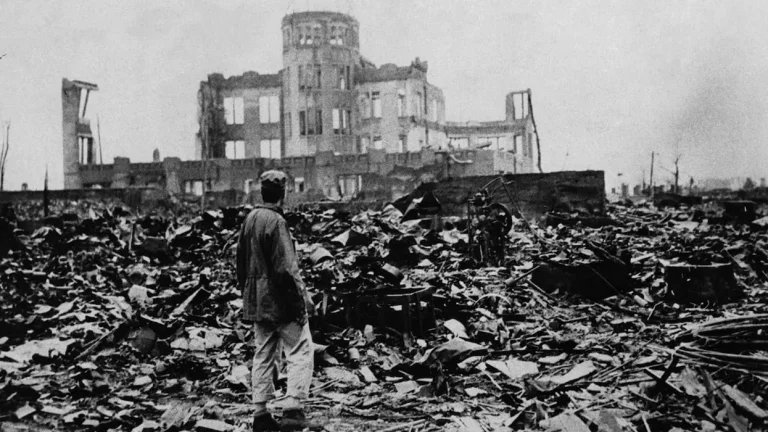
Kiyoshi Tanimoto’s memoirs recall the shocking moment when he saw the atomic bomb being dropped, which he considered “God’s judgment” upon the city.
One evening in May 1955, the American public watched the unfolding of an extraordinary moment on television. Kiyoshi Tanimoto, a Christian pastor from Hiroshima who had spent a decade working among the victims and ruins left by the atomic bomb, became the honored guest on the program This Is Your Life. In a set made up to look like a living room at NBC studios in Los Angeles, Tanimoto – who was in the US to raise funds for Japanese war victims – found himself seated with the show’s host, Ralph Edwards, as prerecorded trumpet fanfares blared and a succession of surprising guests passed through the program’s famous arch.
The first to appear was the Methodist missionary who had introduced Tanimoto to Christianity many years earlier. Then came Tanimoto’s wife and children, who had flown from Japan with hastily arranged passports. Then a man entered who, it was said, had missed the program’s rehearsal and been pulled out of a bar just in time for his appearance. He tried, unsuccessfully, to hold back his tears; his handshake with Tanimoto, whose face remained frozen, was brief. Robert A. Lewis had been the co-pilot [of the plane] Enola Gay.

More than 70 years later, Tanimoto’s daughter, Koko Kondo, recalls this meeting in her foreword to Hiroshima, 8:15 – her father’s long-lost memoirs of the atomic bombing. The book intriguingly offers a sense of the mixture of grief and cynicism that underpinned the restoration of US-Japan relations after the war. It takes readers from the dizzying destruction and suffering inflicted on Japan – witnessed by Tanimoto – to questions about the moral and historical significance of what America did.
Born in 1909 and raised as a Buddhist, Tanimoto converted to Christianity when he was young. He studied at Emory University in the United States, became fluent in English, and grew familiar with American Christian values. After returning to Japan and working as a pastor in Hiroshima, he was about two miles outside the city center when the atomic bomb fell at 8:15 a.m. on August 6, 1945. Tanimoto recalls looking at the horizon and seeing “a sharp flash of light that pierced a pale brown cloud.” As he threw himself to the ground, he felt a powerful blast of wind pass by him. Distance and topography saved his life. The slope of a nearby hill caused the heaviest part of the blast wave to pass over him.
Everyone had expected an American air raid: many Japanese cities had been bombed in recent months, and Hiroshima was an important industrial center. But as Tanimoto began to make his way back toward Hiroshima, it became clear that something was very wrong. Most of the people he spoke to had seen no planes in the sky that morning, or had seen only one. And yet, on the ground it looked as if every part of the city had been hit simultaneously and with devastating intensity.
“Could it be that I had been dreaming before,” Tanimoto wondered, “and had not known about an extraordinary air raid that had struck Hiroshima? I began to doubt myself and even to doubt my senses … The whole city was covered in dark clouds, while huge fires were breaking out in different directions … I was terribly frightened.”
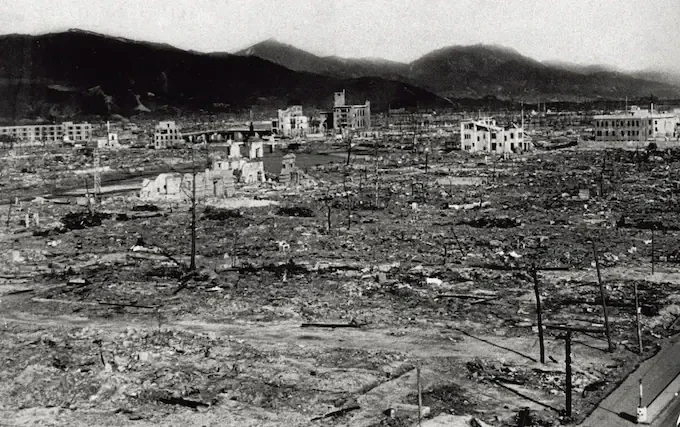
Tanimoto hurried to see what had happened to his family and church. Coming from the opposite direction, he encountered a strange, macabre procession: people barely able to walk, their clothes and hair burned, leaning on sticks or on relatives as they slowly made their way away from everything Tanimoto was about to see. Entire neighborhoods had disappeared. Soldiers were in the streets, pouring gasoline over piles of lifeless bodies and setting them on fire. Those still alive cried out for water, and Tanimoto stopped to do what he could before hurrying on. On the way, he found his wife and infant daughter. Both had survived, although his wife’s clothes were covered in blood and she looked “like a ghost.”
Soon, Hiroshima’s residents realized that the mysterious weapon had not finished its work. It turned the question of survival into one that could not be answered in a moment, but required weeks, months, even years. Countless people who had suffered only minor injuries that day later found their hair falling out, their gums bleeding, their limbs going numb, and red and black spots appearing on their bodies – the signs of what later came to be called “atomic sickness.”
Tanimoto’s memoirs, written two years later, recounted all of this without banal phrases or literary pretensions. Whether this reflects his personality or the fact that he was writing in his second language – English – rather than his first, it only benefits the work. Some moments in history are so shocking, so heartbreaking, that merely describing them is to condemn them.
Related
History
What Lincoln and the technological revolution he led can teach us today
History
Exhibition “Luigj Gurakuqi in the Documents of the Central State Archive” Opens, Honoring His Contribution to Albanian National History
History
1941: When leaders of the Sanjak regions sought protection from Tirana
History
Was King Arthur, after all, real?
History
The 1973 oil crisis forced Nixon to rethink time
History
The Life and Work of Murat Bey Toptani
History
The Forgotten Photograph That Rewrites the History of the Second World War
History
An American physicist’s account of the atomic bombing of Nagasaki
History
Albania Judged by an English Lady
History
John Kantakouzenos’ Campaigns Against the Albanians
History
Albania as Judged by an Englishwoman
History
Why and who killed Hasan Riza Pasha?





