
On August 26, 1944, the day after the liberation of Paris, General Charles de Gaulle walked along the Champs-Élysées amid scenes of emotional uproar. The leader of Free France returned to the capital to restore its authority after four years of Nazi occupation. “There was a constant flurry of press cameras […]
The Forgotten Photograph That Rewrites the History of the Second World War
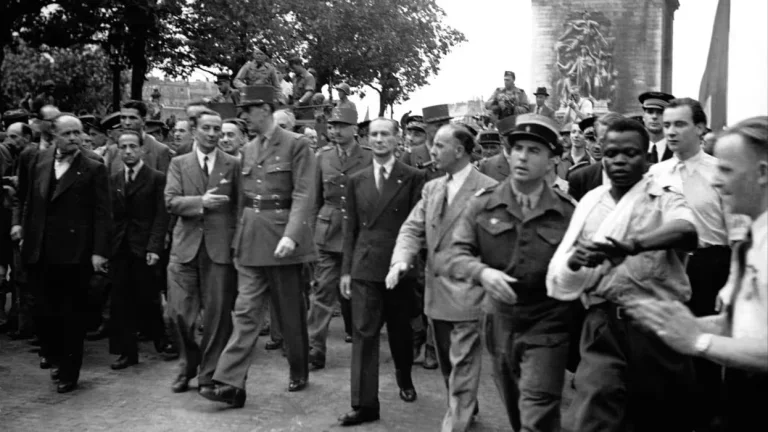
On August 26, 1944, the day after the liberation of Paris, General Charles de Gaulle walked along the Champs-Élysées amid scenes of emotional uproar. The leader of Free France returned to the capital to restore its authority after four years of Nazi occupation.
“There was a constant flurry of press cameras,” writes Matthew Cobb in Eleven Days in August – his account of the liberation, in which he describes “the joyful chaos prevailing behind the massive cordon of policemen and firefighters stationed around the perimeter of the Place de l’Étoile.” The photographs from that day tell an important, if little-known, story. There, amid the revelry, among the celebrating crowds and solemn officials, cameras captured a small Black man walking in the procession a few meters from the General. His name is Georges Dukson.
De Gaulle’s march through Paris, with Dukson nearby
If you aren’t looking for him, you might not notice him amid the human skyline of hats and thinning-haired heads of French servicemen. But once you see this lone Black man, with his baggy trousers, white shirt and bandaged arm, you can’t take your eyes off him.
“Life,” wrote Susan Sontag in On Photography, “is not about significant details, lit by a flash, fixed forever. Photographs are.” The significance of Dukson’s presence on that day is not immediately apparent. At times he seems to disrupt the scene of de Gaulle at the moment of the nation’s glory. As de Gaulle lays a wreath beneath the Arc de Triomphe, there is Dukson a few meters behind him, while a French official fixes his gaze on him. As de Gaulle descends the main street of Paris, there is the smaller, steadier frame of Dukson behind his shoulders. There again he is pushed away from the General, by a man who looks like a police officer. Dukson appears to protest – protecting his injured hand and raising his healthy arm – even as he continues to walk. In one photo, de Gaulle is clearly aware of the scuffle, directing his gaze toward the commotion.
So why does this detail matter, from a historic moment that took place 80 years ago this month? To answer that question, we must go back one day, to August 25, when Paris was officially liberated after the German surrender. In the months before the big day, de Gaulle was deeply concerned about public opinion regarding the liberation and France’s presumed role in it. A proud patriot in the role of a supplicant, the exiled leader knew the Americans and British would provide most of the troops and firepower needed to drive the Germans out of France. But he wanted French soldiers to be among the first to enter the capital.
The Americans agreed. But, being no less concerned about public opinion than de Gaulle, they had one condition: the French troops in question had to be white. The United States was comfortable shedding blood and spending its treasure for Free France and, later, choreographing that freedom in a way that gave the French considerable credit for it. What they could not tolerate was the sight of one of Europe’s most symbolic cities being rescued by Black soldiers.
For the details, in December 1943 de Gaulle met in Algiers with the Supreme Allied Commander, General Dwight Eisenhower. A few weeks later, a confidential sealed message from Eisenhower’s chief of staff, giving the details, stated: “It is most desirable that the above-mentioned division consist of white personnel … This means the 2nd Armored Division, which, with only a quarter of its personnel native-born, is the only available operational French division that can be one hundred percent white.”
The British agreed. General Frederick Morgan wrote to the Supreme Allied Command: “It is unfortunate that the only French formation which is 100 percent white is an armored division in Morocco. Every other French division is only about 40 percent white. I have told Colonel de Chevene [sic] that his chances of getting what he wants would be greatly improved if he could create a white infantry division.” De Gaulle accepted. He was unable to object, and there is no suggestion that he even tried.
Thus it happened that on August 25, many of those who had fought for the liberation of Europe were denied the right to take part in it. At the eleventh hour, it became clear that the freedom they were fighting for did not apply to them. They call it blanchiment, or “whitening.” Dukson did not get the message. That is what makes his appearance the next day, in the victory parade, so significant.
Georges Dukson was a lover, a fighter, a chancer, an adventurer, a braggart, an extrovert and something of a scoundrel. He was born in the western coastal town of Port-Gentil in Gabon, then part of French Equatorial Africa – which also included present-day Chad, the Central African Republic and the Republic of the Congo.
His father had fought for the French during the First World War and, as a teenager, Dukson enlisted immediately for the second. After six months of basic training in Gabon’s capital, Libreville, he was sent to France as a sergeant. He was captured by the Germans in June 1940 and spent the next two years as a prisoner of war. After several attempts, he finally managed to escape in 1943 – along with a fellow prisoner, a wealthy industrialist who hired Dukson as a driver and to run some errands once they reached Paris.
What we know about Dukson comes from a book by Parisian journalist René Dunan, entitled Ceux de Paris, Août 1944: an account by a witness to the liberation of Paris, somewhere between a war diary and a rough first draft of history. Dunan, a gifted storyteller, describes Dukson as “all kinds of brave” and “persistent,” someone who “risked everything to succeed.”
“I don’t know why,” Dunan wrote, “but from the beginning I enjoyed the company of this young man of color from Gabon … We drank together, I saw him again on other evenings after the liberation, and so, little by little, I pieced this account together from him. It is an account that is at once magnificent and mournful.”
Dunan tells his story well, even if his narrative is undermined by the kind of asides that reveal the racist attitudes of the time. He introduces Dukson as if he were an exotic exhibit: “His skin was so black that it reflected the light. Sometimes it was so smooth you could see yourself in it. When he first appeared in the hazy glow of the little bar on Rue de Chéroy, all I could make out was the whites of his eyes.” Over the next 16 pages, he treats Dukson like a child (“He was subject to that inferiority complex which will always and forever trouble people of color who live among white people”) and gives him an anthropological character as a “victim, like all Negroes, of the crowd that can lead him astray.”
There is no reason to doubt the basic authenticity of Dunan’s account, although, as with many war stories, some elements may have been embellished. We simply need to be aware of the filter through which Dunan offers his interpretations of Dukson’s behavior and character.
We encounter the two men in the final days of Nazi occupation in France. The U.S. Third Army under General George Patton had advanced from the west and was moving toward the capital. So was the French 2nd Armored Division – a multinational, multiracial force that included several thousand colonial troops from Morocco and Algeria – as well as a contingent of Spanish Republicans. The Germans were retreating, but had not yet left. Parisians were emboldened, but not yet liberated. When locals waved toilet brushes at a detachment of German soldiers withdrawing along Boulevard Saint-Michel, the Germans fired at them.
The Resistance was making its presence felt in Paris. At this moment of transition, with fighting from street to street, various military and administrative forces attempted to claim authority. Dukson joined the partisans, who were calling for open revolt. He was given a Colt pistol and assembled a group of fighters. Dunan described them as “a band of extraordinary courage, bravery and self-confidence.”
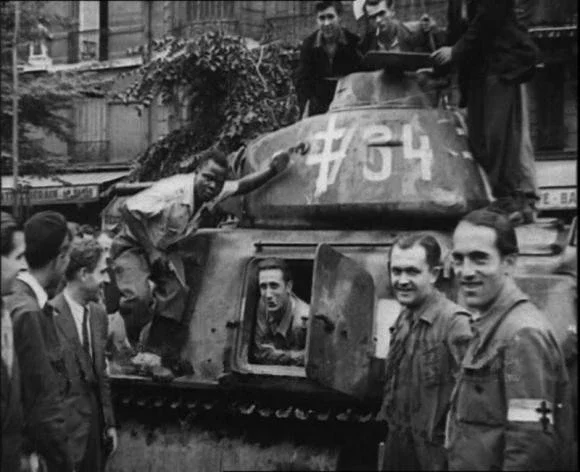
On Sunday, August 20, the day de Gaulle returned to France, the Resistance raised the tricolor at Paris’s Hôtel de Ville. Around that time, a small but angry crowd of unarmed people surrounded a Panzerkampfwagen R35 tank with several German soldiers still inside. Overwhelmed, the Germans surrendered. At one point, Dukson stood atop the vehicle and later, walking backward as if signaling an airplane where to land, triumphantly led it through the streets. A day or two later, at the corner of Boulevard des Batignolles and Rue de Rome, Dukson was shot in the arm by a stray bullet (which is why his hand is bandaged in the photographs). “Hurry, I have to get back there,” he told the nurse treating him, before returning to the fighting with hand grenades in his pocket, unable to hold a weapon in his hands.
Dukson’s injury during the fighting in Paris
In accounts that seem prone to a certain kind of exaggeration, Dunan describes Dukson waiting for hours in front of a wall, barefoot, with a knife in one hand and a revolver in the other, for a German truck to pass, then leaping “like a jaguar” to shoot one German soldier and slit the other’s throat. Another time, Dukson played dead on the sidewalk, lying on his stomach, then leapt up to shoot at the German vehicle as it came near him. At one point, Dunan writes, Dukson jumped onto a German tank and killed the driver, while his fellow insurgents dealt with the others. Photographs show him standing atop tanks and alongside captured Germans. They called him “the Black Lion of the 17th Arrondissement.”
Cobb mentions another Parisian diary, that of the retired teacher Berthe Auroy, who heard of an alleged Nazi collaborator whose hair had been shaved by a Black man in the 17th Arrondissement. It may have been Dukson, although, as Cobb writes, around five thousand Africans lived in Paris during the occupation, so we cannot be sure.
“Dukson was unstoppable,” Dunan writes. “Making sure he won today’s battle, which he had been unable to achieve in 1940. Making sure they paid for his captivity. In the evening, at the little bar on Rue de Chéroy … Dukson recounts his successful day, standing there covered in blood and glory. People congratulated him, honored him. He swelled with pride. From sergeant he was promoted to adjutant and then to second lieutenant. Nothing could stop him.”
Well, almost nothing. In the days after the chaos of liberation, something like the rule of law began to be restored in the city. Conduct that had been considered “resourceful” under Nazi occupation was now illegal. Dukson had gone from enforcer of order to breaker of the law, selling on the black market goods the Germans had left behind. He was arrested by the new Paris military police. On the way to prison, he jumped near a traffic light and tried to escape. The police shot him in the leg and the bullet tore through his thigh. He was taken by car to the hospital. He died on the operating table.
As General Morgan had implied, whitening was much easier said than done. With most of the original French army captured, killed, deserted or otherwise sterilized, two-thirds of the Free French forces consisted of colonial troops. Their ranks came from across West, Central and North Africa, as well as the Middle East, the Pacific and the Caribbean. These were the troops who helped in the Allied liberation of North Africa and Italy, and who would later land in southern France. There simply were not enough white soldiers in any single battalion to carry out the plan.
But it had to be done. Where necessary, Black soldiers were confined to barracks and replaced by white counterparts brought in from other units. When there still weren’t enough white men, de Gaulle included soldiers from North Africa and the Middle East who could pass for white, as well as Spaniards.
Only one Black soldier, due to a technicality, managed to stand out. Claude Mademba Sy was born in Versailles to a father who was an African commander in the French Army. He was considered a French citizen, not one of the colonial troops, and he was in a French regiment. For whatever reason, the French simply did not exclude him.
With the physical presence of Black soldiers eliminated, the erasure of history could begin almost immediately. Just three months later, on November 11, 1944, the first photographic exhibition devoted to the liberation of Paris, featuring selected shots by François Boucher, opened at the Musée Carnavalet. Of the 1,500 photographs he collected, only one showed a Black soldier. The curator thought it could not be shown.
So Dukson’s appearance in the victory parade is not just historically significant. The Second World War still looms large in the European imagination. (That is why Rishi Sunak’s early departure from the D-Day commemoration was considered such a disgraceful mistake.) It shapes our thinking about the continent and has a profound impact on our politics. And for good reason. In various ways, it laid many of the foundations of the continent’s current institutions.
Avoiding another war in Europe was the rationale behind the creation of the EU. The Holocaust shapes Germany’s relationship with the Middle East (and is why many European nations have not collected statistics on race and ethnicity). “The war” is the historical reason why Germany is not part of the UN Security Council, while France is – even though Germany’s population and economy are significantly larger.
The war is also central to the creation of patriotic myths in most European nations. Many Austrians cheered Hitler’s troops as they marched during the Anschluss in 1938. Today, the nation has defined its status as the “first victim of the Nazis.” The Resistance is essential to France’s self-image, even though by the end there were more collaborators than those who resisted. Despite turning away thousands of Jews and holding Nazi treasure worth millions of dollars, much of it looted from dispossessed Jews, the Swiss take pride in their wartime neutrality.
As Paul Gilroy explains in After Empire, speaking of Britain: “The memory of the country at war against enemies who are consistently and clearly evil has recently acquired the status of an ethnic myth. It shows how the country remade itself through war and victory, but it can also be understood as a rejection or evasion of its own current problems.”
In this shared myth, Black people do not appear at all. In this great, bloody drama, they do not appear as heroes, villains, victims, perpetrators, occupiers, collaborators or resisters. With a few exceptions, you will not see them in monuments to the fallen, or in the endless films and books devoted to this subject. Like Dukson on the Champs-Élysées during the liberation, if you don’t look for them, you would not know they were ever there.
But they were there, in considerable numbers and with a visible impact. As whitening showed, Europe undertook this task of erasure with considerable prejudice. It seems impossible to imagine the Second World War in Europe without the presence of people of color, especially after the Americans arrived on the Western Front. They were not present everywhere, but they were present at almost every stage and, at certain moments, their involvement was essential to the war effort.
University of London professor David Killingray estimates that nearly one million Africans fought in the Second World War. In addition, 20,000–25,000 Caribbean colonial troops served. Not all of them went to Europe, as Dukson did. Some stayed in Africa or the Caribbean. Others were sent to Burma, India and the Middle East. Most fought for the United States, Britain and France. From the outset, the French viewed their colonial troops as essential to their preparations for war. Of the 80 French divisions deployed in 1939, seven were African and three came from other colonies.
De Gaulle left France in 1940, after the German occupation and the establishment of the Vichy regime, and proclaimed the French government in exile in London. But he made the capital of Free France the Congolese capital, Brazzaville. “That meant that the French were all Congolese while Europe was at war and Germany was madly determined to conquer the planet,” says author Alain Mabanckou in Letter to France.
The fact that de Gaulle was able to move to Brazzaville was largely thanks to the only Black governor in the French Empire, Félix Éboué, who was the first to abandon Vichy and support him [de Gaulle]. The grandson of enslaved people, born in the French colony of Guiana in South America, Éboué was first governor of Chad and then of Equatorial Africa. Many white governors in the region and beyond quickly followed his example, while, when Algeria was finally liberated from Vichy in 1942, de Gaulle moved his base there, where it remained until liberation.
Black involvement extended beyond these three great powers. For the Allied cause, most of Belgium’s military contribution came from Black people. After Belgium surrendered – after just 18 days of fighting – most of its remaining troops were from the 40,000-strong Force Publique of the Congo, which fought mainly against the Italians in East Africa and helped staff garrisons in West Africa.
After the Netherlands surrendered – after just a few days of fighting in May 1940 – and until the Americans arrived 18 months later, the local Schutterij forces in the Dutch colony of Suriname shared responsibility with the Royal Netherlands East Indies Army. When what is now Indonesia was occupied by the Japanese in 1942, the Dutch colonies in the Caribbean were their only base. Suriname in particular was important because it supplied most of America’s bauxite, vital for military production, while it was a sensitive location because it lay near French Guiana, which remained under Vichy French rule until 1943. By 1940, Italy had “recruited” 256,000 “askari” into its Royal Corps of Colonial Troops, of whom 182,000 were from Eritrea, Somalia and Ethiopia and 74,000 from Libya – although most were mercenaries and conscripts and had limited military value.
Then there were the African Americans. The British asked the United States to refrain from sending Black troops to the United Kingdom, because they did not want to administer American-style segregation on British soil. The Americans made it clear they could not exclude Black soldiers, even if they wanted to, because they were essential to the war effort. “Sixty percent of the technicians in the U.S. Army are colored and provide the bulk of its organized stevedoring labor in port,” a British civil servant in Washington said in a telegram to the Foreign Office.
About 200,000 African American soldiers passed through Britain during the war, most on their way to Europe. Serving in a segregated army, most were not allowed to join combat troops and instead served on supply lines, distributing food, equipment and medicine, burying the dead, and driving, fueling and repairing trucks. “When American combat forces entered occupied France, they could go only as far as their supply lines allowed,” Matthew Delmont writes in Half American. “Which meant they could go only as far as Black supply troops could get them … Almost everything the Allies transported to the front passed through the hands of at least one Black American.”
Together, Black troops played important roles in Africa, where they resisted Mussolini’s troops in the east and defended against further German incursions in North, West and Central Africa. With North Africa liberated from Nazi control, thanks to their significant contributions, the Allies could open the strategic southern flank against Italy – which proved successful – forcing the Germans to move and disperse their resources. The legendary African American Tuskegee Airmen provided effective cover for Allied troop landings at the Battle of Anzio in Italy, shooting down a dozen Nazi planes.
The 92nd Infantry Division, also known as the Buffalo Soldiers – the only Black infantry division to fight in Europe – fought through southern Italy to Tuscany.
These are more than just facts of military history that have been marginalized. These important elements of Europe’s past speak to how we misunderstand the present.
At the Alliance Française, the French government’s cultural institute in Libreville, Gabon, they say they have never heard of Dukson. If it weren’t for the photographs and Dunan’s written accounts, the Lion of the 17th Arrondissement would have remained outside history.
The information we have does not give us a very clear picture of everything that happened that day, when Dukson and de Gaulle were at the center of attention. In his account, Matthew Cobb states that footage shot earlier in the day at the Place de la Concorde shows Dukson “apparently acting as a steward.” Cobb’s theory is that he was unable to carry out the task because his arm was injured, and so he “moved to the front” of the parade and was caught on film before being pushed back.
The scene seems much more confrontational to me. The photograph suggests that he is being pushed because he appears to be too close to someone or something, and that he is protesting.
The importance of seeing Dukson in the photo with de Gaulle is that it prompts us to ask some questions. How might Europeans think differently about themselves if the Second World War were understood as a multiracial effort in which Black people were integral – rather than a conflict in which, if their presence is acknowledged at all, they are seen as peripheral? How might conversations about responsibility, duty, rights, sacrifice, patriotism, immigration, integration, welfare, equality and justice, as they relate to Black people and immigrants, change if their contributions at this pivotal moment were fully recognized? How might the French understand immigration and non-white people differently if they knew that Toulon, the first major city to vote for the National Front, was liberated by a substantial contingent of colonial troops?
How would we understand terms like “threat to Western civilization” and “the values of liberal democracy” if we managed to understand not only that the greatest threat to those values came from within the continent, but that Black people rallied en masse to defend them – even when their colonial rulers decided those values did not apply to everyone?
In short, how different would our view of the place of Black people in today’s Europe be if we were able to notice Dukson in those photographs of August 26, 1944, and not think, “What was he doing there?” but instead, “Where is everyone else?”
Related
History
What Lincoln and the technological revolution he led can teach us today
History
Exhibition “Luigj Gurakuqi in the Documents of the Central State Archive” Opens, Honoring His Contribution to Albanian National History
History
1941: When leaders of the Sanjak regions sought protection from Tirana
History
Was King Arthur, after all, real?
History
The 1973 oil crisis forced Nixon to rethink time
History
The Life and Work of Murat Bey Toptani
History
The Pastor Who Saw Hiroshima Burning
History
An American physicist’s account of the atomic bombing of Nagasaki
History
Albania Judged by an English Lady
History
John Kantakouzenos’ Campaigns Against the Albanians
History
Albania as Judged by an Englishwoman
History
Why and who killed Hasan Riza Pasha?





