
Just moments after winning the California primary, which many said had paved the way for him to secure his party’s nomination as the Democratic candidate in the presidential election, Robert F. Kennedy was assassinated. His death, two months after the assassination of Martin Luther King, left wounds […]
50 Years Since the Assassination of Robert Kennedy, the Event That Changed History
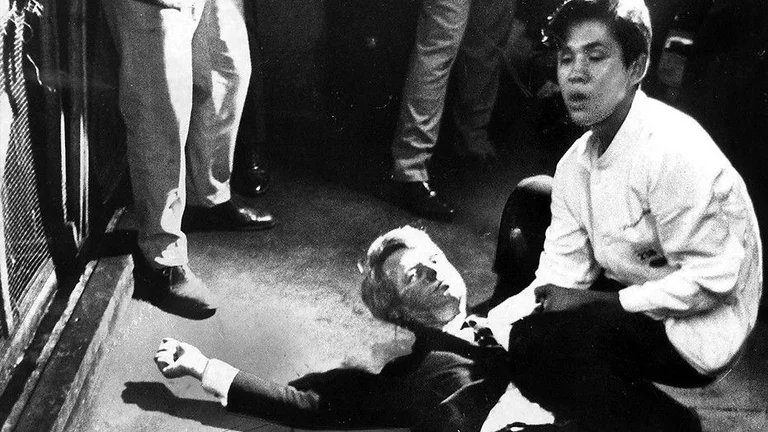
Just moments after winning the California primary, which many said had paved the way for him to secure his party’s nomination as the Democratic candidate in the presidential election, Robert F. Kennedy was assassinated. His death, two months after the assassination of Martin Luther King, left deep wounds that still leave their mark today, 50 years later in the United States.
1968 was a turbulent year. A year shaken by the war in Vietnam, racial protests and the assassination of Martin Luther King, an icon of civil rights.
“Those of us who lived through 1968 remember the madness, dreams and anxieties of that time. I want to repeat it: we lived with anxiety,” says historian David Nasaw.
With the arrival of June, Robert Kennedy, who for a moment offered a glimmer of hope to many Americans, was also assassinated—just two months after announcing his candidacy for president.
“I am not running for president just to oppose another candidate, but to propose new policies,” Kennedy said.
Robert Kennedy was bringing a wave of change, supporting civil rights, campaigning against poverty and speaking openly against the war in Vietnam.
“I hope both sides will try to put an end to the killing as soon as possible,” Robert Kennedy said.
“Fifty years ago, given the racial tensions, the idea that Black people would think a white politician was good was truly an achievement,” says Larry Tye, author of Kennedy’s biography.
Larry Tye adds that Kennedy was building a racially diverse coalition of middle-class Americans, liberals, young people and minority supporters.
“He was bringing together the different currents of America. He was doing something no other politician has done in the last 50 years: telling people unpleasant truths they did not want to hear,” says Larry Tye.
“This generation was unable to create many of the conditions that have brought us to where we are today. But it has the responsibility to resolve them,” Kennedy said.
On June 6, 1968, Senator Kennedy’s goals came to a tragic end.
“His assassination ended some hopes for the future. Many young people, who are no longer young today, gave up their ideals. They were able to see the Promised Land, which was snatched away from them. Among them were both white and Black people who believed in change,” says historian Nasaw.
The Republican Richard Nixon won the presidential election. The Vietnam War would continue for another seven years.
“I think Bobby would have been the Democratic candidate in the 1968 election, and I am convinced he would have won. I believe that America at that time would have become a different country. And today, 50 years later, perhaps we would not be facing the same issues of racial divisions, poverty and all the problems that frustrate us, if we had started addressing them in 1968,” says Kennedy’s biographer.
After his funeral in New York, Senator Kennedy’s body was brought by train to Washington, D.C., while around 2 million people stood along the tracks all the way, paying their respects.
It was a moment of unity, but the social and political divisions Kennedy fought against would continue for years. (VOA)
Related
History
What Lincoln and the technological revolution he led can teach us today
History
Exhibition “Luigj Gurakuqi in the Documents of the Central State Archive” Opens, Honoring His Contribution to Albanian National History
History
1941: When leaders of the Sanjak regions sought protection from Tirana
History
Was King Arthur, after all, real?
History
The 1973 oil crisis forced Nixon to rethink time
History
The Life and Work of Murat Bey Toptani
History
The Forgotten Photograph That Rewrites the History of the Second World War
History
The Pastor Who Saw Hiroshima Burning
History
An American physicist’s account of the atomic bombing of Nagasaki
History
Albania Judged by an English Lady
History
John Kantakouzenos’ Campaigns Against the Albanians
History
Albania as Judged by an Englishwoman





