
The Kingdom of Serbs, Croats and Slovenes used unprecedented violence and terror to destroy the Albanian national movement—acts that amounted to true genocide. Under the decree-law of April 1922, the territory of Kosovo was divided. The District of Raška (Sanjak), with its center in Čačak, included the Zvečan district within the territory of Kosovo. On the basis of the proposal of […]
Terror and State Violence against the Albanian Movement in Sanjak and Kosovo in the Early 1920s
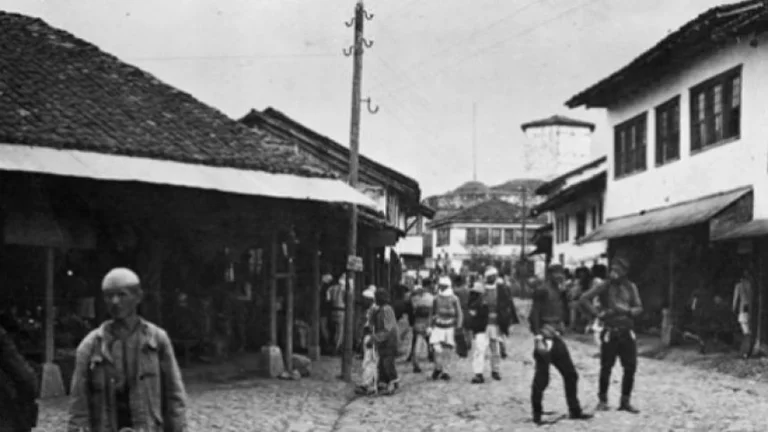
The Kingdom of Serbs, Croats and Slovenes used unprecedented violence and terror to destroy the Albanian national movement—acts that amounted to true genocide.
Under the decree-law of April 1922, the territory of Kosovo was divided. The District of Raška (Sanjak), with its center in Čačak, included the Zvečan district within the territory of Kosovo.
On the basis of the proposal of the command of the Third Army in Skopje, under which Kosovo also fell, dated 1.11.1918, the territorial division was specified in detail. Because of its geographical position and communications conditions, as a geographical whole, the Third Army was divided into the following three divisional districts: Bitola, Vardar and Kosovo. The Kosovo Division, headquartered in Pristina, also included the Novi Pazar Regiment District, which comprised the following administrative districts: Sjenica, Deževo (Novi Pazar), Štavica (Tutin), Mitrovica, Vučitrn, Drenica–Llauša, Istok, Rožaje and Peja.
Throughout its rule, the Kingdom of Serbs, Croats and Slovenes had as its foremost and ultimate goal changing the ethnic structure of Albanian lands. To achieve these aims and secure formal legal backing in the eyes of foreign opinion, it also enacted agrarian-colonization legislation. It began with the law of 25 September 1919 and continued with the enactment of the 1931 law, supplemented and amended in 1933. To implement the “Agrarian Reform” and colonization as successfully as possible, the Ministry of Agrarian Reform was established, while a High Agrarian Directorate was set up in Skopje, with branches in several Albanian cities. This legislation placed Albanian peasants at a disadvantage compared with the Slavic minority and settlers arriving from other regions of the Kingdom of Serbs, Croats and Slovenes.
Immediately after the reoccupation of Kosovo and other Albanian lands, efforts to dispossess Albanians began. The lands of participants in the national movement were the first prize for Slavic settlers, officials, military personnel, gendarmes and Chetniks. The same was done to those who sheltered them, often also to entire villages where armed clashes took place. The so-called abandoned lands were also expropriated, including village communal pastures and the lands of Albanian owners who had temporarily left the country because of the insecurity of life there.
Expropriation and the reduction of arable land intensified after 1923, when agrarian commissions were allowed, as needed, to seize lands not provided for under the legislation. The bodies implementing the Agrarian Reform also took advantage of the fact that the vast majority of Albanian peasants lacked land deeds, having inherited their land from the period of Ottoman rule, and expropriated them as land usurpers.
While assembling large tracts for colonization, the agrarian colonization commissions seized lands that Albanians had bought from landowners during the First World War and classified them as abandoned land. The same actions were deemed legal when the buyers were Serbs. Under the 1931 law, as supplemented and amended in 1933, Albanian peasants could have their land seized right up to the threshold of their homes. There were cases, especially in the Dukagjin Plain, where Slavic settlers were even installed on the upper floors of Albanian homes, while the owners and their families were forced to live on the ground floors of their own houses.
The expropriations did not spare the property of Albanian religious institutions, both Muslim and Catholic.

On 25–26 July 1924, after occupying the free zones of Kosovo, the Serbian authorities killed Azem Galica, the leader of the kaçaks, and the principal leaders of the insurgent bands. After eliminating the main forces of the armed bands, the Serbian regime focused on destroying Xhemijeti. In early 1925, on the eve of the parliamentary elections, extraordinary repressive measures were taken against Albanians.
Using the “Law on the Protection of the State” as a pretext in its attacks on Xhemijeti, the Serbian authorities arrested the printers of the newspaper “HAK” and then officially banned the paper, accusing it of publishing information that undermined the authorities. Meanwhile, on the eve of the parliamentary elections scheduled for 8 February 1925, Ferat Draga was arrested. In a summary proceeding, he was sentenced to 101 years in prison. These government persecutions brought the open activities of the Albanian organization Xhemijeti to an end. After this, the Belgrade authorities released Ferhat Draga. Under these circumstances, Xhemijeti ceased to exist as an organized legal party. In addition to these measures, the authorities resorted to mass killings, burning and demolishing villages with artillery, aerial bombardments, imprisonment and deportation to Serbia, especially of the families of members of the national movement.
As for Sanjak, its part located in Montenegro suffered much more severely than the part in Serbia.
The massacre in Šahovići, Pavino Polje, Vranesh and the surrounding villages was the greatest crime against the Muslim population committed in peacetime in the Kingdom of Serbs, Croats and Slovenes.
On the fateful day of 9 November 1924, the bloodiest tragedy befell the population of Šahovići. More than 650 people were killed, slaughtered, robbed and burned. More than 100 families were displaced to Turkey, while 150 went to Brčko in Bosnia. The aim was to displace this population permanently. This crime was carried out under the pretext of avenging the murder of the head of the Kolašin district, retired teacher Boško Bošković. The murder was blamed on Jusuf Mehoniq, the kaçak leader, who was in Albania at the time.
During the night between 9 and 10 November 1924, a plan was drawn up to liquidate the inhabitants of Šahovići. Among those who made this plan was Nikola Đilas, father of Milovan Đilas, who later also wrote about this terrible crime in his book. The operation to exterminate Šahovići was entrusted to Nikola Đilas, with a total of 2,000 armed men from various parts of Montenegro. Regarding this, Milovan Đilas writes in his book: Muslim clerics had their beards torn out and crosses carved into their heads. In one village, a group of people were tied with wire around a haystack and set on fire. Afterwards, people talked for a long time about the way people had been burned in the flames. One group attacked a farmer at his home in a remote area. The farmer had just skinned a lamb hanging from a plum tree. They intended to shoot him and then burn down his house, but the skinned lamb prompted them to do to the living farmer what he had just done to the lamb. One of them struck him with an axe; first they hung him from the same plum tree where the lamb had been hanging, then an experienced butcher split the farmer’s body in half with an axe…
In the Serbian-language book “A Land Without Justice” (Serbian: Besuda zemlja, 2005), these passages of testimony about the crimes, which appear in the English-language edition, have been removed.
The president of Xhemijeti, Ferhat Bey Draga, addressed the Minister of the Interior on 14 November 1924 with a petition concerning the terrible atrocities in the region. The petition was published in Sarajevo’s “Pravda” (no. 262) on 18 November. Among other things, it said: “Mr. Minister! This massacre was a joint act of the local police authorities and the Vasojevići. The police authorities are responsible, as they had been warned in time of the danger and took no action to prevent this massacre. In these circumstances, the authorities bear greater responsibility than the bands, because so far no one has been arrested.”
Belgrade’s “Politika,” no. 5949, dated 15 November 1924, reported under the headline “Ferhat Beg Draga’s Protest on the Occasion of the Vasojevići’s Retaliation for the Murder of Boško Bošković,” writing about the action taken by Ferat Bey, who sent a letter of protest to the Minister of the Interior, V. Maksimović. “Politika” deemed it necessary to write about Ferat Bey’s letter of protest and the crimes committed against hundreds of innocent men, women and children. There were more victims than words spent on this article published in “Politika.” All of this speaks to the premeditated aim of ethnic cleansing and concealment, intended to ensure that no one would be held responsible.
The former beys and aghas had great influence within Xhemijeti. One of them was Aqif Efendi Blyta, who, through his persistence and bold politics, succeeded in bringing back many Muslims who had voted for the Radical Party in 1920. He managed to strengthen the ranks of the Muslim party Xhemijeti, which soon became the strongest party in Sanjak. Nikola Pašić had recognized early on that the main obstacle to carrying out the Greater Serbian plan he had envisaged for Sanjak was Aqif Blyta. For this reason, in 1925 he unleashed a great wave of terror in Novi Pazar and at the same time ordered the assassination of this influential politician. His aim was to instill fear and terror and sow confusion among the Muslim population of the region. Fortunately, his plans were not realized.
Writing about these difficult circumstances, the newspaper “Hak” said that “many Albanian brothers were covered with earth, while many others were scattered here and there in a very bad state.” Under these circumstances, Bajram Curri and Hasan Prishtina managed to lodge a protest with the League of Nations in Geneva in September 1924. Point 5 of this protest states: “This iron-fisted regime of fire and plunder in Kosovo is the main cause of the mass emigration of the Albanian population to Turkey, an emigration carried out in terrible conditions that cost hundreds of families their lives, while those who remain are condemned to indescribable misery.”
Among the various reports published in Belgrade’s weekly “Republika” was one titled “Massacre in Southern Serbia,” which stated: “From all of southern Serbia come cries of distress. The entire Muslim population has been declared to be kaçaks, left at the mercy of the police and gendarmes. The Muslim newspaper ‘Hak’ in Skopje then publishes long lists of women and children, many of whom have lost their lives in indescribable ways. Throughout southern Serbia, the howls of citizens and the spilling of their blood can be heard. To cleanse southern Serbia of the kaçaks created by our rusting administration, the Minister of the Interior issued such instructions to the deranged and savage police authorities that they declared war on the entire population. Today even the lowest-ranking policeman can kill and rob whomever he pleases in southern Serbia, and no one must interfere. I demand that the crimes of the authorities be stopped and that a commission be appointed to bring the criminals and those who gave the orders before a court.”
Meanwhile, a commission was formed to investigate the situation in Sanjak. The commission drew up a report concluding that Sanjak’s population was divided along religious and political lines as a result of relations both from the past and after 1918. These relations had worsened particularly after the agrarian reform was implemented and the state apparatus abused.
The commission tasked with investigating these crimes had sufficient evidence to conclude that the “soldiers”—meaning the Chetniks of Kosta Pećanac—spared neither the property nor the honor of individuals. But these investigations brought neither peace nor well-being to the Muslims. In the Tutin region, Kosta Pećanac’s Chetniks committed horrific crimes despite there being no reason whatsoever.
In the village of Starčević alone, in 1922, they first killed Gala, Beqir and Zeqir, and the next day killed another 28 members of the large Rizvanović family. They also killed Tefik and Bajram, guests from Kosovo (from the villages of Kelepole and Malindubrava).
At this time, the inhabitants of other areas in Sanjak and Kosovo also suffered. Sarajevo’s “Pravda” wrote about the massacres in Pristina, Podujevo, Mitrovica, Çiçavica, Tutin, Janjevo, Vrella and Shtime, as well as the terrible massacre in Dumnica in February 1924. Twenty-three (23) people were killed, of whom the imams managed to bury only eight; the others had been reduced to ashes. All these killings were described by the government as operations against kaçaks and thieves, and it claimed that the kaçaks and their supporters had been the ones who suffered.
Witnessing this situation, progressive people refused to accept the chauvinistic stance of the Greater Serbian bourgeoisie. In 1921, Kosta Novaković, a representative of Yugoslavia’s workers and peasants, rose in the Belgrade Parliament and spoke, documents in hand, about the government’s crimes in Kosovo. Under pressure from all sides, and also prompted by direct and continuous interventions, the Turkish government had suspended the reception of refugees, but the government of the Kingdom of Serbs, Croats and Slovenes fought at all costs to ensure that emigration continued.
The Yugoslav and Turkish governments had managed to draw up an agreement in 1926 for the deportation of 300,000–400,000 Albanians from Kosovo. This issue was discussed for a long time in the Turkish press, especially in the newspapers “Haqimijeti Milije” and “Miljijet,” on 17 April 1926. In this connection, the Yugoslav government engaged in obfuscation in public, using both statistics and terror, and calling Albanians Turks. (“New Albania,” January 1925.)
Hasan Prishtina also intervened with the League of Nations in Geneva in 1927 regarding the difficult position of Albanians in Kosovo. Hasan Prishtina informed world opinion that Albanians in Kosovo were being subjected to extermination and were being displaced en masse. The displacement, it stated, was due to their not being equal to other citizens. The strongest proof of this was that they had no schools of their own, Hasan Prishtina wrote (cited in “National Freedom,” Geneva 1927). *To be continued
(The article is part of the master’s thesis “Aqif Blyta’s Diplomatic Role in the Defense of Novi Pazar”)
Related
History
What Lincoln and the technological revolution he led can teach us today
History
Exhibition “Luigj Gurakuqi in the Documents of the Central State Archive” Opens, Honoring His Contribution to Albanian National History
History
1941: When leaders of the Sanjak regions sought protection from Tirana
History
Was King Arthur, after all, real?
History
The 1973 oil crisis forced Nixon to rethink time
History
The Life and Work of Murat Bey Toptani
History
The Forgotten Photograph That Rewrites the History of the Second World War
History
The Pastor Who Saw Hiroshima Burning
History
An American physicist’s account of the atomic bombing of Nagasaki
History
Albania Judged by an English Lady
History
John Kantakouzenos’ Campaigns Against the Albanians
History
Albania as Judged by an Englishwoman





