
The Albanian population of Kosovo, the Sanjak, and various regions of Macedonia, Serbia, and Montenegro, although under the rule of the new Nazi-fascist occupier, experienced this as a relief, even as a salvation. The union of most of the Albanian lands with Albania was received with great enthusiasm by the Albanian population. […]
The “Liberation” of Novi Pazar and the Establishment of the New Power
The Albanian population of Kosovo, the Sanjak, and various regions of Macedonia, Serbia, and Montenegro, although under the rule of the new Nazi-fascist occupier, experienced this as a relief, even as a salvation. The union of most of the Albanian lands with Albania was received with great enthusiasm by the Albanian population. This union, although it came as a consequence of the strategic interests of the Axis powers, was regarded as national liberation by Albanians, who had experienced unprecedented violence and terror. Thus, the majority of Albanians’ acceptance of the new situation that had been created was a consequence of the genocidal policy implemented by the Kingdom of Yugoslavia, specifically the Serbian authorities. This discrimination had reached such proportions that Albanians had become convinced that no occupier who came along could be more brutal than the Serbs.
As early as 20 April, at a meeting with Albanian leaders from Kosovo and Dukagjin, as well as from Novi Pazar, Tutin, and Sjenica, the Germans promised to create the so-called “Little Albania” as a counterweight to Greater Albania, which would be in union with Italy. This entity was expected to include the three aforementioned districts in the territory of the Sanjak, as well as some parts of Kosovo and Dukagjin.
First, units of the 60th Motorized Division entered Novi Pazar (16 April), followed by the 294th Infantry Division unit.
Representatives of this district took part in the gathering in Mitrovica on 21 April 1941, where the decision was made to hand over all power to the Albanian authorities, that is, to the Bosniak national group. After returning from this meeting, and in agreement with the German command, the takeover and consolidation of power began, first in Novi Pazar and then in the other municipalities of the Deževa district.
As this was a Bosniak population, the takeover of power had pro-Albanian symbolism. The district authorities, district councils, municipal administration and judiciary, tax administration, and post office were dismissed and taken over. The process began with the district chief. District Chief Dragoljub Pantelić was dismissed and Ahmed Daci was appointed in his place. On the same day, the district chief and all the police officers who were not from Novi Pazar also left the city. The mayor, Dušan Davidović, was then dismissed as well. Ahmed Daci temporarily assumed this position. Later, Jonuz Mulahodović would hold the office. None of the 36 municipal councilors remained in office. Aqif Blyta appointed 36 new ones. They were all Bosniaks.
The municipal officials, Serbs and Bosniaks, remained in their posts. The President of the District Court, Mihailo Damjanović, was dismissed. All employees and judges of this court were released from their posts.
In the same way, the President of the District Court, Đorđe Kostić, as well as the judges and court clerks, were dismissed. Changes were made swiftly in other institutions too: the tax administration, post office, forestry directorate, nurseries, etc. Schools were closed, and preparations immediately began to open schools in the Albanian language. A gendarmerie was also established here, on 23 April 1941. First, the previous force was disarmed, and then an Albanian gendarmerie was formed from the Bosniak (and Albanian, I.A.) population. Reservist gendarme Azem Axhović was appointed its commander. Changes to the municipal administration in the rural areas of the district were carried out on 12 May 1941, in a manner similar to that in the town.
In Tutin, Mustafa Alijević, a cousin of Ferhat Draga, who had been editor of the newspaper “Kosova” until the beginning of the war, was appointed district chief.
Although the Germans took control of the entire Sanjak, after establishing the Demarcation Line with Italy on 6 May, Germany ceded the district of Štavica (Tutin), Bijelo Polje, and Pljevlja.
On this occasion, it retained the districts of Priboj, Nova Varoš, Mileševa, and Sjenica, as well as the Deževa district. Since Germany’s interest was primarily linked to “Trepča”—in fact, to the Deževa district (Novi Pazar) as a buffer zone toward this mine—it created room for the territorial expansion of the Independent State of Croatia (NDH), particularly in the western districts of the Sanjak. In just a few days, from 29 April to 5 May 1941, the troops of the Independent State of Croatia (NDH) occupied the districts of Priboj, Nova Varoš, Prijepolje, and Pljevlja, although, naturally, these areas remained under German protectorate. Ceding part of the Sanjak to the Croatian state was approved by a large number of representatives of the Muslim elite in the Sanjak. Thus, the presence of Croatian troops encouraged the ideas and aspirations of the Muslim elite to unite this province with Bosnia and Herzegovina, which was part of the Croatian state. Prominent representatives of the Muslims of the Sanjak, excluding the representatives of the Štavica and Deževa districts (and without Aqif Blyta’s knowledge), addressed the Croatian leader in a declaration on 6 May, requesting the annexation of the entire Sanjak to his country. Letters with similar requests were sent to Hitler and Mussolini.
A five-member delegation of Bosniaks from Novi Pazar, which visited Zagreb on 15 May 1941 and met with the leader Ante Pavelić, reportedly stated, among other things, that “97% of the population of the Sanjak are of Slavic origin (…) Any partition of the Sanjak would be the most terrible fate for the future of the Bosniaks of the Sanjak”.
In Vienna, on 21 and 22 April 1941, talks between the Italian and German Foreign Ministers, Ciano and Ribbentrop, resumed. On this occasion, the division of the territory was discussed, including the demarcation of zones in Kosovo. The conflicting interests of the Germans and Italians were then made clear. Despite Italian opposition, the division of the territories was adjusted exclusively to German interests.
This part of Kosovo (the districts of Mitrovica, Vushtrri, and Podujeva-Llap) was to remain part of Serbia, which would initially be governed by the Commissariat Council, represented by Milan Aćimović, the prewar minister of internal affairs in Stojadinović’s government.
This decision by the Germans caused discontent and demonstrations, which were held on 23 May 1941.
The Deževa district, or Novi Pazar, was the poorest region in Serbia. The city of Novi Pazar had over 10,000 inhabitants, while the district had four times as many, with 299 villages divided into 11 municipalities.
Milorad Vavić describes the city’s elite, led by Aqif Blyta, as Ferhat Draga’s people, and therefore says: “The group of people who led Novi Pazar acted under the strong influence of Ferhat Bey Draga (otherwise pro-Italian in orientation, Vavić says) and the ‘Albanian National Council’. This influence was also apparent at the meeting of the Albanian Committee (a term for the district branch of the Albanian National League), held on 16 June 1941, at which the decision to unite this region with ‘Greater Albania’ was announced. This session and the decision taken were deliberate attempts to put pressure on the German forces and the Serbian quisling government. Thus, this was another attempt to detach the Mitrovica District from Nedić’s Serbia and join it to Albania, which was under Italian dominance”.
The Commissariat Council wanted power to be established also in the parts of Kosovo and the Sanjak that were under German control, officially part of Serbia, in a way that reflected this situation. The Albanians wanted this part annexed to Greater Albania or, at least, full autonomy for this part of Kosovo and the Sanjak, under which the Albanians would hold all power on the ground, firmly refusing to let this territory come under Serbian rule. Under pressure from the Germans, a meeting with the Commissariat Council took place in Belgrade on 17 June for negotiations.
Xhafer Deva headed the negotiating team, whose members were Shaban Mustafa, Aqif Blyta, and Bahri Abdurahmanović. They demanded that the Mitrovica District be given the same status as the Banat, which at the time was part of Serbia. They then put forward demands for officials in the judiciary, schools, post office, and transport institutions. Another delegation soon arrived, refusing any contact with the Serbian authorities and addressing the Italian mission with a request that it exert influence on the German administration so that a decision would be made to unite this district with Albania. They expanded their demand to include Sjenica, so that the common border with Ante Pavelić’s Independent State of Croatia would be established there. When it finally became entirely clear that they had to negotiate with the Commissariat Council, the first serious negotiations were held on 12 July 1941. On 19 July 1941, the Commissariat Council agreed on the need to review the agrarian relations that had existed in the Kingdom of Yugoslavia. For 1941, it was decided that in the Mitrovica District, çifliçe-sahibia would be entitled to one quarter of the clean harvest and fruit from estates confiscated through the post-First World War agrarian reform. Later, feudal relations were legalized by regulations of Nedić’s government and remained in force until the Communists came to power.
In August 1941, instead of the Kosovo Committee, Albanians formed a new organization called the Albanian Popular League. Its central leadership was based in Mitrovica, while municipal and district organizations were established in the districts and municipalities. At its founding assembly, the organization fell under the influence of representatives of the pro-Italian faction. Ali Draga (Ferhat Draga’s son) was elected president of the League and, on this occasion, took the title of leader of the Albanian Popular Group.
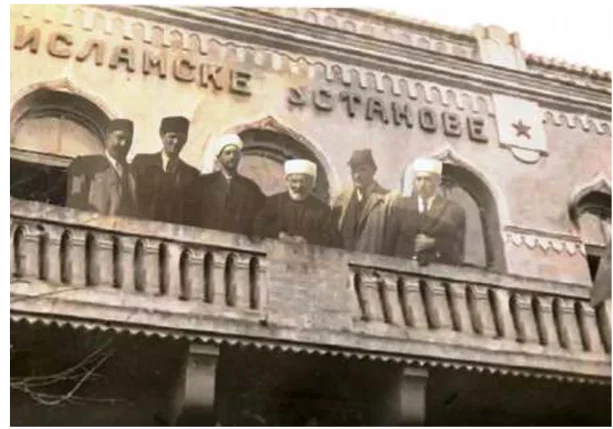
In the photo: Hasan Zvizdić, Aqif Blyta, Mufti Murat ef. Sukić, Mulla Jakup Kardović, lawyer Shefkija Kapičić, and Hafiz Ramiz ef. Palevac
Related
History
What Lincoln and the technological revolution he led can teach us today
History
Exhibition “Luigj Gurakuqi in the Documents of the Central State Archive” Opens, Honoring His Contribution to Albanian National History
History
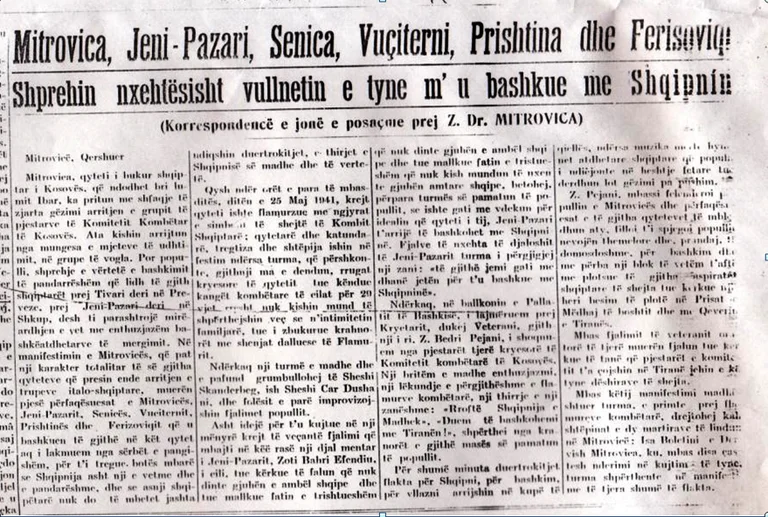
1941: When leaders of the Sanjak regions sought protection from Tirana
History
Was King Arthur, after all, real?
History
The 1973 oil crisis forced Nixon to rethink time
History
The Life and Work of Murat Bey Toptani
History
The Forgotten Photograph That Rewrites the History of the Second World War
History
The Pastor Who Saw Hiroshima Burning
History
An American physicist’s account of the atomic bombing of Nagasaki
History
Albania Judged by an English Lady
History
John Kantakouzenos’ Campaigns Against the Albanians
History
Albania as Judged by an Englishwoman





