Ancient Illyria extended across a very large territory, which today encompasses most of the Balkan Peninsula. Even today, if the territory of ancient Illyria were within a single state entity, it would be considered a large entity by modern European standards. The problems of how ancient Illyria functioned as a homogeneous state entity, the composition of its population and its division into numerous tribal formations, and the consequences of the long Roman, Byzantine and Bulgarian occupations are still subjects of scholarly study. Nevertheless, its geographical extent is the most firmly established and clearest of all these issues, certainly because geography has not changed radically. Many ancient Greek and Roman authors have left accounts of the geographical extent of ancient Illyria. This time, we will recall the testimonies of two authors, the Hellenic historian Appian and the geographer from Alexandria, Ptolemy, which shed considerable light on the location of ancient Illyria.
The Geographic Extent of Ancient Illyria and the Reasons for the Absence of Writing in the Illyrian Language
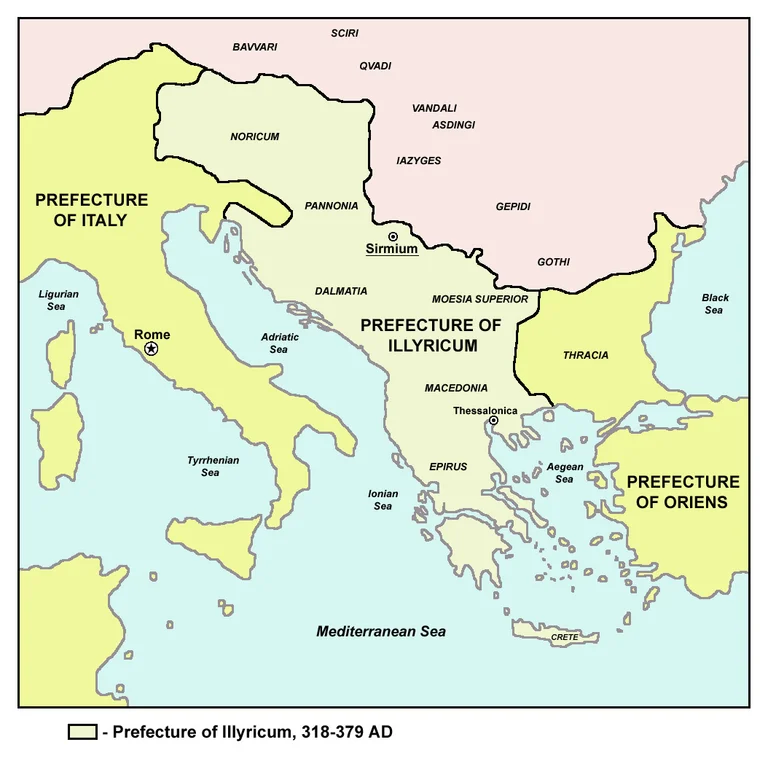
Ancient Illyria extended across a very large territory, which today encompasses most of the Balkan Peninsula. Even today, if the territory of ancient Illyria were within a single state entity, it would be considered a large entity by modern European standards. The problems of how ancient Illyria functioned as a homogeneous state entity, the composition of its population and its division into numerous tribal formations, and the consequences of the long Roman, Byzantine and Bulgarian occupations are still subjects of scholarly study. Nevertheless, its geographical extent is the most firmly established and clearest of all these issues, certainly because geography has not changed radically. Many ancient Greek and Roman authors have left accounts of the geographical extent of ancient Illyria. This time, we will recall the testimonies of two authors, the Hellenic historian Appian and the geographer from Alexandria, Ptolemy, which shed considerable light on the location of ancient Illyria.
The information left by Appian (from the end of the first century to the year 70 of the second century) about the area in which Illyria extended is of interest in forming as clear a picture as possible of its geographical extent. This well-known Hellenic historian, who also made a career in Rome, left the following testimony in his work “Illyrike”:
“The Hellenes call those who live above Macedonia and Thrace Illyrians, from the Chaonians and Thesprotians as far as the river Ister. And this is the length of the country, while its width extends from the Macedonians and the mountain Thracians, past the Paeonians, to the Ionian Sea and the foot of the Alps. The width amounts to five days’ journey, and the length to thirty days, as the Hellenes say. According to the measurement made by the Romans, the length exceeds six hundred stadia, while the width is about one thousand two hundred stadia. This country, they say, received its name from Illyrius, the son of Polyphemus.”
(The Illyrians and Illyria in Ancient Authors: 250)
Meanwhile, the famous second-century AD Alexandrian geographer Ptolemy left even more specific evidence in his work “Geographia” about the territories where the Illyrians lived:
“Illyria (Illyris) is bounded to the north by both Pannonias, according to the boundaries we have set out; to the west by Istria, along a line whose endpoint on the side of Upper Pannonia lies at 36 30’- 45 10’, while its endpoint on the Adriatic Sea (Adrias) is at 36 30’- 44 50’; to the east by Upper Moesia, along a line from the place where the river Savo (Savos) changes its course to its endpoint at Mount Skard (Svardos), whose coordinates are 47 – 41 40’; to the south by part of Macedonia, along a line that runs from the aforementioned endpoint to the Adriatic, whose coordinates are 45- 41 0’, and by the shore on this side of the Adriatic as far as the aforementioned endpoint near Istria.”
(The Illyrians and Illyria in Ancient Authors: 266)
Ptolemy then mentions a series of cities on the coast of Liburnia, Dalmatia, Macedonia and Epirus, which are signs of urban life among the Illyrians. Among these cities are Aulon (Vlora), Epidaurus (Durrës), Rhizon (Rizoni), Ulcinj (Ulqini), Lissus (Lezha), Scodra (Shkodra), Delminium (Delminiumi), Apollonia, Bullis (Bylisi), Albanopolis, etc., some of which are still important Albanian cities today and have preserved their continuity as cities for thousands of years. This remarkably well-defined geography, and these city names so intelligible in our Albanian language, are strong evidence of Illyrian-Albanian continuity, both geographically and ethnically. Naturally, this continuity has undergone reductions resulting from the tectonic upheavals that have affected these areas over the centuries. But the homeland of our ancestors is known to us in all its breadth and length. Many of the numerous cities in this Illyrian territory are also known, and are still inhabited by Albanians today. Therefore, as far as the historical homeland of our ancestors is concerned, we can say that we have solid knowledge of it.
We also have considerable knowledge of part of the lives and fates of our Illyrian ancestors, from the dark ages up to the time when the great demographic upheavals took place. But one great enigma remains: the absence of writing in the Illyrian language. Did they write in their own language, which is known to have been distinct from other languages and to have had its own name, Illyrian, or the language of the Illyrians? Or were they not fortunate enough to attain that level of intellectual and cultural enlightenment which would have enabled them to write in their own Illyrian language? This brief and modest history of Albanian communication and literature inevitably begins at this point.
Did the Illyrians write in their own language
Thus, the study of communication and media among the Illyrians, like research into their entire history, must inevitably begin with a question expressing astonishment: why did the Illyrians fail to communicate in writing in their own language and establish appropriate institutions for the development of writing and culture, given that they lived in close proximity to, and were also intermingled with, the two most advanced peoples of antiquity, the Hellenes and the Romans? What prevented them from being “infected” by the passion for writing in their own language, thereby expressing their ethnic, linguistic and cultural identity? Why did they fail to have an institution or medium of their own, similar to the Hellenic isagoria, where all free citizens had the right to free expression in public? This medium enabled the ancient Hellenes to unleash an extraordinary energy of thought and knowledge, philosophy, rhetoric, logic and poetry, which became a driving force behind overall social development. Could the famous Hellenic isagoria have gone entirely unnoticed by the Illyrians? That is impossible, since some Hellenic authors have left accounts of the Illyrians and their contacts with their neighbors. Thucydides himself (460–400 BC), who is also called the founder of history, provides testimony about the Illyrians in his work “History” when he discusses the civil war in Epidamnus (Durrës) in 436/435. Thucydides reports:
“Epidamnus is one of the cities located on the right as one enters the Ionian Gulf. The barbarian Taulantians, an Illyrian tribe, live near it.
(The Illyrians and Illyria: 24)
Isocrates (436–338 BC), for his part, provides testimony about Philip’s conquest of Illyrian lands, except those along the Adriatic:
“Did he not become master of most of the lands of the Illyrians, except those who live along the Adriatic?”
(The Illyrians and Illyria: 31)
The famous orator Demosthenes also provides information about the Illyrians in the time of Philip, Alexander the Great’s father, recounting that Philip had conquered the Illyrians too, who were not accustomed to obeying and apparently did not accept foreign rule. Reports such as these by Demosthenes also show that the Illyrians were known to the Hellenes and had even been forced into a certain closeness with them:
“…As for the Paeonians, the Illyrians and all his neighbors in general, one must believe that they find it more pleasing to be independent and free than to be subjugated. They are people who are not accustomed to obeying, whereas our man (Philip) is said to be a harsh master…”
(The Illyrians and Illyria: 33)
There are many such testimonies about the contacts, familiarity and relations between the Hellenes and Illyrians, as well as between the Romans and Illyrians, going back to the Iliad. It therefore remains unclear why these contacts did not also prompt some form of literacy among the Illyrians.
Another troubling question is: why were they content, as soon as they had the chance to learn writing and reading, to do so in one of the foreign languages, Hellenic, Latin or Slavic? Was this tendency to identify with other languages and cultures, which had a tradition of writing and institutional forms of communication, conditioned by a “genetic predisposition,” by “natural circumstances,” or by their political and cultural status as a people who had fallen into prolonged captivity?
Ultimately, another question arises: why, after falling under Roman rule, did they never manage to win independence and freedom (even after the dissolution of the Roman Empire) and become a significant force on the peninsula which, at one time, although organized into tribes rather than a state, they had populated almost as broadly as it was long? There are many more questions, while complete answers are still lacking.
Perhaps the answer to the question of when and where the Illyrian ethnos was formed could offer a clearer perspective for investigating the causes of this stagnation in cultural development. Muzafer Korkuti offers the following information about the time when the Illyrian ethnos was formed:
“…such a correspondence between archaeological and linguistic conclusions makes the conclusion more convincing that we must look to the Middle Bronze Age* for the beginning of the formation of the Illyrian ethnos”
(Illyrian Studies: 41)
According to Korkuti’s periodization, the Middle Bronze Age spans the years 1800 (1700)–1500 BC. Korkuti places the actual formation of the Illyrian ethnos in the Early Iron Age, that is, in the 12th–5th centuries BC. Although this issue of periodization cannot be the subject of further study here, we are compelled to raise a dilemma about it: is it possible that the Illyrians, while in the process of ethnic formation, played an important role in the Trojan War, which took place in the 12th century BC? And, on the other hand, is it possible that they were not “touched” at all by the cultural flourishing of the Hellenes in the 5th–4th centuries BC, that is, during the flowering of ancient Greek tragedy? Looking further back, the process of the formation of the Illyrian ethnos also coincides with the period when writing flourished among the Phoenicians and from them passed to the Hellenes. Why it did not pass from the Hellenes to the Illyrians, who were geographically much closer to them than the Hellenes were to the Phoenicians, remains an enigma for now.
The “geographical hypothesis” needs to be reconsidered
No theory has explained this enigma to date, although there have been many attempts to do so. One theoretical attempt is the “geographical theory,” centered on the famous Albanian author and linguist Eqrem Çabej, who, in studies on the origins of Albanian literature written in the 1930s, emphasized the role of Albania’s geographical position as an unfavorable circumstance for the emergence of literature at an earlier time. Çabej concluded that Albania’s position is such that, although it is bordered by the sea on one side, its interior is cut across by mountain ranges that have hindered normal, basic communication. This, in turn, encouraged tribal organization and did not create the conditions for the development of a culture in the Albanian language.
“The literary output of a people cannot be understood without knowledge of its history, but history is often the result of geographical conditions, the influence of the formation of the land and the nature of the country on people’s lives and actions.”
(Çabej: 101)
Thus, he concluded that these mountain barriers between different regions simply did not allow for more dynamic communication that would have produced cultural values in the language of the country, although Çabej says that “Albania, in its entirety, constitutes a geographical unit.” (Çabej: 101) Thus, although divided, fragmented and broken up, according to Çabej it still constitutes a geographical unit, but one that apparently did not function as such.
Other authors, such as Peter Bartl, have also considered the influence of geography and topography on Albania’s history, and he notes:
“The Albanian landscape is dominated mainly by mountains.”
(Bartl:13)
Noel Malcolm also mentions this geographical dimension as a circumstance behind the delayed development of culture, the formation of a state and the creation of the Albanian nation. Malcolm states:
“The Illyrians, who had lived on the coastal plains, were Romanized, both those on the Dalmatian coast and those in most of the territories of the former Yugoslavia. By the time the Slavs began to arrive in the sixth century, only groups speaking ‘barbarian’ languages remained in the Balkans, and they were all in the mountainous regions.”
(Malcolm:35)
Nevertheless, this is a theory that has some logical aspects, but also very serious weaknesses. From a critical perspective, one can say that the theory which claims that geographical position influenced all these aspects of delayed development is debatable, because theories cannot be applied selectively and in isolation; they must have a broader, more universal character. If Albania’s geographical configuration is compared with that of Greece, its closest neighbor, the two are found to be broadly similar. Greece, too, is bordered by seas on one side, while the rest of the country is intersected by mountain ranges and divided into fragmented territories and even islands. These characteristics are also found in some other countries of the Balkan Peninsula, Montenegro and Croatia. Thus, this theory cannot be applied, even with Greece alone as an example, because that country had an ancient culture, at least if the period of the Homeric poems, from the eighth century BC, is taken as a dividing line. Ancient Greek culture, with not only the Homeric poems but also tragedy, philosophy, lyric poetry, the Olympic Games, the many famous libraries of ancient Athens and numerous other cultural achievements, is regarded as one of the pillars of all Western civilization, and indeed of civilization more broadly. Therefore, the theory that identifies geographical configuration as the cause of major cultural delays in the case of the Illyrians and Albanians should be treated with caution.
In fact, another circumstance also makes the geographical theory problematic. The Illyrians lived on vast plains, including the areas of present-day Slovenia, present-day Pannonia, Vojvodina and Serbia, which are broad plains watered by large rivers such as the Danube, Sava and Drava, among others. Although they lived in these vast areas, without any mountain barriers, as far as is known today, they nevertheless failed to develop a written culture in their own language. This shows that we must always take a critical approach to such theories, which will surely be enriched by other approaches in the future.
Natural factors have some influence on the emergence of cultures and social formations, but this role may be more limited than to be generalized as a theory in itself. Therefore, in this regard, we must also seek other factors that could explain why the cultural history of the Illyrians and the Albanians who came after them is so delayed and quite atypical compared with that of neighboring peoples, especially the Greeks. We must not lose sight of the fact that the Illyrians and modern Albanians have been bordered by two peoples who laid one of the foundations of European civilization: the Greeks to the east and the Romans to the west. This direct proximity to the Greeks and Romans, strangely, did not produce any intellectual, mental or cultural stimulus among the Illyrians, at least as far as we know today. To this day, no writings in the language of the Illyrian people (their descendants, the Arbër, Epirote and Macedonian peoples) have been found, so it remains an enigma how peoples living in direct proximity and in fact exchanging things with one another did not culturally influence one another. Among the peoples of the East—the Sumerians, Babylonians, Hittites, Egyptians and Phoenicians—the opposite process took place. Although they too had conflicts and conquered one another, they adopted one another’s cultures and then developed and enriched them, giving them new dimensions, so that even when one people was conquered, its culture continued to develop. They were thus influenced by these cultural exchanges. Nevertheless, in this context we should bear in mind what the ancient historian Herodotus said, because what he said may one day prove to be true:
“The Pelasgians were the first to receive letters from the Phoenicians, and the Greeks received them from the Pelasgians, around the beginning of the sixteenth century BC.”
(Kotini:130)
According to this account, the Pelasgians knew writing, received it from the Phoenicians and passed it on to the Greeks. The unfortunate fact is that the writings Herodotus speaks of have not yet been discovered. But hypothetically, what happened with Sumerian writings could happen: they were discovered in the first half of the 20th century, while no one had known of them before then. Thus, one day an ancient Pelasgian city might be discovered, complete with all its cultural and written heritage in the Pelasgian language. But scientifically, this cannot be established unless such a thing happens. Discussions are also still ongoing about the relationship between the Pelasgian and Illyrian languages, certainly because of the absence of written texts, which would shed more light on those relations than all the speculation in the world. What is indicative here is that Herodotus mentions the Pelasgians, but not the Illyrians. Later authors, however, frequently mention the Illyrians, but not the Pelasgians. No one has yet investigated this change to the point of clarifying whether the Illyrians were descendants of the Pelasgians, replaced them on the stage of history, or were a new ethnos that dominated the Pelasgians (as, for example, the Babylonians did the Sumerians), erasing them from historical memory. Thus, this part of Pelasgian and Illyrian antiquity, or Pelasgo-Illyrian antiquity, remains unclear. The only thing clear from Herodotus is that the Greeks and Pelasgians were not the same people, as several authors of our time have also said.
In the Middle Ages, indications of Albanian writing emerge, although no written Albanian texts from that period have been found to date. For example, Brocardus, Guilelmus Adae, while traveling through Mediterranean regions in the 14th century, wrote:
“although the Albanians have a language quite different from that of the Latins, they use Latin letters in all their books.”
(Skendi: 111)
Unfortunately, this collection of books to which Brocardus refers has not been discovered to date either.
The institutional hypothesis – with greater explanatory power
One of the reasons for the absence of writings in the language of the Illyrians and Albanians until the 16th century is attributed, more than to geography, to the absence of cultural, religious and administrative institutions among the Illyrians and their descendants, the Albanians. In this case, the lack of state institutions meant that there was no kind of point of origin from which the encouragement and motivation to begin writing could emerge, and this is one of the reasons for the great lack of writing in our language. The institutions of those periods could have been either state or religious. To recall the example of ancient Greece, according to the author Jorge Livraga, ancient Greek tragedy arose largely from religious rituals performed in the temples of ancient Greece and later became part of the cultural policies of state institutions, especially during the period of Pericles. During Pericles’ time, the state took the theater and tragedy under its protection and encouraged them, but originally they had emerged from a kind of interaction between religious rituals in the temple of Eleusis, the main temple of Greek polytheism:
“More precisely, Greek theater, which flourished in the fifth century BC, developed from the mysteries at Eleusis, which was both geographically and culturally close to Athens”
(Livraga: 8)
In the absence of state and religious institutions that would produce written culture, the Illyrians’ primary model of organization was tribal. Indeed, the tribal model of organization also persisted in the Middle Ages and during Ottoman rule, about which Bartl states:
“Tribal society lived according to its own laws. Coexistence was regulated by the norms of an unwritten customary code, which was not necessarily uniform among the different tribes, but nevertheless had a common foundation.
(Bartl: 56)
Since tribal organization is pre-state and extra-state (anti-state in essence), it is a small-scale formation and does not accumulate sufficient potential for genuine and dynamic cultural production, especially in written form. Even today, the primitive tribes living in the Andes, the Amazon or Africa, with whom anthropologists are much concerned, have social formations that do not produce a written culture. They produce rituals and oral culture, but not a culture of writing.
Compared with the Illyrian system of organization, the Greek system, based on the city-state, or the Roman state system, which was centralized and took an imperial form of rule for most of its existence, the Illyrians’ tribal organization was seriously flawed. In other words, neither the Greek polis model nor that of a centralized state was adopted; instead, there was a decentralized tribal organization, whose members were rivals among themselves, producing more or less different models of cultural and social life from those characteristic of the Greeks and Romans. This form of tribal organization, without reaching the level of genuine institutional and state organization, also determined the outcome of the Illyrians’ centuries-long conflicts with surrounding peoples or their neighbors, while Romanization lies at the heart of this tribal fragmentation and ethnic and cultural weakening.
The Illyrians who were not Romanized were left without institutions and without any sort of cultural or social identity that would show what they were. Under such conditions, writing in their language was an impossible mission, because they were subjected to the process of Romanization and a large part of them were Romanized.
To better understand the grave consequences of the Roman conquest, and especially Romanization, we must recall the demographic, religious, social and economic situation of the Illyrians before the Roman conquest, in these same geographical areas. Although they had not yet created genuine state institutions that would make the decisive transition from tribal to state organization, in the period before the Roman conquest the Illyrians were undergoing demographic consolidation, economic and cultural development, and the formation of a state with a strong ethnic character.
(Excerpt from the book “Excommunication as a Hidden History”, Rozafa, Pristina, 2015)
Related