
The following will be published: Hasan Prishtina’s speeches in the Ottoman Parliament during his time as a deputy in the Turkish Majlis/Parliament in the period 1908–1912. They show his commitment to defending the rights of Albanians within the Ottoman Empire. Through these speeches, for the first time, the general public can see that Hasan Prishtina fought like a lion for the rights of Albanians. He was a model politician and deputy, still an example today of how the rights of the electorate should be represented in parliament, and many deputies today have an opportunity to learn much from his rhetoric, knowledge, and intellectual and personal courage.
Hasan Prishtina’s Speech in the Ottoman Parliament on the Political Situation and the Repression of Albanians by Young Turk Policies
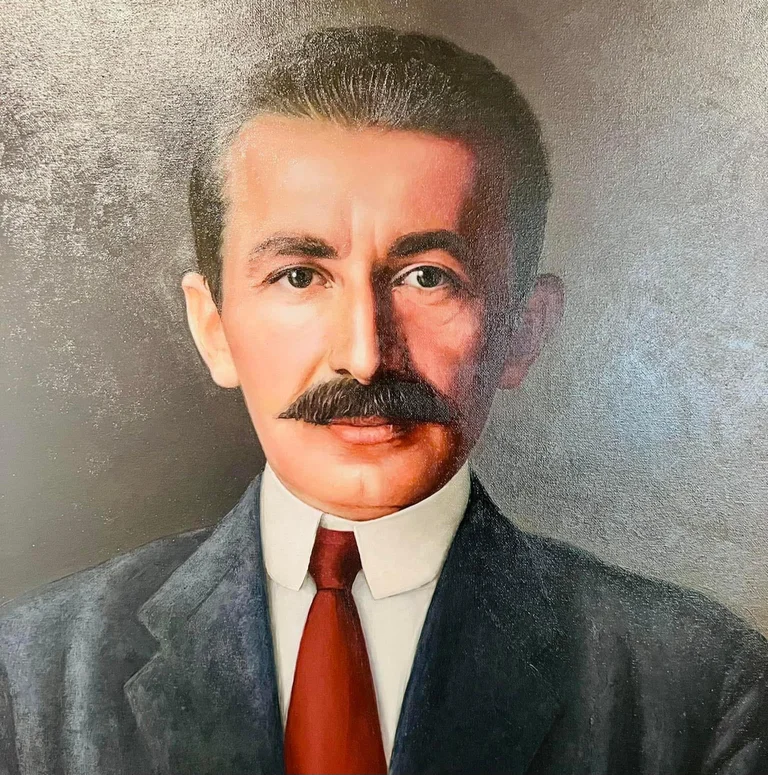
The following will be published: Hasan Prishtina’s speeches in the Ottoman Parliament during his time as a deputy in the Turkish Majlis/Parliament in the period 1908–1912. They show his commitment to defending the rights of Albanians within the Ottoman Empire. Through these speeches, for the first time, the general public can see that Hasan Prishtina fought like a lion for the rights of Albanians. He was a model politician and deputy, still an example today of how the rights of the electorate should be represented in parliament, and many deputies today have an opportunity to learn much from his rhetoric, knowledge, and intellectual and personal courage.
The documents will soon also be published in a collection comprising several volumes, most of which are now seeing the light of day for the first time.
These activities, along with many others, are being carried out by the “Hasan Prishtina” Foundation as part of the 150th anniversary of Hasan Prishtina’s birth and the 90th anniversary of his death.
The “Hasan Prishtina” Foundation was established by Mehmet Prishtina and is a non-governmental, non-profit, independent organization committed to achieving several aims, including promoting and raising issues concerning our national historical and cultural heritage, and raising public awareness of our rich past and national historical and cultural heritage, etc.
Hasan Prishtina’s Speech in the Ottoman Parliament on the Political Situation and the Repression of Albanians by Young Turk Policies
Istanbul, December 7, 1910
… The Prime Minister explained the events in Albania as something resulting from the ignorance of the Albanians and incitement by certain leaders.
But I think he would have served the truth better if, rather than blaming the ignorance of the Albanians for the outbreak of these events, he had blamed the bad methods of the state administration. Because we had approached him [the Prime Minister] long before these events occurred and told him that oppression and violence were being carried out with all their force in Albania.
The law on “bands” and the harsh and wholly unreasonable methods of the information commissions had driven the Albanians to despair. We had told him that if he doubted the truthfulness of our statements, then an impartial investigative commission should be sent. We could not help making such a proposal. But, unfortunately, our pleas were not even taken into consideration. Indeed, at that time a rally was held in Gjakova, attended by 20 thousand people. The first thing they [ ] did when they entered Gjakova was to break the seal of the “Union and Progress” committee…
… on the other hand [ ] they were saying … our suffering is great; we want a parliamentary commission to be sent!
If a commission had been sent, as we had proposed, the blood of thousands of our compatriots would not have been shed, thousands of houses would not have been razed to the ground, and thousands of people would not have been plunged into misery.
- I place the material and moral responsibility on the Prime Minister…
- Prime Minister: I accept it with full pride.
- Ruzhdi Bey (Syria): Speak about material responsibility.
- Hasan Prishtina: If material responsibility had existed in this state, I believe the Prime Minister would have been brought to trial long ago!
- Prime Minister: Send me!
- Hasan Prishtina: If one day a truly constitutional regime is established in this country, you will appear before the high court.
- Prime Minister: But when will you appear, since your moral responsibility is greater?
- Hasan Prishtina: We’ll go to the gallows, if you wish. Please listen, then answer.
Gentlemen, I know that the events began earlier in the Sanjak of Prishtina. But do not imagine this is just any sanjak. It alone provides 22 second-class battalions, not counting, gentlemen, the first-class redif regiment. If you doubt what I am telling you, here is the Minister of War, Mahmud Shefqet Pasha. Now calculate for yourselves how many soldiers that makes. The Sanjak of Prishtina alone provides 30,000 soldiers; it gives this state a tenth, it supplies livestock… It is this same Sanjak of Prishtina that gave 1,000 martyrs in the famous Battle of Plevna, which today occupies one of the most glorious pages in the history of our nation. I do not know whether this is politics or a crime, what is being done to our compatriots, against whom the harshest violence is being exercised.
I do not wish to state here the number of Albanians who have been beaten and persecuted, as my Greek and Bulgarian colleagues do, who gave figures for their compatriots who were beaten and persecuted, because the number of Albanians beaten and tortured reaches into the thousands. I should only point out that Albanians, since they came to be called by this name, have never suffered as they are suffering now.
The Prime Minister said that during the major military operations only ten people were hanged. It would have been better if 1,700 people had been hanged than for the dignity of thousands of Albanians to have been trampled underfoot. I say this, gentlemen, when I think of something else.
The Prime Minister is the Chairman of the Council of Ministers and must pay particular attention to the most pressing political issues. … I do not want to go on any longer here. The Prime Minister, however, boasted that reforms had been carried out in Albania, schools had been opened, roads had been built, and who knows what else. Perhaps he was mistaken here, intentionally or not. In any case, I wish to prove that he is wrong.
We hear it said that the killings in Albania have come to an end… but since the military operations and up to this day, more than 20 killings have taken place.
Gentlemen, even if I accept that the killings, as the Prime Minister said, have been reduced to some extent, be assured that this is due more to the fact that Albanians involved in blood feuds are very wary of one another than to the reforms.
I am ready at any time to give my life for this homeland. Therefore, it is my duty to point out these facts from this rostrum…
The Prime Minister may take this as he wishes.
I am not acting in a way that would cause my conscience to condemn me. Let the world say what it will. I have no personal enmity toward the Cabinet.
I seek no position… nevertheless, I believe that if a Cabinet, whatever its composition, comes to power and does not abandon this policy of violence and terror, and does not adopt as its political course winning over the people and creating general satisfaction, then it is not pursuing a course of action that accords with the interests of the homeland.
Since all my efforts are focused on this fact, I consider it my duty to repeat it continually.
Let us turn to the question of education.
The Prime Minister said that schools had been built in Kosovo, that this work and that work had been done… But I have just come from Kosovo, gentlemen.
Other than converting the Idadie in the center of the vilayet into a Lyceum and building a teacher-training school, I saw nothing else. Only in Prishtina had two schools been built with the help of the people. Some schools are also being built in Gjilan, not so much as a result of the subprefect’s zeal as of the people’s protests. Indeed, I can call one of my esteemed colleagues as a witness.
In Ferizaj, the subprefect wanted to display extraordinary heroism. He demolished the existing schools because, he said, they were unhygienic. Sir, do you know when new ones will be built? Is that not so, Shaban Pasha?
- Shaban Pasha: That is so.
- Hasan Prishtina: That settles this matter too, gentlemen. In other words, the Minister of Education has not done enough for us to boast of having made progress in the field of education.
- Prime Minister: Do not worry; I will answer you.
- Hasan Prishtina: We have just come from there [from Kosovo]. If schools have been built
since we left, I do not know about it. But we can be sure that even in those schools that have been built, lessons have not begun in a single one of them.
Let us turn to the roads. Apart from repairing the road to Gjilan and building the Peja–Mitrovica road, nothing else has been done.
The road to Prizren is also being built. In fact, it was awarded as a contract four years ago to the son of the deputy for Prishtina, Mr. Jahja, who is also our colleague. But four years have passed and it has not been built. In other words, I mean that nothing extraordinary has been done in the field of municipal services.
Let us take the matter of land registration. Please, gentlemen, follow this matter carefully and be compassionate. Know that the main source of Kosovo’s present misfortune is precisely the practice of land registration. Because a piece of land worth 100 liras is valued at 1,000 liras. Some Albanians are saying that the government is using these measures to force us to leave our lands. I think it would be useful to bear in mind the dangerous consequences of such a practice. (Addressing the chair of the session.) May I continue, sir?
(Voices: Continue, continue.)
I also wish to draw the Prime Minister’s attention to another matter.
In the statement he issued last year, I believe he said that he would pursue a policy of justice and generosity. All the members of Parliament are witnesses to this. To employ beatings and torture, actions wholly contrary to the principle of respect for civil rights; to order the closure of Albanian schools and printing presses, which is wholly contrary to the principles of the constitution; to force many Muslim and Catholic Albanians to flee to Montenegro, people who, during the establishment of the constitutional regime, had received enemy bullets in their chests; and also to sentence local representatives to exile, whose only fault was that they were generous people, enjoyed the people’s sympathy, and had thought about the happiness of the homeland and the glory and strengthening of the state; and to make not hundreds but thousands of innocent Albanians groan in prisons of suffering, as if they were not members of human society—is this, gentlemen, a policy of justice and generosity, or a policy of violence, terror, and oppression?
I believe I have troubled you all, gentlemen. I will be brief. Esteemed colleagues! I urge you not to place your trust in this Cabinet, which turns a blind eye to these unlawful and monstrous acts taking place in our country and which, for that reason, is unable to pursue a foreign and domestic policy in keeping with the national interest. Entrust the governance of the state to those who are competent. Also, do not forget that the country is rapidly rolling into the vortex of disaster, and that this day is a day of trial for the people’s representatives.
AIH, A-IV-150, volume one, pp. 302–305
Related
History
What Lincoln and the technological revolution he led can teach us today
History
Exhibition “Luigj Gurakuqi in the Documents of the Central State Archive” Opens, Honoring His Contribution to Albanian National History
History
1941: When leaders of the Sanjak regions sought protection from Tirana
History
Was King Arthur, after all, real?
History
The 1973 oil crisis forced Nixon to rethink time
History
The Life and Work of Murat Bey Toptani
History
The Forgotten Photograph That Rewrites the History of the Second World War
History
The Pastor Who Saw Hiroshima Burning
History
An American physicist’s account of the atomic bombing of Nagasaki
History
Albania Judged by an English Lady
History
John Kantakouzenos’ Campaigns Against the Albanians
History
Albania as Judged by an Englishwoman





