
On March 3, 1878, the Treaty of Peace between the Russian and Ottoman Empires was signed at San Stefano, one month after the Edirne armistice. The Treaty of San Stefano stripped the Ottoman Empire of around 80 percent of its possessions on the Balkan Peninsula. Hoping to avoid opposition from the other Great Powers, Russia […]
146th anniversary marked of the treaty that left Albanians in the “clutches” of the Ottoman Empire
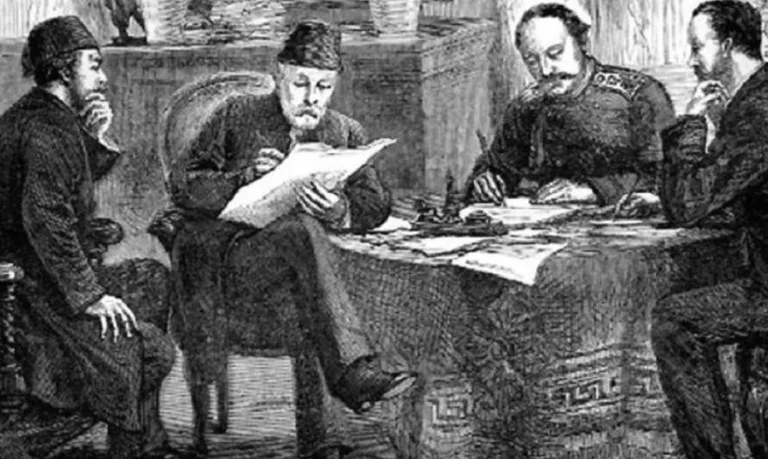
On March 3, 1878, the Treaty of Peace between the Russian and Ottoman Empires was signed at San Stefano, one month after the Edirne armistice.
The Treaty of San Stefano stripped the Ottoman Empire of around 80 percent of its possessions on the Balkan Peninsula.
Hoping to avoid opposition from the other Great Powers, Russia took none of these territories for itself.
The Treaty of San Stefano does not mention Albania, which, in Russia’s view, did not exist as a subject of political rights. Under the Treaty of San Stefano, nearly half of the Albanian lands were ceded to the Balkan Slavic states. Bulgaria was to receive, among other territories, the Albanian regions of Korçë, Bilisht, Pogradec, Struga, Dibër, Kërçovë, Gostivar, Tetovo, Skopje, Kaçanik, etc.
Serbia, which was to expand mainly toward the southwest, would also annex the northern and northeastern parts of Kosovo, as far as the vicinity of Mitrovica.
Montenegro, whose area was to grow more than threefold, would also include within its borders a series of Albanian regions, such as Ulcinj, Krajë, Anamal, Hot, Grudë, Tuz, Kelmend, Plav, Gusinje, and Rugova.
The rest of Albania would remain under Ottoman rule. As a result, under the Treaty of San Stefano, Albanian lands would be divided among four foreign states. The Russian Empire thus gravely mutilated Albania’s territorial integrity and made the Albanian people’s struggle to create a national state exceedingly difficult.
The deep anger that the Treaty of San Stefano provoked in Albania was further inflamed by the terror inflicted by Serbian and Montenegrin armies on Albanians in the territories they occupied, and by the forced displacement from these regions of tens of thousands of Albanian families, who flooded into areas not occupied by the Balkan armies as refugees.
In the vilayet of Kosovo alone, around 100,000 men, women, and children displaced from the Serbian-occupied zone were wandering. Nearly 38,000 people expelled by the Russian and Bulgarian armies had been dispersed, according to the British consul Blunt, across the regions of the vilayet of Monastir. According to information from the Austro-Hungarian consul Lipih (Lipich), more than 26,000 Albanians expelled from the Montenegrin-occupied zone had settled in the vilayet of Shkodër. But the number of displaced Albanians was greater, considering that quite a few of them emigrated to the vilayets of Salonika, Istanbul, Izmir, Adana, and Syria.
The new situation created by the decisions at San Stefano and the events that followed, in March–April 1878, when it became clear that the Western Great Powers were determined to defend Ottoman rule in the Balkans at all costs and, consequently, were not inclined to take the national rights of the Albanians into account, led the Central Committee of Istanbul to conclude that both the armed anti-Ottoman uprising and the demand for Albania’s independence could no longer remain the main points of its political program. Now that the partition of Albanian lands had begun to be implemented and the task of defending Albania’s territorial integrity had come to the fore, an armed uprising against the Ottoman Empire would not only fail to resolve the Albanian question, but would further complicate it and the fate of the homeland./alsatm
Related
History
What Lincoln and the technological revolution he led can teach us today
History
Exhibition “Luigj Gurakuqi in the Documents of the Central State Archive” Opens, Honoring His Contribution to Albanian National History
History
1941: When leaders of the Sanjak regions sought protection from Tirana
History
Was King Arthur, after all, real?
History
The 1973 oil crisis forced Nixon to rethink time
History
The Life and Work of Murat Bey Toptani
History
The Forgotten Photograph That Rewrites the History of the Second World War
History
The Pastor Who Saw Hiroshima Burning
History
An American physicist’s account of the atomic bombing of Nagasaki
History
Albania Judged by an English Lady
History
John Kantakouzenos’ Campaigns Against the Albanians
History
Albania as Judged by an Englishwoman





