
The “Hasan Prishtina” Foundation, following the signing of a cooperation agreement with the “Aleksandër Xhuvani” University of Elbasan, organized a scientific roundtable entitled “Hasan Prishtina, the Ideologue of the Movement for the National Unification of Albanians.” The event was organized through cooperation between the “Aleksandër Xhuvani” University of Elbasan, its Department of History and Geography and Department of Linguistics, the “Hasan Prishtina” Foundation and the Institute […]
Scientific Roundtable Held: “Hasan Prishtina, the Ideologue of the Movement for the National Unification of Albanians”
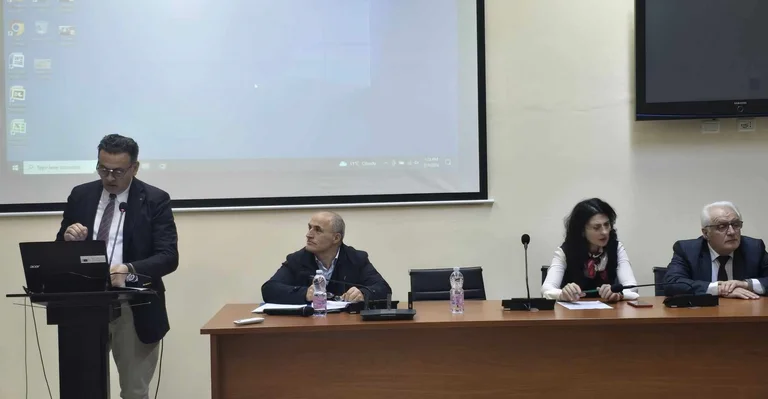
The “Hasan Prishtina” Foundation, following the signing of a cooperation agreement with the “Aleksandër Xhuvani” University of Elbasan, organized a scientific roundtable entitled “Hasan Prishtina, the Ideologue of the Movement for the National Unification of Albanians.”
This event was organized through cooperation between the “Aleksandër Xhuvani” University of Elbasan, its Department of History and Geography and Department of Linguistics, the “Hasan Prishtina” Foundation, and the Institute of Social and Human Studies at the “Hasan Prishtina” University of Pristina.
This was the first scientific collaboration, held as a scientific roundtable on March 7, 2024, in the University Library’s “Martin Camaj” Hall.
Also today, at the “Aleksandër Xhuvani” University of Elbasan, the “Hasan Prishtina” Foundation is presenting an exhibition of documents from the Central State Archive, dedicated to the patriotic activities of Albania’s eighth Prime Minister, National Hero Hasan Prishtina.
Below is Mehmet Prishtina’s paper, entitled “Hasanism as a Political Doctrine”
HASANISM AS A POLITICAL DOCTRINE
Our Hasanist social stratum can now begin to grow stronger, because there are two legitimate governments in Tirana and Pristina that have the chance to restore national unity—not with empty words, but through concrete action. The governments of our two countries need to work together on their governing plans, not for electoral reasons, but because doing so will give Albanians greater moral and spiritual confidence, allowing them to breathe freely and clear their lungs of the dust of past misunderstandings and disputes.
If the Albanians’ long-held dream of having a common front, not divided along ideological and regional lines, is to become reality, now is the time. This is precisely the moment to build bridges over the trenches of political divisions, so we can cross to the other side, toward the sublime goal of a different future in which our children will live more in the satisfaction of work accomplished than in the illusions of unfulfilled dreams.
If Hasan Prishtina once forcefully articulated in Europe’s chancelleries the idea of a shared national aspiration of the Albanians, which neighboring chauvinist states and their European allies were attacking, today Albania and Kosovo can articulate Hasanism in new terms suited to regional and international circumstances and contexts. One such principle would be the civilizing aspect of regional cooperation, in which Albania and Kosovo, without needing to become hostages to the retrograde policies of neighboring states, would bring to the fore all the creative energies that could be institutionalized in Tirana and Pristina.
The Albanians had representatives in the Ottoman parliament, and one of the deputies who worked hardest on the Albanian cause was Hasan Prishtina. In his speeches in the Ottoman parliament, he always spoke about the Ottoman government’s denial of Albanians’ rights. Indeed, in one of his speeches during a parliamentary session, Hasan Prishtina threatened that if the destructive policies in Albanian lands continued, he would be one of the organizers and leaders of the uprising. For, as the wise philosophical saying given by Sami Frashëri two decades earlier also made clear, “the sword puts an end to stale words.”
Hasan Prishtina’s approach to difficult situations on the ground can serve as an inspiration to today’s deputies in Kosovo and Albania, and to the legitimate representatives of Albanians in North Macedonia, the Preševo Valley and Montenegro, who could, for a moment, take off the shirt of party and ideological affiliation and put on that of national unity and coordinated action.
Hasan Prishtina served in the Albanian National Movement as a distinguished patriot and ideologue. His role and contribution were also emphasized in the development of national education during his time as a deputy in the Ottoman parliament (1908–1912). He continually strove to open schools in Albania and to ensure that lessons were taught in Albanian, so that pupils would be educated and taught in the national spirit. He favored the separation of vocational, secular and religious education. As part of all these efforts, Hasan Prishtina decided to allocate 5% of his annual income to be spent on the education and schooling of children in Albania. He made a notable contribution to opening schools in the Kosovo Vilayet, while he sent boys from all Albanian regions to the Elbasan Normal School, financing their education with his own money. According to archival documents, Hasan Prishtina financed the education of more than 70 students at the Elbasan Normal School. Hasan Prishtina’s contribution in this regard is a realistic picture of the rise in Albanians’ national consciousness for freedom and independence from the Ottoman Empire. Hasan Prishtina was among the main financiers of the Congress of Manastir in 1908/09 and a powerful voice in support of the Albanian alphabet in Latin letters.
Whenever we commemorate anniversaries connected with Hasan Prishtina’s patriotic activities, we should view these commemorations in the context of current developments. Today, when Kosovo is a free and independent country, but also threatened from abroad, remembering Hasan Prishtina’s patriotic work is not a rejection of any other historical figure; rather, this remembrance inspires us to continue the path of the great patriots and defend Kosovo against internal opponents and external enemies. Therefore, strengthening Kosovo’s statehood and building a just and equal state means realizing the ideals of the patriots who gave their lives for our people’s freedom, among them Hasan Prishtina.
HASAN PRISHTINA’S DIPLOMACY
Hasan Prishtina’s diplomatic skill was exceptional. He lived in many places that at the time were considered the most developed economic and cultural centers. He studied at the French lycée in Salonika, completed studies in law and public administration at Istanbul State University, and was educated there to administer the state as well as to serve as a diplomat. Before returning to Kosovo, especially after his famous speech in the Ottoman Parliament in January 1911 and on the eve of organizing the general anti-Ottoman uprising, Hasan Prishtina stopped in Salonika, Bitola, Sofia and Skopje, and communicated with all the diplomatic missions, to which he presented the idea of organizing an uprising. He communicated with all the diplomatic missions and informed the great powers’ public that the uprising was imminent, seeking their support. Thus, our national movement could not have resonated in Europe’s diplomatic circles and chancelleries if there had not been a mind like Hasan Prishtina’s to set in motion the entire mechanism of diplomatic communication and articulation with the states that at the time had decision-making power over the small countries of the Balkans as well.
HASAN PRISHTINA’S ROLE IN PRESIDENT WOODROW WILSON’S DECISION-MAKING ON THE ALBANIANS
In 1919, American President Wilson defended with great dignity the principle of peoples’ self-determination, set out in his Fourteen Points.
That same year, Hasan Prishtina was appointed head of the “National Defense of Kosovo” Committee delegation to represent the interests of Albanians at the Paris Peace Conference, whose central demand was the unification of the Albanian territories of the former Kosovo Vilayet with the Albanian state. As is known, Hasan Prishtina and the delegation he headed were not allowed to speak at this Conference, but he sent a letter to President Wilson, and what Hasan Prishtina was unable to present was done by the great American politician Woodrow Wilson. He will remain in history as a living voice that gave resonance to Hasan Prishtina’s unvoiced national political ideas at an international forum such as the Paris Peace Conference.
History has shown, with evidence, that the letters Hasan Prishtina sent him must certainly have influenced President Wilson’s far-sighted decisions.
Hasan Prishtina’s letter to President W. Wilson in Paris, dated December 18, 1918:
“Mr. President,
You are preparing to take part in a congress that must reconstruct Europe on the principles of the right of peoples to decide their own fate, principles for which the glory of having inscribed them on the banner of humanity belongs to you.
At this solemn moment, we, the representatives of two and a half million Albanians—the oldest people of the Balkan Peninsula—address you with a plea to consider our people’s wishes with complete impartiality, which distinguishes you so greatly from others, and to enable us to submit these wishes to the Peace Conference.
Over many centuries, and despite the many hardships we had to face, our people nevertheless preserved their language, their distinct identity and their traditions. For five full centuries, our people resisted Ottoman pressure with great determination and ultimately wrested all those great achievements from Turkish rule with its abolition in 1912. It is true that Albania was established as an independent state at the meeting of ambassadors in London in 1913, but most Albanians remained outside the borders of that state.
Therefore, the Albanian people received your proclamation concerning peoples’ right to direct their own fate as the message of a savior. We have no doubt that you, Mr. President, together with your allies, will grant the Albanian nation the same rights enjoyed by the Armenians, Czechs, Yugoslavs and other nations. The Albanian nation, which made so many sacrifices to realize its national ideal and shed so much blood for this purpose, remains convinced that you and your allies will put an end to its suffering in the name of justice and equality.
Confident in these principles, we address you with a plea, Mr. President, to use your influence to ensure that, during the negotiations concerning Albania’s future, the Albanian people’s delegation is also invited to participate in the Peace Conference, so it can present and justify the wishes and demands of the Albanian nation.
We extend to you, Mr. President, our deepest respect.
In the name of the Albanian nation
(signed) Hasan Bey Prishtina
Today, during my scientific research and on the occasion of the 115th anniversary of the founding of the Elbasan Normal School, I am presenting new archival documents, being published for the first time from the French, to document the Albanians’ continued demands that the unjust partition of Albanian borders be corrected, whereby more than half of Albanian territory and population, by the decision of the Conference of Ambassadors in London in 1913, remained outside the lands of London Albania.
Below, we present a statement by the British Prime Minister, Mr. Asquith, delivered in the House of Commons in London:
“We shall never sheathe the sword, which we did not unsheathe lightly, until Belgium—and I add Serbia today—have gained all that they have sacrificed, and even more”
This statement seriously alarmed all Albanian nationalist circles. The archival sources and the statement by a British Prime Minister are further evidence for us of how the partition of Albanian ethnic lands was supported at the Conference of Ambassadors in London in 1913.
I will conclude with dissident Adem Demaçi’s comment on the mission of the Hasanist doctrine. The well-known activist publicly made this statement for the first time in 2009 in Vushtrri: “I am not a symbol, but a devoted, unyielding soldier of Hasan Prishtina, and where Hasan left off, I will continue; together, we will continue. Once we create our own stratum of Hasanists, no force will be able to stand in our way.”
THANK YOU!
Related
History
What Lincoln and the technological revolution he led can teach us today
History
Exhibition “Luigj Gurakuqi in the Documents of the Central State Archive” Opens, Honoring His Contribution to Albanian National History
History
1941: When leaders of the Sanjak regions sought protection from Tirana
History
Was King Arthur, after all, real?
History
The 1973 oil crisis forced Nixon to rethink time
History
The Life and Work of Murat Bey Toptani
History
The Forgotten Photograph That Rewrites the History of the Second World War
History
The Pastor Who Saw Hiroshima Burning
History
An American physicist’s account of the atomic bombing of Nagasaki
History
Albania Judged by an English Lady
History
John Kantakouzenos’ Campaigns Against the Albanians
History
Albania as Judged by an Englishwoman





