
We have known Dr. Daut Dauti since he began writing for Pristina magazines and newspapers and showed promise of a successful career in journalism. In the early 1990s, we also encountered him in Albanian publicistics. His writings dealt especially with historical topics rooted in documents from the British Archives, […]
The Creation of Albania in London, as a Result of a Compromise Among the Great Powers
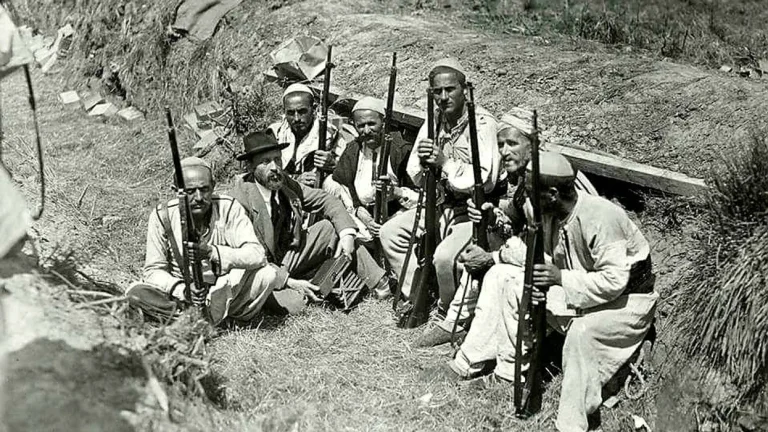
We have known Dr. Daut Dauti since he began writing for Pristina magazines and newspapers and showed promise of a successful career in journalism. In the early 1990s, we also encountered him in Albanian publicistics. His writings dealt especially with historical topics rooted in documents from the British Archives, through which, in one way or another, he imposed himself on the Albanian public everywhere, not only with an approach that demystified historical truth, but also through the “opposition” his studies presented to the (official) Albanian historiography that had taken shape up to that point and had been under the strict control of the state. Dr. Dauti graduated from the Faculty of Law at the University of Pristina, earned a master’s degree in London in European Union Law, and completed his doctorate in history at the University of Leeds in England, in an exceptionally interesting field encompassing the period from the Albanian League of Prizren to the London Conference. Dr. Daut Dauti’s studies are a brilliant contribution to shedding light on periods about which so little has been written here, and sometimes with such proximity, as the distinguished British historian Noel Malcolm also emphasizes in his assessments of him. Thus, in this lengthy interview conducted especially for “Akademia” magazine, we will speak with him about some of the issues that characterized the period studied by this researcher, including particular issues which, without a doubt, are being encountered for the first time in our publicistics and historiography. Dr. Daut Dauti has published numerous works of publicistic and scholarly writing, making him one of the most distinctive voices in contemporary Albanian historiography. Interviewed by: Haqif Mulliqi

Mr. Dauti, you are an experienced journalist, publicist, lawyer, and so on. One question anyone might ask you is this: how did you develop such a great, almost passionate, interest in historiography?
I believe that initially it was a journalist’s curiosity that drove me to the British Archives, or the PRO (Public Record Office). I wanted to know what British diplomats had written about us Albanians, especially during and after the Second World War. I was interested in their position because we knew so little about Albanian-British relations, which had not been very extensive or close and were completely severed after the Second World War. There was very little material on this subject in Albanian or English. My first contact with documents in this archive had a great impact. Before me were documents that had once been secret, concerning important situations and personalities, which I was reading half a century later. I started this work as a journalist, beginning with one topic, but continued it as a publicist, and later it became almost my primary interest. My interest broadened because the documents I found were voluminous and covered many situations and different periods. This interest continued for decades and culminated in research for my doctoral thesis at the University of Leeds, my largest project in historiography. But in reality, my interest has not ended there, because it continues to spur me on to uncover files still covered in dust that speak about Albanians and their history. I still visit this archive, as well as several others, because there is always something there that piques one’s curiosity to discover things we do not know, or to shed light on things we do not know sufficiently or as well as we should.
I think many people remember some interesting serialized articles you published in the first half of 1991, which continued for many years: Albanians in the Intelligence Services documents; the one on the Albanian-British conflict in Corfu; the series on Kim Philby and the CIA and MI6’s efforts to overthrow the communist regime in Albania during 1949–1952; and so on. What made this kind of documentation of Albanian historiography distinctive, particularly after around five decades of political and ideological thought dominating this field?
We prepared most of these documents for publication in newspapers together (you and I), with great enthusiasm. It was the first time that documents from the British archives were published in Albanian publicistics; these documents, previously (top) secret, had been compiled by diplomats and consuls serving in the Balkan region. These reports were initially intended to inform a small number of senior British officials who had to make decisions on these matters. So, seeing and reading something official that was once very important is work that deepens your desire to pursue further research. Then, the opportunity to share it with a wide readership creates a feeling of satisfaction. Informing the public for the first time about the contents of documents relating to the Corfu Issue, Kim Philby, the Anglo-American plan to overthrow the communist regime in Albania, and other topics was work that I still consider very important today.
Can the science of historiography develop under state control?
History is a science, and science does not tolerate “regulation” or any kind of state interference. Interference means setting rules for research and publication. Scientists, including historians, would not create an accurate or clear picture if they were restricted in their topics, methods of research, and interpretation. A historian is obliged to study a subject and present the facts or final results regardless of how they reflect on the existing state of society. State interference has been a problem especially in the countries of Eastern Europe, that is, in the former communist bloc, as we still call a certain geographic area that includes the Balkans. During communism, states designed history in such a way as to suit the political system and communist rule. In the Balkans, in addition to the problem of communism, there have also been territorial claims, as there are today, and for this reason history has been burdened with a considerable dose of nationalism. Here, the state demanded service from historians. But there are many cases where historians themselves have offered, and continue to offer, their services within lines previously drawn by the state. During communism, historical events were redesigned and personalities and heroes were constructed in such a way as to serve the political system. If an explanation differed from the prescribed one, state intervention followed, with penalties. We have had quite a few such cases in Albania, but also in Kosovo, when this country was part of Yugoslavia’s territorial and political system. For example, Yugoslav history said that Kosovo had voluntarily joined the Yugoslav state and that after 1945 it had progressed and was equal to all the peoples of that state.
Therefore, in the Balkans, there are many cases where the histories of three or four states claim an event or a personality, usually a hero, as their own. Today, Albanian historiography is also faced with this problem. During communism, the lines for studying and interpreting events and personalities were set. Today, historians who depart from this line are no longer punished. But some still think that these historians cause “problems” because they challenge the “traditional” line.
In one of your recent articles, which we happened to read, you write about the division of the Albanian border to Albania’s detriment. Kosovo was left outside, as was the western part of so-called “Southern Serbia” (later Macedonia), but the borders of “London Albania” continued to be contested after the First World War as well: the border between the villages of Korçë and Greece, the Vermosh issue with Montenegro, and the issue of Saint Naum, then with Serbia. Why do you think this happened?
Albania is a state created as the result of a compromise among the Great Powers reached in London in 1913. In reality, the vast majority of states created, especially since the 19th century, have been the result of international compromises. But the compromise over Albania was excessive, entirely unreasonable and, as such, painful for Albanians.
Among Albanians at large and some of our historians, Great Britain is viewed unfavorably. London, they say, is to blame for dividing Albania in half. In reality, the opposite is true, and matters could have been even worse had the British sided with the Russians and French, who did not favor the creation of an independent Albania. British Foreign Secretary Edward Grey declared that his country was neutral on this issue and that London was merely providing good offices. In reality, Grey supported the formation of the Albanian state. The formation of the Albanian state meant the end of Russian and Serbian dreams of access to the Adriatic and Mediterranean. British interest lay in keeping Russia as far as possible from these seas. A few days before the start of the London Conference, the Greek and Serbian foreign ministers met with Edward Grey, and both asked him the same question: what would the British position at the Conference be? Grey replied to both of them: Albania would be formed as an autonomous state. Nevertheless, the British were not interested in the ethnic distribution of Albanians. Their interest was to prevent Russian penetration into the Balkans and the Adriatic. That was the compromise serving British interests.
The compromise over Albania largely excluded the ethnic criterion. Since that exclusion left half the territory and population outside the borders, Albanians never accepted it. Wars are moments when borders change, and on such occasions Albanians have acted in the hope of adjusting the borders to their needs or applying the ethnic criterion.
After the London Conference, the Great Powers showed no interest in Albania, despite the agreement they had reached that the state would be helped to develop and stand on its own feet as an independent country. The Great Powers did not honor the obligations they had undertaken in London. This unfavorable situation for Albania continued after the First World War as well. The powers’ neglect was a sign that Albania had been left undefended. This was why neighboring states continued to contest their borders with Albania and tried to seize as much territory as possible.
Since the issue of northern Kosovo and Mitrovica are “hot” national and international topics, I suggest we pause here, especially to consider the main economic asset not only of the Balkans, “Trepça”! To be honest, on this subject I would not hesitate to say that one of the best studies I have found on Trepça is in your book, “The Struggle for Trepça,” and today this same “struggle” continues to be the most contentious point in the final consolidation of issues in the region.
To a great extent, “Trepça” today determines the difficult situation between Kosovo and Serbia and Mitrovica’s status as a divided city. Mitrovica, because of the railway built in 1873, was a strategic point. Austro-Hungarian expansionist aspirations to reach Thessaloniki were linked to Mitrovica. But Mitrovica became even more important in 1927, when the British obtained the concessions to exploit “Trepça”—that is, when the mine was revived, along with Mitrovica and the entire region. The British were the ones who increased the region’s value and strategic importance. In Stantërg, the British built a center that included a complex of modern residences, a swimming pool, tennis courts, and facilities for extracting and processing the ore mined at “Trepça.” This was the beginning of the 20th century, and such things could be found in the Balkans only in Mitrovica, where an English culture was beginning to spread. Archival records indicate that the British had respect for Albanians, whom they considered diligent and competent miners. On the other hand, Albanians also respected the British—the owners of Trepça—because they had revived life in the region.
Unfortunately, the British presence in Kosovo ended in 1941, when the Germans occupied “Trepça” after the invasion. That was how long British interests were present in Kosovo, and they were the first and most important not only in the former Yugoslavia, but also in the Balkans. In 1946, “Trepça” was nationalized by the Yugoslav communist regime, and this act terminated the 50-year British concession contract at Trepça. The Germans and Yugoslavs exploited “Trepça” only after British investment had made this possible. However, the compensation to the British was inadequate.
Even today, Serbs “forget” the monasteries and other cultural and religious heritage sites they have appropriated and would give them all up for “Trepça,” or even a share of it. What does this mean to you as a historian and political scientist?
Belgrade is not interested in monasteries or the religious or human rights of Serbs in Kosovo. Belgrade’s interest is the territory of Kosovo. Serbian policy has demonstrated that it wants to connect Serbia territorially to the northern part of Kosovo, where Leposavić lies, extending as far as Mitrovica, so that the industrial complex called “Trepça” would be included there.
Since “Trepça” is still an important factor in relations between Serbia and Kosovo, it would not be a bad idea to consider giving priority to the British during privatization. This would completely neutralize any eventual external claim to “Trepça,” while closing the door to Belgrade’s territorial claims against Kosovo.
One of the most interesting studies I have had the chance to read, without a doubt, and not just by you, is: “The Albanian Question in British Diplomacy, 1877–1880.” As the title indicates, your book is based on documents from the Foreign Office archives, the British Parliament, the British Library, and the private correspondence of several British officials who, in various official capacities, were involved in the Albanian Question during the period covered in this book. Why did you choose to study this particular historical period for Albanians?
The period 1877–1880 saw major changes in the Balkans and within the Ottoman Empire following the Russo-Turkish wars. These changes also affected Albanians, who until then had expressed sporadic national tendencies. With the League of Prizren, Albanians emerged with a national program that included a demand for the establishment of an autonomous state. This was a period of major events for Albanians, initiated by the Congress of Berlin in 1878. The British therefore showed great interest in recording these moments, which is why the main and most numerous sources today can be found in their various archives. This is also why I became interested in this topic.
The book presents important events that took place during the aforementioned years in the four Albanian vilayets and that directly or indirectly influenced the emergence of Albanian nationalism. I think an exceptionally interesting finding in your study is that, unlike the earlier studies we have read, it shows that not all the Great Powers of the time were always against Albanians and their cause. For example, you conclude that there were moments when important diplomats, especially British ones, favored the creation of a nucleus of an Albanian state, even within the Ottoman Empire—which was also an aim of the Albanian leadership of the time, was it not?
Since the Congress of Berlin, there has been a current within British politics—in Parliament, government, and diplomacy—that favored the establishment of an Albanian state. This is an important fact that our historians ignored until recently. A large number of supporters of the Albanians operated within the Conservative Party, led by Benjamin Disraeli (1804–1881), who served two terms as Prime Minister of Great Britain, from 1874 to 1880. This was why the leaders of the League of Prizren handed their Memorandum only to Disraeli, so he could defend the Albanian cause in Berlin. The British did not take the Albanians under their protection, but neither did they oppose them as all the other participating states did. Indeed, Disraeli went down in history as someone who had no respect at all for the peoples of the Balkans, except for the Albanians.
Russia’s position toward the Albanians in Berlin is well known. At this stage, Austria-Hungary and Italy saw Albanian territory as land that would fall under their rule if the Ottomans withdrew. Germany supported Austria-Hungary. France supported Greece and Serbia. Great Britain had initiated the Congress and had gone to Berlin to protect its own interests: stability in the Adriatic and Mediterranean, where its route to India lay. Russia’s access to these seas meant the end of the Ottoman Empire. The existence of the Ottoman Empire was in Great Britain’s interest. The creation of an Albanian state also meant the end of the Ottomans in Europe, and no one, including Britain, was prepared to unsettle Istanbul over this. Besides having no interest in the uncontrolled fall of the Ottoman Empire, the British also faced no domestic public pressure to create an Albanian state. Therefore, the Albanian Question was silenced by the British in Berlin because they saw no reason to act on it.
In Berlin, everyone came out a winner except the Albanians and the Ottomans. The Austro-Hungarians took over the administration of Bosnia and Herzegovina and offered Albania to them. The Russians, aided by France, made Montenegro and Serbia independent and secured autonomy for Bulgaria. The British took Cyprus and finally brought the Mediterranean and the route to India under their control. According to this strategy, the Albanians could wait longer. All the powers had territorial claims or ambitions to conquer Albanian territory. Great Britain was the only one with no such ambitions anywhere in the Balkans, and this made London the perfect protector. In the eyes of the Albanians, an Albania with four vilayets would be born and developed in the British incubator. This was why Albanians sought friendship with the British and never stopped trying to find ways to influence London’s policy.
In your studies, you have documented that for a long time the British government opposed Greek ambitions, supported by France, to take Ioannina and a large region of Epirus, which was populated mainly by Albanians.
During the Congress of Berlin, and afterward, the French Prime Minister Waddington, an Englishman naturalized as a French citizen, emerged as Greece’s main defender. He continually pressured Disraeli to accept an enormous expansion of Greece that extended almost as far as what is today known as Central Albania. Waddington stopped only when Disraeli instructed his ambassador in Paris that he no longer wished to hear about Greek expansion toward Ioannina. Disraeli had visited Albania in 1830, where he had spent pleasant moments with Albanians and learned about the Greek and Albanian questions. Disraeli was the only prime minister in Berlin who cared to distinguish between Albanians and Greeks. He called Ioannina the capital of Southern Albania and had no intention of handing it over to Greece. In 1879, Disraeli also wrote to Bismarck about this issue and received his agreement. On that occasion, Bismarck too acknowledged that the Albanian Question was proving much more problematic than had been thought in Berlin. Thus, Ioannina and its surroundings as far as Arta remained in Albania because of Disraeli.
You also conclude in your study that British and Austro-Hungarian friendship did not go far in defending the legitimate rights of Albanians, despite all the interest—or at least, as was the case with the friendship these two empires, especially the other European states, built and strengthened with Greece, Serbia, and Montenegro. Is this evidenced by the fact that these three states were, in effect, “sponsored” by Russia, which grew considerably stronger relative to the Ottoman Empire, especially after Moscow lost the Crimean War?
With the exception of Great Britain, all the other powers saw Albania as their future dominion. Russia’s power was growing, and it was not easy to oppose it in Berlin. British foreign policy, especially that led by the Conservatives, was built on resisting Russian expansion toward the Balkans, the regions of British colonies in Asia, and Istanbul. This was why there was a powerful alliance between the British and Ottoman Empires. It was also why Great Britain and France, together with Sardinia, came to the aid of the Ottoman Empire in its war against Russia, which had begun expanding. This war, known as the Crimean War (1853–1856), was bloody and brought major changes that were also reflected in the Balkans. Russia lost the war, but gained the right to interfere in the Balkans because it was recognized as the protector of the rights of the Orthodox population under Ottoman rule. In exercising this right, Russia regarded national problems as religious ones and succeeded in spreading the idea of Pan-Slavism. At the same time, Russia coined the term “the sick man of the Bosphorus,” a synonym for the sultan and the Ottoman Empire. The Ottoman Empire was in decline, but was not sick at all, and the British never accepted this expression.
In his speech at the launch of your study, Noel Malcolm said that “The Albanian Question in British Diplomacy, 1877–1880” was a subject other authors had also addressed, but no one before had treated the Albanian Question of this period as it was treated in this work. Malcolm also noted that, with tireless scholarly rigor, you had examined in minute detail the events of that time that were important to the Albanian people and to the history of the region and of Europe. He added that, thanks to the contents of the book we are discussing, it sheds light on the situation on the ground and how it was characterized by British diplomats in reports they sent to their government in London. A special commendation from the distinguished historian for your work.
Noel Malcolm is one of the world’s most outstanding and best-known historians and intellectuals. In the Balkans, he is known for his book on the history of Bosnia and the one on Kosovo, the two best works written about these two peoples. But in Great Britain and around the world, Noel Malcolm is better known as one of the leading scholars of Thomas Hobbes. As a senior research fellow at Oxford, he has written a series of other works, including “Agents of Empire,” also a well-known work about two Albanian families from Ulcinj. A few months ago, he also published a book called “Useful Enemies.” This book, which examines the reasons and causes of the divide between East and West, has, like his other books, been highly acclaimed by readers and critics. Above all, Noel Malcolm is a friend of the Albanians and chairman of the Anglo-Albanian Association, based in London, which was founded by Aubrey Herbert during the First World War. Malcolm spoke about my book at its launch at the Embassy of the Republic of Albania in London, and this is a great honor for me.
What do the British say, especially about events in the Vilayet of Kosovo and the border with Serbia in 1877, on the eve of the organization of the Albanian League of Prizren, and which events related to the Vilayet of Kosovo, especially along the border with Serbia in 1878, can you single out?
Although peace negotiations between Serbia and the Ottoman Empire had ended in early March 1877, by August of that year Belgrade was openly preparing for new attacks. Consul White reported a major mobilization of Serbian forces preparing to be sent south, that is, toward Kosovo. This mobilization was in fact aimed at occupying new territories and expelling Albanians from the lands that had come under Serbian rule. With this move, the Serbs intended to further destabilize the Albanian territories within the Ottoman border. Belgrade also gave signs that it would attack in the direction of Bosnia, which alarmed European diplomats in Belgrade, since Vienna, which had declared Bosnia its zone of interest, would not tolerate such a move. The British warned the Serbian government about these plans. The Serbian attack toward Bosnia did not take place, but what diplomats noted in Belgrade was that the Serbs, led by Prince Milan, had begun turning their backs on Vienna and orienting themselves toward Russia. The growing Russian influence was visible throughout Serbia. This new turn was a danger to the Balkans and dashed the hopes of Serbian liberals for a return to Europe.
One of the figures much discussed in our historiography is Ali Pasha Maxharri, who was killed by League fighters in Gjakova. Why did this Ottoman pasha make such a great effort to persuade the Albanians to implement the decisions of the Congress of Berlin?
Mehmet Ali Pasha and Karateodori Pasha were plenipotentiary representatives of the Ottoman Empire at the Congress of Berlin. The former was a German convert to Islam and, because of his origins, Albanians called him Ali Pasha Maxharri. The latter was Greek and had made a successful career, as he was the son of the sultan’s personal physician. This is not surprising, since most officials in the Ottoman diplomatic service or foreign policy were Christians.
In any case, both pashas tried to represent the Sublime Porte with dignity in Berlin, striving to preserve as much territory as possible. Ali Pasha’s efforts in this regard prompted the German chancellor, Prince Bismarck, to tell the pasha that he had come to Berlin to hear and accept decisions, not to lay down conditions, since he represented the losing side. Bismarck even went so far as to mock Ali Pasha to belittle him. He called him “der Magdeburger,” after the place in Germany where he was born.
When the issue of Bar was discussed, Karateodori Pasha strongly opposed the transfer of the city to Montenegro. He stressed that the city was inhabited by Albanians and was being unjustly separated from one ethnic community and transferred to another with which it had no connection. Karateodori’s objection was not taken into account when the decisions were made. But what matters is that, in opposing the decision, Karateodori Pasha had raised the Albanian national question for discussion, and it too was denied.
Ali Pasha Maxharri was sent to Kosovo by the sultan to persuade the Albanians not to resist the decisions of the Congress of Berlin and to hand over Plav and Gusinje to Montenegro. On August 19, Ali Pasha Maxharri met the British ambassador in Istanbul, Henry Layard, and told him he was going to Kosovo on a mission assigned to him by the sultan. The pasha arrived in Prizren on August 24 and asked the leaders of the League of Prizren to accept the terms of Berlin. His proposal was categorically rejected, and the pasha decided to continue on to Plav and Gusinje. In early September he stopped in Gjakova, where he was killed by members of the League. The pasha, failing to take into account how much the situation had changed, had misjudged the situation created by the Albanians and thus became the first victim of the decisions of the Congress of Berlin. His killing changed the situation even further. After this event, the Great Powers practically no longer knew what to do, while the Albanians’ desire for independence from the Sublime Porte grew stronger.
How was the border between Kosovo and Serbia established during this period, after the Congress of Berlin, and why was Përpellac, an Albanian locality still on the border with Serbia today, one of the most sensitive points in establishing the border between the Ottoman Empire and Serbia? Why was this?
Serbia’s border with Kosovo, like its borders with Montenegro and Greece, proved more problematic than had been thought in Berlin. British diplomats knew that the Serbs had set aside large sums of money to bribe members of the boundary commission for Kosovo and Bulgaria. Përpellac proved to be a major obstacle to the final determination of the border with Kosovo. This place was strategic because a large part of Kosovo could be controlled from there. It therefore became a subject of discussion in the foreign ministries of European states. The treaty was interpreted to mean that the border would be established according to the watershed, but Serbia opposed this because the larger and more strategic part would remain with Kosovo. Serbia’s opposition compelled Lieutenant Blandensburg to visit the region, where he became convinced that the inhabitants were also Albanians. The British consul in Belgrade was forced to list for Prince Milan all the severe measures the Serbian government had taken to drive Albanians from their lands, without allowing them to take anything with them. Finally, Serbia, which did not accept the Austro-Hungarian maps drawn up in Berlin, withdrew from Përpellac, and the northern border of Kosovo with Serbia that was established then still exists today.
How did Lieutenant Bladensburg report on the Albanian League of Prizren, and what do those reports say?
The British government received information from the field through its regular consular and diplomatic missions. At times it sent temporary diplomats. During crises or conflicts, it sent military officers with specific assignments, who prepared reports for the government in London. London sent officers to the Vilayets of Shkodra and Kosovo several times for this purpose. One of them was Lieutenant Blandensburg. He made several reports for the Foreign Office, but the best known is the one about the situation in Kosovo in 1879. His report describes the dire situation in Kosovo, as the region was filled with refugees from Serbia who lacked even the most basic necessities. This had radicalized the political situation, but the League of Prizren, with its effective organization, managed to deal successfully with this problem and other difficult situations.
Reports of this kind were frequently sent to London. They provided information that was important to the decision-making process. Today, however, these reports also serve as important materials for enriching our history.
What were Serbia’s diplomatic activities and military and police measures for territorial expansion and the expulsion of Albanians from their ethnic lands at this time, and how were Albanians expelled from Niš?
British documents indicate that until 1878 Niš was an important city for Albanians, Turks, Serbs, Bulgarians, and Jews. The city’s most beautiful quarter was the Albanian neighborhood (Arnavut Mahallesi), which had 300 houses. The city as a whole had around 1,500 Albanian residents. After 1878, only Serbs remained in the city, as everyone else had been forcibly expelled. Albanians were particularly targeted by the violence because the city’s economy and politics were in Albanian hands. The most beautiful houses belonged to Albanians, and Serbian officers and other officials moved into them. From a report sent from Niš by the Ottoman consul, Nikolaides, to the British consul in Belgrade, we learn that the value of the property Albanians had left behind amounted to 2 million piasters. Under British pressure, the Serbian government undertook to compensate the Albanians. But the Serbs never fulfilled this obligation. Consul Nikolaides also compiled a list containing several hundred other villages in southern Serbia from which Albanians had been expelled. Regarding these villages too, the Serbian government pledged to ensure the return of those who had been expelled and to compensate Albanians who did not wish to return. None of this promise was fulfilled either. In a short period, almost the entire city was demolished, on the pretext that a new urban plan was being implemented.
According to the British, what were the relations between the Ottoman authorities and the League of Prizren?
Reports on the League of Prizren from British consuls in the field were conflicting. The permanent consul Green in Shkodra and the temporary consul in Prizren, St. John, were not in favor of the Albanian cause. Green had fallen under the influence of the Austro-Hungarian consul, Lipitch, who was of Slavic origin, while St. John operated under the influence of the Russian consul. Both called the League’s leaders tribal chiefs. Their aim was to portray Albanians as disorganized people who supposedly lacked national consciousness. To them, the League of Prizren was a fanatical (Muslim) religious organization founded by the sultan (Abdul Hamid) to oppose the decisions of the Congress of Berlin and persecute Christians. Most of the reports by these two consuls about the League are dark in tone. St. John repeatedly wrote that the League of Prizren would massacre Christians, but found no example to illustrate his malicious prediction about the Albanians. On several occasions, Consul Green in Shkodra advised British journalists not to go to Prizren because their lives would be in danger. The reality was different, and during the League’s period, when it operated as an experienced government, the Albanian vilayets functioned better than under Ottoman rule.
This situation was clearly described by British diplomats in Istanbul, who ranked higher than St. John and Green. Ambassador Layard and, later, Fitzmaurice, both well-known diplomats with extensive knowledge of the Balkans and the Ottoman Empire, together with several other diplomats, wrote to the Foreign Office several times, urging it not to take into account the reports these two consuls sent from Shkodra and Prizren, because they did not present the situation as it was. For this reason, Fitzmaurice drafted a special report. It described the League of Prizren as a nationalist organization making demands similar to those of other Balkan nations. The diplomats in Istanbul viewed the League of Prizren favorably and considered its demands justified. Indeed, these diplomats submitted a request to London that the Albanians be accommodated in an autonomous state under the Sublime Porte, which would serve as a nucleus for an independent Albanian state.
When did the British diplomatic and political position on the Ottoman territories in the Balkans begin to change?
As long as the Conservatives, led by Disraeli, were in power, London recognized the League of Prizren as an organization representing the demands of the Albanians. On May 12, 1879, British Foreign Secretary Lord Salisbury officially received the League of Prizren’s two delegates, Abdyl Frashëri and Mehmet Vrioni, at the Foreign Office. Salisbury even advised Frashëri and Vrioni about what the League should do in the future. This move was sharply criticized by the opposition, namely the Liberals. They thought the British government should have treated the League’s representatives in the same way as the German chancellor, Bismarck, who refused to meet them.
However, things changed in 1880, when the Liberals led by William Gladstone (1809–1898) came to power. With his liberal doctrine, he gave the Russians the right and the opportunity to interfere in the Balkans and in other Ottoman territories where Christians lived. Gladstone was religious and favored Christians. His rise to power signaled the stifling of a climate favorable to Albanians that had been established in Britain by Lord Byron and continued by Disraeli, Urquhart, and several other figures. Gladstone established a foreign policy from which Serbia, Montenegro, and Greece would later benefit.
With Gladstone’s rise to power, the Albanians, but especially the Sublime Porte, had reason to be afraid. Their fears increased when Ambassador Layard, known for his positive stance toward the Albanian cause and the Ottoman authorities and hated by the Liberals, was replaced by Joachim Goschen. Lord Fitzmaurice was sent to Istanbul to oversee reforms. But something unexpected happened. Goschen and Fitzmaurice became even more committed to the Albanian cause. These two leaders of British diplomacy in Istanbul formed the view that an Albanian state should be established. However, in London, Prime Minister Gladstone thought otherwise. After all, Gladstone faced no public pressure to act on the proposals of the diplomats he had sent to Istanbul. For this reason, the initiative to establish a nucleus of an Albanian state gradually faded away.
Let us return once more to events in the Vilayet of Shkodra in 1877 and the demarcation of the border with Montenegro. What were Montenegro’s military and diplomatic activities, and what was the Albanian resistance to defending their territory during this period?
The Ottoman military forces offered no worthy resistance to Montenegrin attacks. Ottoman territory, which was in fact inhabited by Albanians, easily fell into the hands of the Serbian and Montenegrin armies. This was a source of concern for Albanians. It was why Albanians began organizing themselves, since the Sublime Porte did not defend Albanian lands. The League of Prizren was also formed as a result of the fear created by the Porte’s failure. The League’s organization was excellent. The League, which abolished Ottoman rule, operated as a genuine government. Its organization was evident in the military sphere. When Albanians took over the defense of the border, things changed. A powerful Albanian army was created, as all Albanian soldiers, especially officers, deserted the Ottoman units and joined the League’s forces. This army, commanded by Ali Pasha Gucia, halted the process of demarcating the border or transferring Albanian territories to Montenegro. In a short time, the League’s forces became a serious threat to Montenegro. The Montenegrin army tried several times to enter Plav and Gusinje but suffered a crushing defeat. Reports sent by British consuls to London indicated that Prince Nikola was seriously afraid that these Albanian forces might even occupy Montenegro. The Montenegrin prince’s fear was reasonable. But it seems the Albanian forces did not realize how strong they were. Defending only the territories that Berlin had ordered handed over to Montenegro was a mistake. The Albanian forces should have attacked and advanced as far as Cetinje, because this was possible and would have changed the future of these two countries.
How was the situation at this time reflected in the central Ottoman government, and how did it affect the Albanian Question?
From July 1878, Ottoman rule in the Vilayets of Kosovo and Shkodra had practically ceased to exist, because governance had fallen into the hands of the League of Prizren. This situation suited the Sublime Porte because the central government favored preserving Ottoman territory, of which the Albanian vilayets were a part. But the Ottoman authorities’ position changed when the League became so strong that the situation was moving toward the creation of an Albanian state, which would mean reducing Ottoman territory and ending the Ottoman Empire’s presence in Europe. The situation changed further when the decisions of the Congress of Berlin were in fact not implemented and the Great Powers were forced to meet once again at the Berlin Conference two years later (1880). Gladstone began pressuring the sultan unconditionally to surrender the territories. This was the moment when the League’s forces and those of the Porte were forced to clash militarily on many occasions. The sultan was forced to dissolve the League of Prizren by taking drastic measures.
What consequences did the decisions of the Congress of San Stefano and the efforts of some powers to exert influence in Albania have for the Albanians, and what consequences did the fall of Bar and Ulcinj have for the organization of the Albanian political factor and the diplomatic measures taken by the Great Powers on that occasion?
The Congress of San Stefano created a Greater Bulgaria that was an extension of Russia. This Bulgaria’s territory penetrated deep into the lands of present-day Albania and Kosovo. In other words, the creation of such a Bulgaria ran counter to the idea of the existence of a future Albanian state. San Stefano was an attempt at Pan-Slavic expansion sponsored by Russia. This was something the British, as well as the other European powers, could not accept. The Congress of Berlin was therefore organized, and up to that point the British position and that of some other powers coincided with that of the Albanians. The fall of Bar, Ulcinj, and other territories inhabited by Albanians radicalized them. It was the moment when Albanian leaders began seeking a way out of the Ottoman Empire, which had been shown to be no longer capable of protecting the territories the Albanians considered their own.
What proposals were there for exchanging territories when it came to Ulcinj?
The Porte put forward several proposals to exchange Ulcinj, but two were more important. The first concerned a territory in the Sanjak east of the border with Montenegro. The second concerned a territory in Herzegovina. The British supported both proposals, but the Austro-Hungarians opposed them. Vienna did not want to reduce its territory in Herzegovina, nor did it intend to narrow the Sanjak strip separating Serbia from Montenegro. Therefore, it was proposed that the territory to be transferred to Montenegro would be Ulcinj.
One of the truly impressive sections of your study concerns the Albanian resistance to handing Ulcinj over to the Montenegrins.
From 1878 to 1881, Albanians organized as never before. When the Ottoman army withdrew from the territories that were to be given to Montenegro, Albanian forces rushed in and occupied the abandoned Ottoman positions before the Montenegrins arrived. In the end, Consul Green was forced to acknowledge the organizational strength of the League of Prizren, exercised through its branch in Shkodra. Thousands of armed Albanians headed for the border. Lake Shkodra was filled with boats transporting fighters to the front. The bakeries in Shkodra produced 8,000 okas of bread every day to be sent to the border. A long line of women and children had formed to carry food and ammunition. Forces also arrived from Mirdita, which surprised and frightened the consuls in Shkodra. The Shkodra city orchestra accompanied fighters heading to the border with musical performances. Businesses in Shkodra and the surrounding area began operating in support of the war effort. The consuls began writing reports expressing amazement at the Albanians’ organization and their determination to defend their lands.
There were many events at this time in the Vilayets of Ioannina and Monastir as well, and the Greeks were also working to stir up unrest in southern Albania to strengthen their position, weren’t they?
The Greek government never stopped obstructing the Albanian cause in the Vilayets of Ioannina and Monastir. It did so by mobilizing its army to threaten the borders, engaging its diplomacy around the world, and, on the ground, involving the Orthodox Church. In this way, Athens sought to persuade the world that all Orthodox Christians were Greek. The Greek government also tried to destabilize the part of Albania where there were no Orthodox Christians. Athens paid quite a few Albanian Catholic and Muslim agents who, openly or secretly, served the Greek cause to the detriment of the Albanian one.
In your works and studies, you have discussed British opposition to the French position, which presented itself as defending Greek interests in relation to Albania. What was the British and other powers’ position on the Albanian Question and Greece’s borders at the time we are discussing, and what was Protocol XIII of the Treaty of Berlin, and why did the British insist on its implementation?
Protocol XIII of the Treaty of Berlin stipulated that the Ottoman and Greek governments should reach a bilateral agreement on the new border of the Greek state. If the two parties could not reach agreement, they were to seek assistance from the Great Powers. There was no agreement by early 1880. The Greeks sought a large territory extending northward into Albanian lands. The Ottomans rejected this expansion and offered less territory. The Greek demand was fully supported by France. The Greeks also sought British support. For this reason, in early January of that year, the Greek ambassador in London met with the British Foreign Secretary. But the British did not support the Greek proposal because they considered it baseless and unreasonable. The Greek ambassador spoke bitterly to the British Foreign Secretary. The British Foreign Secretary told the Greek diplomat that the delay in determining the border was due to Athens’s claims making the situation more difficult. The Foreign Secretary even informed the French Prime Minister, Waddington, that he should abandon his support for the Greek demand because this position could, in reaction, increase Albanian aspirations for independence. The Porte and the Great Powers were not prepared to deal with the question of Albanian independence. Therefore, the Berlin Conference allowed Greece a “moderate” expansion, and France, because of Britain, abandoned its support for the unreasonable Greek demand.
What efforts did the British and the other powers make to persuade the Porte and the Albanians to implement the decisions of the Congress of Berlin?
As soon as Gladstone came to power, he sent signals to the Porte that he would not tolerate delays in the process of surrendering territories, especially after the Congress of Berlin. Under his influence, all the Great Powers agreed on this issue and mobilized a large naval fleet, which they concentrated in Dubrovnik. From there, they threatened the sultan and the League of Prizren, demanding that they surrender the territories, namely Ulcinj and its surroundings. The threat to send the fleet to the shores of Ulcinj produced no result. The sultan argued that a conflict between his forces and those of the League risked destroying the empire. The Albanians had sworn that they would defend Ulcinj at all costs. Gladstone went one step further. He threatened the sultan that if he did not surrender the territories, his fleet would sail farther and occupy the port of Izmir, and Ottoman customs revenues would be used to pay for the delay in surrendering the territories. This was a serious violation of Ottoman sovereignty that humiliated the sultan. The other powers did not support Gladstone’s proposal. Gladstone told the sultan that he would do this with the British fleet alone. In fact, this was a “bluff,” but it seemed real. A conflict between the British and the Ottomans posed a great danger to the Great Powers. Even Bismarck disagreed, writing that “Gladstone is behaving like a mad professor.” In any case, the sultan believed Gladstone’s threat and yielded. This meant that the Porte now had to send large forces to compel the Albanians to leave their lands, including Ulcinj. This happened, and after several military clashes, Ottoman forces occupied Ulcinj and handed it over to the Montenegrins under the agreement. The sultan then ordered the army to subdue the League’s forces, and he had the support of the Great Powers in this. By 1881, the League of Prizren had been dissolved, bringing Albanian political, military, and economic organization in the four vilayets to an end. But the Albanians’ desire for autonomy, and eventually independence, did not fade.
Related
History
What Lincoln and the technological revolution he led can teach us today
History
Exhibition “Luigj Gurakuqi in the Documents of the Central State Archive” Opens, Honoring His Contribution to Albanian National History
History
1941: When leaders of the Sanjak regions sought protection from Tirana
History
Was King Arthur, after all, real?
History
The 1973 oil crisis forced Nixon to rethink time
History
The Life and Work of Murat Bey Toptani
History
The Forgotten Photograph That Rewrites the History of the Second World War
History
The Pastor Who Saw Hiroshima Burning
History
An American physicist’s account of the atomic bombing of Nagasaki
History
Albania Judged by an English Lady
History
John Kantakouzenos’ Campaigns Against the Albanians
History
Albania as Judged by an Englishwoman





