
Sami Frashëri (1850–1904), or as he signed his writings, Shemsetin Samiu, has consistently attracted the attention of Albanian and Turkish scholars, because this great thinker, who lived during the long century of the Ottoman Empire, devoted his scientific and philosophical work to Albania and Turkey at the same time. There are […]
Sami Frashëri’s National Contribution on the Eve of the Albanian League of Prizren
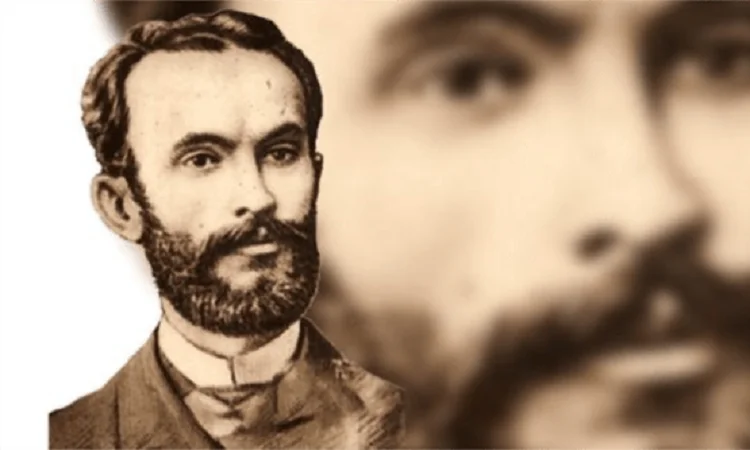
Sami Frashëri (1850–1904), or as he signed his writings, Shemsetin Samiu, has consistently attracted the attention of Albanian and Turkish scholars, because this great thinker, who lived during the long century of the Ottoman Empire, devoted his scientific and philosophical work to Albania and Turkey at the same time. His works were written in the official language of the Ottoman Empire, that is, Ottoman Turkish, which Sami preferred to call Turkish—since he had a cause to promote the purification of the Turkish language, which he maintained was an ancient, rich, beautiful and independent language. He crowned his love for this language with the publication of the most comprehensive dictionary of Turkish, Kamus-i Turki (1901), which remains to this day one of the best-known dictionaries for scholars of language and history. He would do the same with his mother tongue, Albanian, giving it an alphabet using Latin letters, known in Albanian historiography as the Istanbul Alphabet, with which the works of the Frashëri brothers and many books of the National Renaissance were published—including the 12 issues of the journal Drita, later called Dituria.
As is known, the Alfabetarja—published in February 1879, co-authored with the distinguished National Renaissance figures Jani Vreto (1822–1900), Pashko Vasa (1825–1892) and Sami Frashëri, who was only 29 at the time—not only aimed to unite Albanians in reading and writing, but also contained articles on the origin and history of the Albanians, while also covering the geography of Albanian lands, human and social morality, and basic arithmetic knowledge—as essential knowledge for everyone. Sami wrote his first two pieces in Albanian for this work. In his first piece, entitled The Albanian Language, he says, among other things: “Today is the day for Albanians, too, to begin writing and reading their language, so that they may preserve their nation.” In his second piece, entitled Geography—which formed part of a survey of the world’s physical and political geography—he devoted particular attention to information about Albania’s geography: what Albania is and where it extends, how many inhabitants it has, what its main cities are, and so on. Likewise, in the great work Historical and Geographical Dictionary, he devoted an important place to entries on the histories of cities located in Albanian territory and, in particular, to the ethnic identity of their inhabitants, who were Albanian. These were, of course, encyclopedic entries compiled during the years of the Congress of Berlin, while Albania’s neighbours were creating false opinions regarding the existence of Albanians as an ethnic group.
It should be emphasized that Sami’s contribution to Albanian learning was part of the programme of the Albanian League of Prizren, officially founded in June 1878, whose aim was to create a state identity, initially within the Ottoman Empire. At the heart of this platform was raising the national consciousness of the Albanian people, with a determined demand that Albanians be educated in the Albanian language—a people who until then had been educated in different languages: Muslims in Ottoman Turkish, Orthodox Christians in Greek, and Catholics in Italian. The aim of the Albanian National Renaissance figures was thus to unite the people through education, at a time when the Ottoman Empire was heading towards disintegration and Albania’s neighbours, supported by the Great Powers, were pursuing policies to seize as much Albanian land as possible and, at the same time, seeking to divide Albanian society along religious lines.
At the same time, in the period when Sami was born and active, various currents prevailed within Ottoman society itself. These can be described as movements to create a new identity, seen as reformed, while facing, as always, the conservatives who fought to preserve or restore the glorious era of the classical Ottomans. Albanians were undoubtedly part of this society and, willingly or otherwise, had aligned themselves with different sides. It was the Albanian intellectuals active in Istanbul who became part of these movements on Ottoman soil in Istanbul. Some of them defended Ottomanism. Others, meanwhile, had aligned themselves with Turkism, an ideology supported by the Ottoman elite in Istanbul. This debate continued for a long time among Ottoman figures such as Ahmet Vefk Pasha (1823–1891), Sylejman Hysni Pasha (1838–1892) and Sami Frashëri, one of Istanbul’s young intellectuals. Relevant scholars, such as Nihat Sami Banarli (1907–1974), maintain that Sami was influenced by Ahmet Vefik Pasha, who had become acquainted with the Turkish literature of the émigrés while studying in France and brought this new approach to Istanbul. Thus, in the second half of the 19th century, a movement of scientific Turkism emerged in the Ottoman state, alongside which stood Ottomanism and Islamism. The clash of these ideas favoured the formation of nationalism, which found expression in literary works rooted in the idea of shared belonging and directly connected to roots, or history. It was simply an undertaking that sought to champion historical periods that would lead to a common organization on the basis of language and culture.
On the other hand, Sami was the brother of Abdyl Frashëri, a prominent activist for the national cause. A letter from Sami concerning an article by Abdyl entitled The Albanian Language, which Abdyl had sent by post from Janina on 18 December 1875 with the intention of publishing it in the newspaper Istikbal, where one of its editors was his brother, Shemsettin Samiu, shows us that the Frashëri brothers had begun their national cause long before the League of Prizren. The article in question was not published, because by the time it reached the newspaper’s editorial office, the Sublime Porte had closed the paper. However, the existence of an article with this title is documented by Sami’s letter, in which, on 11 January 1876, he wrote to Abdyl Frashëri that he hoped to publish the aforementioned piece as soon as the newspaper Istikbal reopened (it never did). This fact highlights the Frashëri family’s cause and the national spirit in which Sami was raised and worked.
Another important factor that shaped Sami’s patriotic activity was the political circumstances created by the Treaty of San Stefano (Aya Stefanos), under which Albanian lands were at risk of being divided between Bulgaria, Serbia, Montenegro and Greece. As a result, the Albanian elites rolled up their sleeves to defend the Albanian people’s existence by founding the Albanian League of Prizren, which aimed to unite Albanian lands into a single administrative unit within the Ottoman Empire. A state identity would be created there, initially with autonomy, with the right to education exclusively in Albanian, the establishment of a defence force, and so on. Sami served this cause through numerous writings in various Ottoman newspapers. Ottoman society learned about the activities of the Albanian League and its programme through Sami’s article in the newspaper Terxhymani Shark, in which he published the League of Prizren’s programme. In dozens of articles devoted to the Albanian League and the events that took place in these areas, he sought to convince Ottoman society that state reforms in the Ottoman sanjaks located in Albanian territory should be carried out in such a way as not to fragment Albanians within Greek and Slavic Orthodox societies. Specifically, in an article dated 15 June 1878, he wrote that Albania should be united into a single vilayet, separated from territories with Slavic and Greek populations, and that Christian Albanians should not feel the need to read and write in Greek or Slavic, but should be allowed to write in their own language. Indeed, he displayed a subtle diplomacy towards the Ottomans and also conveyed a political message to the Albanian elite when he said, “The small Vatan is defended by defending the great Vatan.” In this case, by the great vatan he meant preserving the Ottoman Empire, while the small one meant the Albanian lands.
To make his case even more persuasive, he emphasized that “Albanians number more than two million; two-thirds of them are Muslims and one-third Christians, divided into Orthodox and Catholics. It is their nationality that separates the latter (the Orthodox and Catholics) from the Greeks and Bulgarians.” He continued by underscoring the importance of Muslim Albanians to the existence of Ottoman rule in Europe. According to him, Albanians were the ones holding back Slavic and Greek megali ideas, because as long as Albanians remained strong, Greek expansion to the north, Bulgarian expansion to the west, and Serbian and Montenegrin expansion to the south would be impossible.
His writings published in Terxhymani Shark, especially those from the days when the Congress of Berlin was in session, reveal his patriotic ideas regarding Albania and the Albanians. During this period, he commented on foreign newspaper reports about the decisions of the congress. He was aware that the so-called Eastern Question was an invention of the enemies of the Ottoman Empire, intended to break it up, which would lead to the disappearance of the Muslims of the Balkans—namely, the Albanians and Bosniaks who made up this community in the region. In his view, Austria-Hungary and Russia were the two powers seeking to invade Ottoman Rumelia, and, ultimately, the latter (Russia) would annex Albanian cities in order to gain access to the Adriatic. According to him, these two powers were waging a “crusade” against the defenceless Muslim population in these parts, and their aspiration was for the land of the Balkans to belong only to Christians. He vehemently opposed the ceding of the regions of Epirus to Greece (which included Janina, Arta and Preveza), citing historical facts and demographic figures, and emphasizing that “those lands have been inhabited by Albanians since ancient times.” Here, we should emphasize that none of Sami’s writings revealed any tendency towards racism or a refusal to acknowledge the other communities that were part of these cities.
He based his population figures on official Ottoman data. He spoke of an Albanian majority, but did not exclude the Greeks, Vlachs and other communities who were among the inhabitants of the cities in question. Indeed, on some occasions he accused his Greek colleagues of racism that acknowledged no ethnicity other than Greek and no religion or faith other than Orthodoxy—as in the case of his debate with the Greek newspapers Neologos, Temps, Messager d’Athenes and others over the identity of the Albanians of Epirus, Janina and other areas. These newspapers regarded them as nonexistent, basing their view on their Orthodox religion. This debate took place while discussions were being held at the Congress of Berlin. Thus, in his article of 24 July 1878, entitled Political Notes, he informed the public that foreign newspapers writing about Greek affairs reported that the Congress had discussed giving the region of Selemvria in Thessaly and the areas around the Kallamas River in Epirus to Greece, while the Ottomans were seeking a border running from Cape Zagora in Thessaly to Marënglliq in Epirus. Sami agreed with neither form of partition. He drew attention to the Albanian national element in Janina, Marënglliq, Tërhallë and elsewhere, since, in his view, although some of them were Orthodox, they did not want to accept the rule of the new Greek state. Indeed, referring to an article in the newspaper Istanbul, which justified the Bosnian Muslims’ fear of possibly coming under Austria’s Catholic sphere of influence (but which, according to that newspaper, gave Greek Muslims no reason to worry about possibly remaining under Greek administration, since the principles of that administration were based on constitutional principles and religious freedoms), Sami concluded that his fellow journalists in Istanbul were mistaken about the Greeks, since the latter recognized no nationality other than Greekness and no religion other than Orthodoxy. Moreover, according to him, at its core, Hellenist ideology regarded all non-Greek peoples as barbarians. At the end of the article, he informed the public that the owner of the newspaper Istanbul was nothing other than an Ottoman subject of Greek origin who took the side of the Greeks.
His writings on the history of the founding of the Albanian League of Prizren and the efforts of Slavic and Greek circles to portray this organization as a pan-Islamic body acting under the Sublime Porte’s directives show that Sami felt obliged to defend the truth about the Albanian League of Prizren with great fervour. In an article dated 13 August 1878, entitled Political Notes, he refers to a report sent from Belgrade and published in the newspaper Politisch Korrespoendenz, which stated that Serbia was rapidly preparing its army to face the army of the Albanian League of Prizren, since the latter, as an organization founded by the Empire, would attack Serbia. The newspaper also noted that the offices of the Serbian Directorate of Foreign Affairs were preparing a statement to be given to the consuls of the Great Powers in Belgrade, with the aim of creating this negative opinion of the League. Sami emphasized that the Sublime Porte had no hand in the League founded by the Albanians. On the contrary, the League was established out of a need to defend the Albanian territories that the Congress of Berlin had assigned to Serbia and Montenegro (even though Albanians had informed the decision-makers at the congress, through numerous pamphlets, that these territories were Albanian and inhabited by Albanians). In another article, as part of this debate, he exposed the Greeks’ efforts to portray the Albanian League of Prizren as a pan-Islamist movement sponsored by the Sultan. As a counterargument, he underscored the fact that the members of the Albanian League were represented without religious distinctions.
In conclusion, it can be said that Sami Frashëri’s contribution to the Albanian national cause was immense at a time when identities were being redefined, that is, when the national dimension was coming to the fore alongside the religious one. He can be described as the leading figure of the Albanian patriotic movements. Thus, by way of conclusion, all the Albanian patriotic activities carried out during the final decades of the 19th century, characterized by modern movements within the Ottoman Empire and the Albanian League of Prizren, are closely associated with the name of Sami Frashëri—from the Central Committee for the Defence of the Rights of the Albanian Nationality, founded in Istanbul immediately after the Treaty of San Stefano and chaired by his brother Abdyl Frashëri, although it is known that Sami was one of the principal initiators of this first Albanian political movement.
Recent studies indicate that most of the documents drafted in the spring of 1878 by the Central Committee—which were related to opposition, even rebellion, against the territorial partition of Albania under the Treaty of San Stefano to the benefit of the Balkan states; the pamphlets sent to the decision-making powers at the Congress of Berlin, arguing and demanding the rights of the Albanians; the fervent appeals to compatriots to take up arms against any decisions at the Congress of Berlin that might prove unfavourable to the Albanian people’s existence; and the memoranda addressed to the Sultan calling for the unification of the Albanian regions into a single administrative unit to be called Arnavutluk Vilajeti (Albanian Vilayet)—were written by Sami or had his approval. It is therefore no coincidence that the renowned scholar Kristo Frashëri (1920–2016) titled his first study of Sami Frashëri, published as early as 1967, Shemsettin Sami Frashëri – Ideologue of the Albanian National Movement. /Telegrafi/
Related
History
What Lincoln and the technological revolution he led can teach us today
History
Exhibition “Luigj Gurakuqi in the Documents of the Central State Archive” Opens, Honoring His Contribution to Albanian National History
History
1941: When leaders of the Sanjak regions sought protection from Tirana
History
Was King Arthur, after all, real?
History
The 1973 oil crisis forced Nixon to rethink time
History
The Life and Work of Murat Bey Toptani
History
The Forgotten Photograph That Rewrites the History of the Second World War
History
The Pastor Who Saw Hiroshima Burning

History
An American physicist’s account of the atomic bombing of Nagasaki
History
Albania Judged by an English Lady
History
John Kantakouzenos’ Campaigns Against the Albanians
History
Albania as Judged by an Englishwoman





